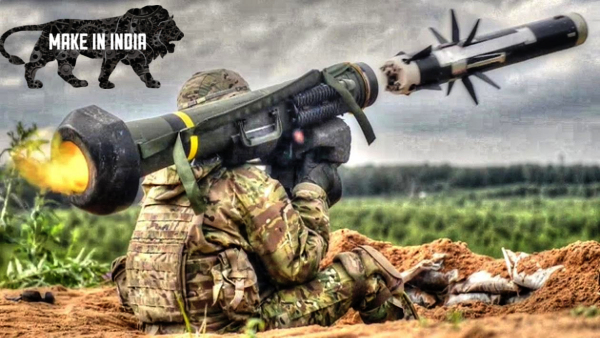
India could become part of the global production network for the Javelin anti-tank guided missile following a major industrial agreement between Tata Advanced Systems Limited and the Javelin Joint Venture, the partnership between Raytheon, an RTX business, and Lockheed Martin.
Under a Memorandum of Understanding announced on 30 August 2026, Tata Advanced Systems has been selected as the Javelin Joint Venture’s prime Indian partner for prospective in-country co-production of the Javelin All Up Round. The arrangement envisages establishing final assembly and integration capabilities in India while also examining the manufacture of selected missile components within the country.
The development represents an important step beyond the traditional model of importing complete weapon systems. If the proposed manufacturing arrangement progresses to production, India would become part of a distributed Javelin industrial network linking American missile and electronics facilities with an Indian final assembly and integration operation.
At the same time, the agreement remains an MoU rather than a notification that mass production has already begun. The official announcement states that Tata Advanced Systems and the Javelin Joint Venture will explore the establishment of the Indian assembly and integration facility and associated component-production capabilities. Details such as the location of the Indian facility, production volumes, investment, localisation percentage and schedule for commencement of production have not yet been announced.
Tata Selected Following Evaluation of Indian Companies
The selection of Tata Advanced Systems is particularly significant because it follows a broader competitive assessment of potential Indian industrial partners. According to the Javelin Joint Venture, Tata was selected as the prime partner for future co-production after multiple companies were evaluated for their capabilities and technical expertise.
The Javelin manufacturers have been studying Indian production options for some time. In February 2025, the Joint Venture publicly stated that it was examining co-assembly and co-production opportunities in India through a competitive source-selection process. At that time, it also renewed an MoU with public-sector missile manufacturer Bharat Dynamics Limited to evaluate possible Javelin manufacturing opportunities in the country. The 2026 announcement now specifically identifies Tata Advanced Systems as the prime partner for future in-country co-production efforts following that wider evaluation process.
This distinction is important. The earlier engagement demonstrated that the manufacturers were assessing different industrial pathways in India; the latest agreement represents a much more specific step by identifying the company expected to lead the future Indian co-production structure.
How the India-US Javelin Production Chain Could Work
The proposed production model will not initially transfer the entire Javelin manufacturing chain to India. Instead, it will connect specialised production centres in the United States with final assembly and integration capabilities established in India.
Lockheed Martin is expected to continue multiyear production of Javelin sub-assembly kits at its facility in Troy, Alabama, while Raytheon will manufacture the missile’s Guidance Electronics Units at Tucson, Arizona. These sub-assemblies and guidance units would then be shipped to India, where final assembly and integration of the Javelin All Up Round would take place under the proposed Tata-led arrangement.
The MoU also provides for exploration of component-manufacturing capabilities in India, potentially creating scope for greater localisation as the programme develops. The companies have not, however, identified which additional missile components could eventually be produced by Indian suppliers.
The arrangement therefore represents co-production rather than complete indigenous manufacture. Its importance lies in bringing missile integration, final assembly, manufacturing knowledge and potentially an expanding component supply chain into India while connecting Indian industry directly with one of the world’s largest precision-guided weapon production programmes.
Knowledge Transfer and Missile Manufacturing Capability
For India’s defence industrial ecosystem, one of the most consequential aspects of the agreement could be the accumulation of manufacturing and integration expertise.
Tata Advanced Systems Chief Executive Officer and Managing Director Sukaran Singh said the initiative would bring critical assembly expertise and knowledge transfer into India’s defence industrial base while supporting greater self-reliance. According to the company, local assembly could also improve operational readiness by providing the Indian Armed Forces with more timely access to the weapon system.
The significance extends beyond assembling individual missiles. Precision-guided weapons involve tightly controlled processes for electronics integration, propulsion, warhead sections, seeker and guidance systems, environmental sealing, quality assurance, testing and final certification. Participation in such a production chain can therefore create industrial competencies that may be relevant to a broader range of future missile programmes.
Tata Advanced Systems already operates across missiles, radars, unmanned systems, artillery, command-and-control systems, optronics, protected vehicles and major aerospace manufacturing programmes. It also maintains long-standing industrial relationships with both Lockheed Martin and other international aerospace and defence manufacturers. The Javelin programme would extend that manufacturing footprint further into the production of an internationally deployed precision anti-armour missile.
India Has Already Moved Towards Procuring Javelin
The industrial agreement follows an earlier move towards introducing the Javelin into Indian service.
On 19 November 2025, the U.S. State Department approved a possible Foreign Military Sale to India of Javelin missile systems and associated equipment with an estimated ceiling value of $45.7 million. The U.S. Defense Security Cooperation Agency subsequently notified Congress of the proposed sale.
India’s request covered 100 FGM-148 Javelin rounds, one additional fly-to-buy Javelin missile and 25 Lightweight Command Launch Units or Block 1 Command Launch Units. The proposed package also included training equipment, missile simulation rounds, technical documentation, spares, system integration assistance, training, lifecycle support and related logistical services.
That U.S. notification represented approval for a possible Foreign Military Sale and should not by itself be interpreted as evidence that the full transaction had already been contracted at the notified value. DSCA notifications establish the maximum estimated package presented to Congress; the eventual quantities, configuration and financial value can change when final agreements are concluded.
The new Tata-Javelin industrial agreement nevertheless creates a possible bridge between India’s initial acquisition requirement and a longer-term manufacturing arrangement within the country.
A Fire-and-Forget Anti-Tank Weapon
The Javelin is a man-portable, medium-range precision-guided weapon designed principally to defeat armoured vehicles, including main battle tanks. Its fire-and-forget guidance allows the missile to guide itself after launch, enabling the operator to relocate without having to remain exposed while manually guiding the weapon to its target.
The system can employ both top-attack and direct-attack trajectories. In top-attack mode, the missile approaches an armoured target from above, where tank protection is generally less substantial than across the frontal arc. Direct attack provides an alternative trajectory for targets or situations where a top attack is unsuitable. Lockheed Martin states that Javelin provides engagement capability from approximately 65 metres to four kilometres under most operating conditions.
The missile is designed not only for shoulder-fired infantry use but also for integration with vehicle-mounted and remotely operated launch systems. Raytheon describes it as a multi-purpose weapon capable of engaging armoured vehicles as well as other battlefield targets such as bunkers and fortified positions.
Global Production Is Already Being Expanded
The decision to develop an Indian production component comes as Javelin manufacturing is being expanded to meet strong international demand.
The Javelin Joint Venture has produced more than 55,000 missiles and more than 12,000 reusable Command Launch Units. Lockheed Martin has also been increasing production capacity in the United States as demand from the U.S. military and international operators has risen.
The manufacturers argue that adding India to the production architecture could improve the resilience of the global supply chain. Larger combined production volumes could also generate economies of scale for the overall programme while establishing an additional skilled manufacturing base.
For India, this creates another dimension to the project. An Indian Javelin facility would not necessarily have to function solely as an assembly operation for domestic requirements. Integration into the broader Joint Venture supply chain could eventually create opportunities for Indian manufacturing to support wider production requirements, although the companies have not yet announced export allocations or confirmed that Indian-built rounds will be supplied to third countries.
A Significant Step, but Localisation Will Determine Its Long-Term Value
The Tata-Javelin agreement is therefore best viewed as the creation of an industrial framework rather than the completion of the localisation process.
Its immediate significance is that the Javelin Joint Venture has moved from broadly evaluating Indian companies to selecting Tata Advanced Systems as its prime partner and outlining a specific transnational manufacturing model. Final assembly and integration in India would represent a considerably deeper industrial role than importing completed missiles, while prospective component manufacture could expand India’s participation further.
The scale of that transformation will ultimately depend on what happens after the MoU. The percentage of indigenous content, number and complexity of components manufactured locally, participation of Indian suppliers, testing and certification responsibilities, production volumes and the extent of technology and manufacturing knowledge transferred to India will determine whether the project develops primarily into an assembly programme or matures into a substantial Indian missile-manufacturing ecosystem.
Even at its present stage, however, the agreement marks a notable development in India-US defence-industrial cooperation. For one of the world’s most widely fielded anti-armour missile systems, India is now being positioned not merely as a prospective customer but as a future production location within the Javelin manufacturing network.
Source: Lockheedmartin:
https://news.lockheedmartin.com/2026-08-30-Javelin-Joint-Venture-and-Tata-Advanced-Systems-Signs-Agreement-for-Missile-Co-Production-in-India?utm_source=chatgpt.com
You may also like
-
Indian Army Aviation Executes Extraordinary One-Skid Casualty Evacuation at 18,600 Feet Near Nun-Kun
-
Skyroot Ships Second Vikram-1 Hardware to Sriharikota as India’s Private Rocket Programme Accelerates
-
ISRO Readies EOS-05, India’s First Imaging Satellite from Geosynchronous Orbit
-
Astra Microwave’s Order Book Crosses ₹4,300 Crore as Uttam Radar Drives Indigenous Defence Electronics Growth
-
AXISCADES Expands Indigenous Aerospace Manufacturing Footprint with ₹234-Crore Cloud Wave Acquisition
