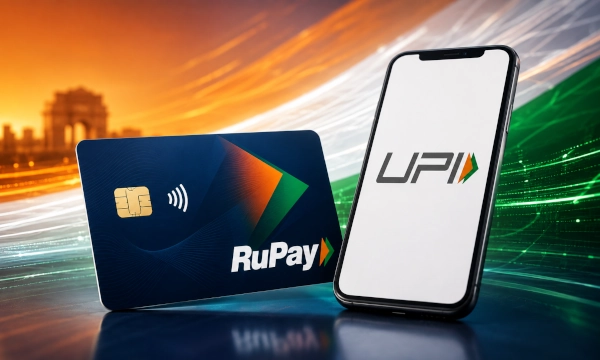
India’s payments ecosystem is undergoing a structural transformation that could alter the balance of power in the country’s credit-card market. The change is being driven not simply by the rise of RuPay as an indigenous card network, but by the integration of RuPay credit cards with the Unified Payments Interface, or UPI. This combination allows consumers to access revolving credit through the same QR-based payment interface that has already become deeply embedded in everyday Indian commerce.
The implications are significant because the traditional credit-card model depends heavily on physical or digital card acceptance infrastructure. A conventional transaction usually requires a customer to tap, swipe or enter card credentials, while the merchant must be connected to a card-acceptance network through a point-of-sale terminal or online gateway. RuPay Credit on UPI changes this model by allowing an eligible credit card to function through a UPI app, where the consumer scans a merchant QR code, selects the RuPay credit card as the funding source and authorises the transaction using a UPI PIN.
This effectively shifts the customer interface away from the physical card and towards UPI. The card remains important as the underlying credit instrument, but from the consumer’s perspective it becomes less visible because the same familiar payment experience can be used whether the money comes from a bank account or a credit line.
UPI Has Already Won the Everyday Payment Interface
RuPay’s greatest advantage is that it does not need to create a new payment habit among consumers. UPI has already become India’s dominant everyday digital-payment interface, and hundreds of millions of people are accustomed to scanning QR codes for transactions ranging from groceries and fuel to restaurants, medicines and local services.
This gives RuPay Credit access to a payment environment that conventional card networks spent decades trying to build through physical terminals, acquiring banks and merchant partnerships. Instead of persuading each merchant to install dedicated card infrastructure, RuPay can use the extensive UPI QR network that already exists across large cities, smaller towns and neighbourhood markets.
For small merchants, this can be particularly important because many businesses that never adopted credit-card terminals already display UPI QR codes. Once such merchants are enabled to accept RuPay Credit on UPI, they effectively become potential credit-card acceptance points without requiring a traditional point-of-sale machine.
The result is that RuPay can potentially expand credit usage into parts of the economy where conventional cards have historically had limited reach. This could be one of the most important ways in which RuPay challenges Visa and Mastercard domestically.
RuPay Is Competing Through Infrastructure, Not Just Through a Card
Visa and Mastercard remain enormously powerful global payment networks with decades of experience, international acceptance and strong relationships with banks. RuPay cannot challenge them simply by issuing another piece of plastic with similar features.
Its more important advantage comes from its close integration with India’s domestic payments infrastructure. RuPay operates within the broader ecosystem built by the National Payments Corporation of India, while UPI has become the country’s primary digital-payment rail for retail transactions.
That gives RuPay a different competitive proposition. Instead of competing only for the same point-of-sale transaction that might otherwise have gone to Visa or Mastercard, RuPay can place itself directly inside the UPI experience and become the credit layer beneath the QR-code payment.
This is the key distinction. RuPay is not simply trying to win market share as another card network; it is trying to become the default domestic credit instrument inside India’s most widely used payment platform.
Everyday Small Payments Could Become Credit Transactions
Traditional credit cards in India have historically been used more frequently for larger discretionary purchases, online shopping, electronics, travel, dining and other relatively high-value transactions. Smaller everyday payments were more commonly made through cash, debit cards or direct UPI transfers from savings accounts.
RuPay Credit on UPI changes that behaviour because using credit becomes almost as easy as making an ordinary UPI payment. A customer can use the same linked credit card to pay for groceries, fuel, medicines, food delivery, neighbourhood retail purchases and small service transactions without carrying or physically using the card.
This can dramatically increase transaction frequency. Instead of making a handful of large credit-card payments each month, the same customer may make dozens of small payments using the underlying credit line.
That changes the role of the credit card itself. Rather than remaining an occasional financing tool, the card begins to function like an everyday payment account embedded within UPI.
RuPay Could Expand the Credit-Card Market Rather Than Merely Take Share
RuPay’s growth potential is not limited to taking existing customers away from Visa and Mastercard. It could also enlarge the overall credit-card market by making credit more useful to consumers who previously saw little reason to own a conventional card.
A person who rarely uses a physical card may still use UPI several times every day. If that same customer can obtain a RuPay credit card and use it through the familiar UPI interface, much of the behavioural barrier to credit-card adoption disappears.
This could be particularly significant in smaller cities and towns, where traditional credit-card penetration remains lower than in major metropolitan areas but UPI adoption is already widespread. RuPay can therefore potentially reach consumers who are digitally active but not yet deeply integrated into the conventional card ecosystem.
The opportunity is consequently larger than a simple network substitution. RuPay Credit on UPI could help convert a portion of India’s enormous UPI user base into active credit users.
Merchant Acceptance Could Become RuPay’s Most Powerful Weapon
The value of a payment network depends heavily on where consumers can use it. Visa and Mastercard built their dominance through massive merchant-acquiring networks and near-universal card acceptance across formal retail channels.
India’s UPI system has created a parallel acceptance network using simple QR codes. This network extends far beyond traditional card terminals and includes millions of small merchants that may never have invested in conventional card infrastructure.
RuPay Credit can potentially ride on top of this QR network. A merchant that already accepts UPI may not need a new terminal simply to receive a RuPay Credit payment, provided the merchant is eligible and properly enabled for such transactions.
This creates a very different form of competitive pressure on global card networks. RuPay is not only competing at merchants that already accept cards; it can potentially bring credit-card functionality to places where card acceptance was previously absent.
Banks Gain a New Distribution Channel
RuPay Credit on UPI also gives issuing banks a new way to distribute and activate credit products. Traditionally, banks had to persuade customers to use the card through their own mobile applications, promotional campaigns, rewards programmes and physical card acceptance.
With UPI integration, the customer can link the RuPay credit card to major payment apps already used for day-to-day transactions. The bank provides the credit line, while UPI provides the familiar interface through which the customer spends.
This effectively separates the credit product from the payment interface. The customer does not have to abandon a preferred UPI app merely because the card was issued by another bank.
For banks, that can lead to much higher engagement with the underlying credit line. A card that might otherwise have been used only occasionally can become an everyday transaction instrument.
Rewards and EMI Features Are Moving into the UPI Experience
RuPay’s competitiveness also depends on whether UPI-linked credit transactions can match the benefits traditionally associated with conventional cards. Rewards, cashback, instalments and other benefits remain important reasons why consumers choose one credit card over another.
The RuPay Credit ecosystem has therefore moved towards ensuring that eligible UPI-linked transactions can also generate reward points and other card benefits. This helps reduce the perception that scanning a QR code with a credit card is somehow inferior to tapping the physical card.
EMI functionality is also increasingly important. If eligible RuPay Credit transactions conducted through UPI can be converted into instalments, the customer no longer needs to move back to a conventional card transaction in order to access financing options.
This gradually makes UPI a more complete credit interface. The more rewards, EMI, redemption and account-management features migrate into the UPI experience, the less important the physical card becomes in everyday usage.
RuPay Could Benefit from Greater Card-Network Choice
Regulatory changes can also strengthen RuPay’s position by giving consumers greater visibility over which payment network is attached to their cards. Historically, customers often accepted whichever network was selected by the issuing bank.
Greater choice changes that dynamic. If consumers understand that the RuPay version of a credit card can be linked directly to UPI while a Visa or Mastercard version does not offer the same functionality under the present framework, some may actively prefer RuPay.
That creates an important shift in the market. RuPay no longer needs to rely entirely on banks to push its cards because the UPI advantage can generate consumer demand for the network itself.
If that behaviour becomes widespread, banks may have a stronger incentive to issue more RuPay cards simply because customers increasingly expect UPI compatibility.
Visa and Mastercard Still Dominate High-Value Spending
Despite RuPay’s rapid rise, Visa and Mastercard remain extremely strong in several important segments. Their networks are deeply embedded in international travel, premium cards, corporate payments, high-value online commerce and overseas transactions.
RuPay’s strongest growth has so far been associated with frequent, relatively low-value domestic transactions. This is a major achievement, but it does not automatically displace the global networks from the more profitable parts of the credit-card market.
A consumer may use RuPay Credit on UPI for everyday purchases in India while still preferring Visa or Mastercard for international travel, hotel reservations, overseas websites or premium rewards programmes. This means the competitive outcome is likely to be more complex than one network simply replacing another.
The Indian market could therefore become increasingly segmented. RuPay may become dominant in domestic, high-frequency credit usage, while Visa and Mastercard remain disproportionately strong in international and high-value spending.
International Acceptance Remains an Important Challenge
RuPay has expanded its overseas acceptance through partnerships with international payment networks, but it still does not match the global reach of Visa and Mastercard. For customers who primarily spend within India, this limitation may not matter very much.
For frequent international travellers, however, overseas acceptance remains critical. Visa and Mastercard have spent decades establishing relationships with merchants, acquirers and financial institutions across almost every major market in the world.
RuPay therefore needs to continue expanding internationally if it wants to challenge the global networks beyond the domestic market. A card that combines near-universal Indian acceptance through UPI with strong international usability would be considerably more competitive.
Until that gap narrows, RuPay’s biggest strength will continue to be its domestic integration rather than its global reach.
RuPay’s UPI Advantage Could Eventually Be Tested
One of the biggest questions surrounding RuPay’s current advantage is whether it will remain exclusive. RuPay credit cards can presently be linked directly with UPI in a way that Visa and Mastercard credit cards cannot replicate under the existing framework.
That gives RuPay an unusually strong competitive moat. However, this advantage is partly regulatory rather than purely technological.
If Visa and Mastercard are eventually permitted to link their cards to UPI in the same manner, much of RuPay’s differentiation could narrow. The competition would then move back towards rewards, fees, premium features, international acceptance, banking relationships and customer loyalty.
RuPay therefore has an important strategic window. The more consumers become accustomed to using RuPay Credit through UPI now, the more difficult it may be for competing networks to dislodge those habits later.
Direct Credit Lines on UPI Could Disrupt the Entire Card Model
There is an even more disruptive development beyond RuPay Credit itself. The Reserve Bank of India has already permitted eligible pre-sanctioned bank credit lines to be accessed through UPI.
This means that the long-term future of digital credit may not always require a traditional credit card as the underlying instrument. A customer could eventually access bank credit directly through UPI without relying on a physical or virtual card.
The conventional model involves a bank issuing a card, the card operating through a payment network and the merchant receiving payment through the card-acquiring system. RuPay Credit on UPI modifies that architecture by inserting UPI between the card and the merchant.
Direct credit lines on UPI could go further by eliminating the need for the card altogether. In that model, the bank provides the credit line directly and UPI becomes the transaction interface.
RuPay Credit may therefore be both a challenger to Visa and Mastercard and a transitional step towards a more fundamental transformation in how consumer credit is delivered in India.
India Could Create a Different Model of Credit Payments
India may eventually develop a retail-credit architecture very different from that seen in many Western economies. In much of the world, the credit-card network remains the central infrastructure through which consumer credit reaches merchants.
India has already created UPI as a dominant real-time payment network independent of the traditional card system. By integrating RuPay credit cards into UPI, the country is combining revolving consumer credit with a national instant-payment interface.
This means the customer may no longer think primarily in terms of paying by card or paying by bank account. The consumer simply scans the same QR code and chooses the preferred funding source.
That funding source could be a savings account, a RuPay credit card or eventually a direct bank credit line. The payment experience remains largely unchanged while the underlying source of money changes.
The Real Challenge to Visa and Mastercard
RuPay’s challenge to Visa and Mastercard is therefore not about creating a better physical credit card. Its real strength lies in connecting an indigenous card network with India’s dominant digital-payment infrastructure.
That allows RuPay to reach merchants that may never have accepted conventional cards, gives customers access to credit through an interface they already use every day and gives banks a much larger number of opportunities to activate their credit products.
Visa and Mastercard will continue to play major roles in India because of their global networks, premium products and international acceptance. Their position is particularly strong in travel, corporate payments and high-value transactions.
However, RuPay Credit on UPI has created an entirely new competitive battlefield. The contest is no longer simply about which network logo appears on a card.
It is increasingly about which network becomes the preferred source of credit behind India’s QR-code economy. If RuPay can maintain its UPI advantage, improve premium offerings, expand internationally and remain attractive to banks and merchants, it could become the leading network for everyday domestic credit transactions in India.
That would represent far more than a gain in card-market share. It would demonstrate that India has created an indigenous payment architecture capable of challenging the world’s largest card networks by changing the very interface through which consumers use credit.
You may also like
-
India Moves to Build Port Cranes at Home, Reducing Dependence on Chinese Equipment
-
India and Uzbekistan Advance Long-Term Uranium Supply Partnership as Nuclear Cooperation Deepens
-
India’s Telecom Base Crosses 1.35 Billion as Broadband Connections Near 1.1 Billion
-
India to Push Cross-Border Digital Payments and CBDC Linkages at BRICS Summit
-
From Chandrayaan-3 to Aditya-L1: The Made-in-India Chips Powering India’s Space Missions
