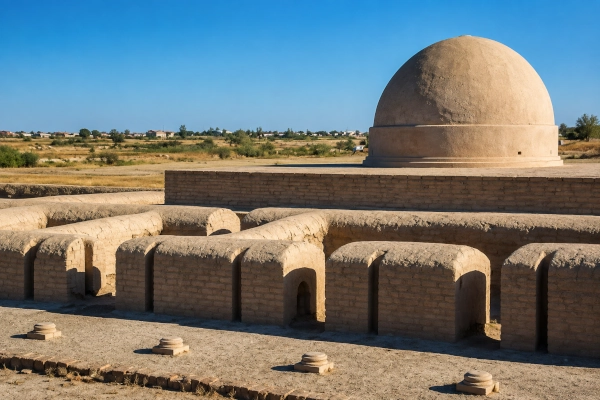
India and Uzbekistan have opened a new chapter in their civilisational partnership with an agreement to work together on the conservation and restoration of the ancient Buddhist sites of Fayaz Tepa and Kara Tepa at Termez in southern Uzbekistan, two of Central Asia’s most important surviving witnesses to the historical journey of Buddhism from the Indian subcontinent along the Silk Road.
A Letter of Intent for the project was concluded on 30 August 2026 during Prime Minister Narendra Modi’s State Visit to Uzbekistan. The agreement brings together India’s Ministry of External Affairs and Uzbekistan’s Cultural Heritage Agency and was included among the formal outcomes of talks between Prime Minister Modi and Uzbek President Shavkat Mirziyoyev in Tashkent.
The heritage initiative forms part of a much wider cultural package announced during the visit. India and Uzbekistan also concluded a Cultural Exchange Programme for 2026–30, an agreement on archival cooperation and an MoU on Ayurveda and other traditional systems of medicine. India announced 100 Lal Bahadur Shastri Scholarships for the study of Hindi in Uzbekistan, while an ICCR Sanskrit Chair is to be established at Tashkent State University of Oriental Studies.
Taken together, these measures give an unusually strong civilisational dimension to a bilateral relationship that was simultaneously elevated to a Comprehensive Strategic Partnership. While contemporary cooperation is expanding across trade, defence, critical minerals, technology and digital infrastructure, the restoration of the Buddhist monuments at Termez reaches much further back—to a period when monks, merchants, artists and scholars moved between India and Central Asia through the great networks that connected the civilizations of Eurasia.
Termez Was One of Central Asia’s Great Buddhist Centres
Modern Termez stands close to the Amu Darya in the Surkhandarya region of southern Uzbekistan, near the country’s border with Afghanistan. In antiquity, this region formed part of Bactria, a crossroads connecting the Indian subcontinent with Iran, Central Asia and the wider Silk Road.
The strategic location of ancient Termez made it far more than a trading centre. Archaeological discoveries show that it became an important centre of Buddhist religious and intellectual life, particularly during the period of the Kushan Empire, when political and commercial networks linked northern India, Afghanistan and large areas of Central Asia.
UNESCO describes Ancient Termez as a place where Buddhist monuments existed alongside remains connected with Greco-Bactrian, Kushan and later Islamic civilisations. The organisation identifies the city as one of the important Central Asian centres through which Buddhist culture spread along the Silk Roads.
Within this wider archaeological landscape, Kara Tepa and Fayaz Tepa stand out as particularly important monastic complexes. Their architecture, sculpture, wall paintings and inscriptions preserve physical evidence of the movement of Buddhist religious traditions and artistic ideas between India and Central Asia.
Kara Tepa: A Vast Monastic Complex of Caves and Courtyards
Kara Tepa, also written Qoratepa or Kara Tepe, occupies a group of hills near ancient Termez. Archaeological research has revealed an extensive Buddhist monastic centre containing both rock-cut and above-ground structures, an architectural combination that gives the site an unusual character.
Its complexes incorporated monastic cells, prayer spaces, courtyards, colonnades, stupas and chambers carved into the hills. Some sections were arranged around open courtyards, while passages connected surface structures with underground spaces.
Systematic archaeological research indicates that construction at Kara Tepa began around the first and second centuries CE, with the complex reaching particular prominence during the third and fourth centuries. It eventually declined as the religious and political landscape of the region changed.
The site’s importance extends far beyond its architecture. Archaeologists recovered sculptures, stucco work, paintings and numerous inscriptions. Particularly significant for understanding the India-Central Asia relationship are the more than 150 inscriptions recorded in Indian scripts including Kharosthi and Brahmi.
These inscriptions provide material evidence that Buddhist communities at Termez were connected with the wider cultural sphere extending through Gandhara and the Indian subcontinent. They demonstrate that the movement of Buddhism across Central Asia involved not only the transmission of religious ideas but also languages, writing systems, artistic traditions and communities of monks and pilgrims.
Fayaz Tepa: Monastery, Stupa and Buddhist Art
Located close to Kara Tepa, Fayaz Tepa represents a different type of Buddhist complex. UNESCO describes it as a sangharama-type monastery built around a central courtyard, with monastic and ritual spaces accompanied by a detached stupa.
The complex prospered particularly during the first to third centuries CE, when Kushan-era Termez was an important centre of commerce and cultural interchange. Its surviving remains include mud-brick architecture, religious spaces, sculptures and traces of wall paintings.
Among the most celebrated discoveries associated with Fayaz Tepa is a seated Buddha image regarded as an important example of Buddhist-Hellenistic artistic interaction. The art of the region reflects a cultural environment in which Indian Buddhist traditions encountered influences associated with Gandhara, Bactria, Iran and the Hellenistic world.
Archaeologists have also found Indian-script inscriptions at Fayaz Tepa. Scholarly studies record dozens of such inscriptions from the monastery, reinforcing the evidence that Buddhist religious communities in ancient Termez participated in cultural networks extending southwards towards India.
For modern visitors, Fayaz Tepa is therefore not simply the ruins of an ancient religious building. It is a surviving archaeological record of a period when Central Asia served as a bridge through which Indian religious and philosophical traditions interacted with the wider Eurasian world.
The Kushan World Connected India and Central Asia
The rise of Buddhist institutions around Termez is closely associated with the Kushan period, one of the most important eras in the history of cultural exchange between India and Central Asia.
At its height, the Kushan realm connected territories stretching from Central Asia and Afghanistan into large parts of northern India. Political stability across these regions facilitated commerce, travel and the movement of ideas. Merchants followed long-distance trade routes while monks and pilgrims travelled between monasteries and centres of learning.
Buddhism benefited enormously from these networks. Monasteries were established along important trade corridors, where they could receive patronage from rulers, merchants and local communities. Buddhist texts, images and ritual traditions moved progressively north and east, eventually reaching the great oasis centres of Central Asia and, through them, China.
Termez occupied an important position within this process. Its archaeological remains demonstrate that the movement of Buddhism was not merely a one-way transmission from India. As Buddhist culture entered new regions, it absorbed local influences and generated new artistic and architectural forms.
That shared history provides the deeper context for India’s decision to participate in the conservation of Fayaz Tepa and Kara Tepa today.
Restoration Is Also a Technical Challenge
Preserving the two archaeological complexes presents considerable conservation challenges because substantial portions of the monuments were constructed using earth-based materials such as mud brick and cob. Such structures are particularly vulnerable to rainfall, wind erosion, temperature variations and the gradual deterioration that follows archaeological excavation.
Once an ancient mud-brick wall is uncovered, it loses much of the natural protection provided by centuries of burial. Unless carefully consolidated and maintained, exposed surfaces can deteriorate rapidly.
Fayaz Tepa has already benefited from international conservation efforts. Under a UNESCO/Japan Funds-in-Trust initiative launched in the early 2000s, specialists worked on protecting its archaeological remains, conserving the stupa, installing protective structures and improving the presentation of the site. The programme also sought to develop local conservation capacity and integrate preservation with sustainable cultural tourism in the Termez region.
Conservation work has also previously been undertaken at Kara Tepa, including protection of excavated areas and treatment of wall paintings and archaeological objects. The new India-Uzbekistan initiative can therefore build upon decades of archaeological and preservation experience rather than beginning with unexplored monuments.
The detailed scope, financial allocation and timetable of India’s proposed restoration work have not yet been publicly specified. The 30 August document is a Letter of Intent, meaning the two governments have established their intention to cooperate while the technical programme will need to be developed in greater detail.
A Wider Heritage Partnership Is Emerging
The agreement is significant because both governments have explicitly placed the Buddhist sites within a much larger programme of heritage cooperation.
In their joint statement, India and Uzbekistan expressed support for collaboration among research institutions, museums and conservation centres. They also highlighted the use of advanced technologies for cultural preservation, including digitisation and the creation of three-dimensional models of archaeological artefacts and heritage sites.
This creates possibilities extending beyond physical restoration. Digital documentation can establish highly accurate records of monuments before conservation begins and help specialists monitor deterioration over time. Three-dimensional modelling can assist structural analysis while simultaneously making fragile archaeological remains accessible to scholars and the wider public without requiring constant physical handling or unrestricted visitor access.
India itself has accumulated considerable expertise in archaeological conservation across Buddhist heritage landscapes stretching from Bihar and Uttar Pradesh to Ladakh and the Himalayan region. Collaboration with Uzbek archaeologists and conservation specialists could therefore become an important avenue for exchanging expertise in monument preservation, archaeological research and heritage management.
An ICCR Sanskrit Chair in Tashkent
Another important cultural outcome of the visit is the decision to establish an Indian Council for Cultural Relations Sanskrit Chair at Tashkent State University of Oriental Studies.
The location is particularly appropriate. Tashkent State University of Oriental Studies has a long tradition of studying Asian languages, societies and civilisations, and India studies have formed part of Uzbekistan’s academic engagement with South Asia.
A Sanskrit Chair can support university-level teaching as well as research into India’s classical intellectual traditions, literature, philosophy, religion and historical links with Central Asia.
Its relevance to the Termez restoration project is especially interesting because archaeological evidence from Buddhist Central Asia contains Indian linguistic and script traditions. Although the inscriptions at Kara Tepa and Fayaz Tepa are not simply Sanskrit documents, the study of Sanskrit and related historical languages forms part of the broader scholarly toolkit required to understand the Buddhist intellectual world that linked India with Central Asia.
The Sanskrit initiative therefore complements the restoration programme at an academic level: one preserves physical remains, while the other strengthens the study of the intellectual and linguistic traditions from which those remains emerged.
100 Lal Bahadur Shastri Scholarships for Hindi
Prime Minister Modi also announced 100 Lal Bahadur Shastri Scholarships for Hindi-language study in Uzbekistan, commemorating the 60th anniversary of the former Indian Prime Minister’s passing in Tashkent.
The scholarships add a contemporary language dimension to the cultural partnership. India studies already have a significant presence in Uzbekistan, and the two countries have agreed to expand academic and research cooperation in both directions.
More than 400 Uzbek students have previously been selected under ICCR scholarship programmes, including AYUSH-related scholarships, while over 2,700 Uzbek nationals have participated in India’s ITEC capacity-building programmes.
The new Hindi scholarships therefore build upon an established educational relationship rather than creating one from the beginning.
Ayurveda Adds Another Civilisational Connection
India and Uzbekistan also signed an MoU covering Ayurveda and other traditional systems of medicine, bringing another element of India’s traditional knowledge systems into the bilateral relationship.
The agreement sits alongside existing cooperation in modern healthcare, pharmaceuticals, biomedical research and medical education. India and Uzbekistan have agreed to strengthen public-health collaboration and encourage joint scientific work aimed at new treatments and therapies.
The presence of Ayurveda within the same diplomatic package as Sanskrit, Buddhist heritage and Hindi is noteworthy. These initiatives represent different dimensions of India’s cultural engagement: physical heritage, classical knowledge, language and traditional medicine.
They also demonstrate that contemporary diplomacy between the two countries is being constructed around both strategic interests and older civilisational connections.
Termez Shows That the Silk Road Carried Ideas as Well as Goods
The expression “Silk Road” can sometimes create the impression that the ancient routes across Central Asia were primarily commercial highways carrying luxury goods between East and West. Archaeological sites such as Fayaz Tepa and Kara Tepa reveal a much richer story.
Along the same routes travelled monks, translators, physicians, craftsmen, artists and scholars. Religious texts moved alongside textiles and precious objects. Scripts and artistic techniques crossed borders along with commodities.
Buddhism provides one of the clearest examples of this intellectual movement. Emerging in India, it travelled north-west through regions such as Gandhara and Bactria, developed major institutions across Central Asia and eventually became one of the great religious traditions of East Asia.
Termez stood directly within that historical geography.
The monasteries preserved there are therefore part of both Uzbek heritage and the wider history of Indian civilisation beyond the geographical boundaries of the modern Indian state.
Cultural Heritage as Modern Diplomacy
India’s involvement at Termez also fits into a broader pattern in which the country increasingly uses shared civilisational heritage as a component of international engagement.
Buddhist heritage occupies a particularly important position because archaeological and religious connections link India with a wide arc stretching through Sri Lanka, Nepal, Bhutan and Southeast Asia to Central and East Asia.
India’s role as the land in which Buddhism originated gives it a natural connection with these countries, but effective cultural diplomacy depends on more than historical claims. Conservation programmes, archaeological cooperation, scholarships, academic exchanges and support for heritage institutions translate historical connections into practical partnerships.
The Fayaz Tepa and Kara Tepa initiative follows precisely this model.
Rather than simply commemorating an ancient Indian connection with Uzbekistan, the two governments intend to cooperate physically in preserving archaeological sites that embody that connection.
Ancient Links Accompany a Modern Strategic Partnership
The timing is also significant because the restoration agreement was concluded during a major expansion of India-Uzbekistan relations.
During their 30 August talks, Prime Minister Modi and President Mirziyoyev elevated bilateral relations to a Comprehensive Strategic Partnership. Their discussions covered trade and investment, defence and security, critical minerals, digital public infrastructure, UPI, space, healthcare, agriculture, education and tourism.
The two countries are therefore building a modern strategic relationship while simultaneously rediscovering the historical foundations of their interaction.
This combination gives the partnership an unusual depth. Contemporary India and Uzbekistan are cooperating on technologies such as digital payments and artificial intelligence at the same time that they are working to conserve Buddhist monasteries built nearly two thousand years ago.
The relationship stretches, symbolically and practically, from ancient stupas to modern digital infrastructure.
Restoring More Than Ancient Walls
The conservation of Fayaz Tepa and Kara Tepa will ultimately involve stone, earth, plaster, paintings and archaeological structures. Yet the importance of the initiative extends beyond the physical remains themselves.
The sites preserve evidence of an era when the regions that today constitute India, Afghanistan and Central Asia participated in extensive networks of cultural exchange. The inscriptions, monasteries, stupas and sculptures of Termez show how Buddhist ideas moved across those landscapes and were transformed through interaction with different peoples and artistic traditions.
By agreeing to work together on their preservation, India and Uzbekistan are recognising that this shared history remains relevant to their relationship in the twenty-first century.
The simultaneous establishment of a Sanskrit Chair in Tashkent, 100 Hindi scholarships, an Ayurveda cooperation framework, archival cooperation and a new Cultural Exchange Programme gives the restoration project an intellectual and human dimension extending far beyond archaeology.
Fayaz Tepa and Kara Tepa once stood within a world in which monks, merchants and travellers carried Indian ideas northward across the mountains and river valleys of Central Asia. Nearly two millennia later, India and Uzbekistan are returning to those same monuments—not as relics of a forgotten past, but as surviving evidence of a civilisational relationship that both countries now intend to preserve for the future.
You may also like
-
India to Push Cross-Border Digital Payments and CBDC Linkages at BRICS Summit
-
India and Norway to Deepen Maritime Partnership at September Joint Working Group Talks
-
Indian UPI Payments to Work with Uzbekistan’s UZQR Network as India Expands Digital Payments Footprint into Central Asia
-
India Plans First Northern Sea Route Cargo Voyage in 2027 as Arctic Shipping Cooperation With Russia Deepens
-
Dandaka in the Mahabharata: The Vast Forest Realm of Central India
