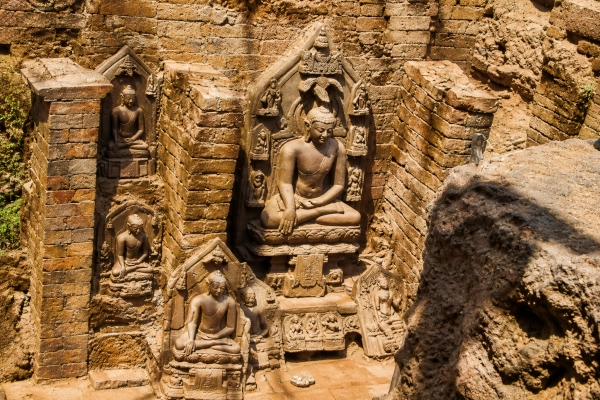
A major archaeological investigation into Kashmir’s ancient Buddhist past has entered a new stage, with the second phase of excavation beginning at Zehanpora in Baramulla district on 29 August 2026.
Jammu and Kashmir Chief Secretary Atal Dulloo formally marked the commencement of the new excavation season during a visit to the site, where he inspected the trenches, archaeological remains and antiquities recovered during the first phase. The work is being undertaken by the Centre of Central Asian Studies at the University of Kashmir in collaboration with the Jammu and Kashmir Department of Archives, Archaeology and Museums.
The site has attracted considerable archaeological interest because preliminary evidence points to an early historic settlement associated with Buddhism and broadly dating to around the first five centuries CE. Researchers have already uncovered structural remains, pottery, metal objects and a human skeleton, while architectural evidence suggests that part of the complex may have served religious and monastic functions.
Phase II is expected to continue for approximately three months, or around 100 days, giving archaeologists substantially more time than during the first excavation season, which had to be curtailed by the onset of winter. The broader investigation and documentation of the large archaeological landscape could take several years.
A Site Hidden Beneath Ordinary-Looking Mounds
For generations, the large earthen mounds surrounding Zehanpora appeared to many residents to be ordinary features of the landscape.
Their archaeological significance became increasingly apparent after systematic surveys, archival research and modern mapping techniques were brought together. The site covers roughly 10 acres, and University of Kashmir archaeologists have indicated that structural remains extend across a considerable portion of the plateau.
The location itself is historically important. Zehanpora lies within the Baramulla region near the traditional north-western approach into the Kashmir Valley, a corridor that connected Kashmir with Gandhara and, beyond it, Central Asia.
An official account by the Jammu and Kashmir Department of Archives, Archaeology and Museums describes Zehanpora as strategically situated along this ancient entry route. It also notes that the seventh-century Chinese Buddhist pilgrim Xuanzang entered Kashmir through the Baramulla region and described numerous stupas and monasteries before staying at the important Buddhist centre of Ushkur.
This geographical setting makes Zehanpora important not merely as an isolated religious site but potentially as part of a much wider network linking ancient Kashmir with north-western South Asia and Central Asia.
Old Photographs Helped Reawaken Interest in Zehanpora
One of the most fascinating elements in the rediscovery of Zehanpora involved historical photographs preserved thousands of kilometres away.
During a fellowship visit to France in 2023, archaeologist Dr Mohammad Ajmal Shah of the University of Kashmir located an old photograph in a museum archive showing three structures identified as stupas in the Baramulla region.
Shah recognised similarities between the historic photograph and the distinctive mounds at Zehanpora. The discovery strengthened the case for conducting a more intensive archaeological investigation of the site.
Researchers subsequently employed drone surveys, remote sensing, mapping and ground verification to study the landscape before excavation.
What appeared superficially to be a group of natural mounds gradually began to reveal an organised archaeological complex buried beneath the soil.
Prime Minister Narendra Modi later highlighted the discovery during his Mann Ki Baat address in December 2025, drawing national attention to the archaeological work at Zehanpora.
The First Excavation Revealed an Early Historic Settlement
The first excavation season provided the first substantial physical evidence of what lay beneath the mounds.
Archaeologists uncovered pebble-built walls, pottery fragments and iron objects including nails. These remains offered evidence of organised construction and everyday activity within the settlement.
A more detailed account by the J&K Department of Archives, Archaeology and Museums records a substantial assemblage that included pottery, charcoal, animal bones, ceramics, terracotta objects and metal artefacts, among them iron nails, pins, brackets and rods, as well as copper objects.
Fragments of glass bangles, a cowrie shell and a small clay object interpreted as a gaming or hopscotch piece were also among the finds reported from the excavation.
Individually, such objects may appear modest compared with monumental stupas. Archaeologically, however, they can be extremely valuable.
Pottery styles can help establish chronological sequences. Metal artefacts provide evidence about technologies and craftsmanship. Animal remains can illuminate diet and economic activity, while charcoal can potentially provide material for radiocarbon dating.
Taken together, these finds allow archaeologists gradually to reconstruct how people actually lived within the settlement.
A Human Skeleton Adds Another Dimension
Among the more unusual discoveries made during the first phase was a human skeleton.
The remains are undergoing scientific investigation, and authorities have cautioned against drawing conclusions about the individual or the circumstances of burial until detailed analysis is completed.
Skeletal remains can potentially provide information about age, biological characteristics, diet, health, disease and burial practices. The position of the skeleton and its relationship with surrounding archaeological layers could also help researchers determine whether it represents a formal burial, a later intrusion into the site or another type of depositional event.
Chief Secretary Dulloo said material recovered from Zehanpora is being subjected to scientific testing, including carbon dating where applicable, as researchers work to establish the site’s chronology more precisely.
This is an important qualification to the widely used description of Zehanpora as a “2,000-year-old” site.
That figure represents the site’s approximate early historic antiquity. Precise dates for particular structures and occupation layers will require scientific analysis of suitable samples and careful study of pottery, architecture and other archaeological evidence.
Evidence of Buddhist Religious Architecture
What makes Zehanpora especially important is the architectural evidence pointing towards a Buddhist religious landscape.
The official account of the first excavation describes what appears to be an apsidal chaitya associated with an adjacent stupa, alongside other structural remains. Researchers have interpreted the broader complex as containing spaces that may have served ritual, residential and construction-related functions.
An apsidal structure has a rounded or semicircular termination. Such forms are known from Buddhist chaitya or worship architecture at several early historic sites in South Asia.
Dr Mohammad Ajmal Shah has dated the principal structures provisionally to the Kushan period, although continuing excavation and scientific analysis will be necessary to establish the site’s complete chronological sequence.
The Department of Archives, Archaeology and Museums has more broadly placed the archaeological evidence in the early historic period, likely between the first and fifth centuries CE.
This wider range is significant because large religious complexes often developed through several construction phases rather than being built at a single moment.
Phase II could therefore reveal whether Zehanpora experienced repeated periods of construction, rebuilding and occupation.
Kashmir During the Kushan Age
If the Kushan-period attribution is strengthened by further excavation, Zehanpora would belong to one of the most consequential periods in the history of Buddhism in north-western South Asia.
The Kushan Empire flourished principally during the first centuries CE across territories extending through parts of Central Asia, Afghanistan, present-day Pakistan and northern India.
Its position astride major trans-regional trade corridors encouraged the movement not only of merchandise but also of religious ideas, artistic traditions, languages and communities.
Kashmir occupied an important geographical position within this interconnected world.
Buddhist monasteries and sacred sites emerged at numerous locations in the Valley, while Kashmir subsequently became an influential centre of Buddhist scholarship connecting the Indian subcontinent with Central Asia and regions further east.
Archaeologically documented Buddhist sites in Kashmir include Harwan, Ushkur, Kanispora, Parihaspora and several locations in southern Kashmir, placing Zehanpora within a much larger cultural landscape.
Zehanpora’s Position Near the Baramulla Gateway Matters
The Baramulla corridor gives the discovery particular historical importance.
Mountain geography sharply limits the routes through which people can enter the Kashmir Valley. For centuries, the north-western approaches around Baramulla connected Kashmir with the wider Gandhara region and trade routes leading towards Central Asia.
The official account of the excavation specifically identifies this position as one of the reasons Zehanpora is archaeologically significant.
A substantial religious and residential complex located near such a route could have served more than a purely local population.
Monasteries along major communication routes elsewhere in the ancient world often became places where travellers, monks, merchants and scholars interacted. Zehanpora’s eventual interpretation may therefore contribute to understanding the movement of people and ideas between Kashmir and neighbouring regions.
The evidence available at present, however, does not establish every aspect of the site’s function. Further excavation is required before the scale of its monastic, residential or commercial activity can be reconstructed confidently.
Phase II Will Examine the Settlement More Systematically
The renewed excavation is intended to move beyond the initial discoveries and establish a much clearer picture of the site’s extent and chronology.
Authorities say researchers will investigate archaeological deposits and cultural layers systematically, documenting architecture, artefacts and their precise contexts.
The principal questions include how large the settlement was, how its buildings were arranged, when different portions were constructed and how the site’s inhabitants used various parts of the complex.
The project is being led on the ground by Dr Mohammad Ajmal Shah, Director of Excavations, with participation from University of Kashmir archaeologists including Dr Mumtaz Ahmad Yatoo, other researchers and postgraduate archaeology students.
This academic participation is another notable feature of the programme. Students are receiving direct field experience in excavation, stratigraphic recording, documentation and archaeological interpretation rather than learning these techniques only in classrooms.
Modern Archaeological Techniques Are Central to the Project
The Zehanpora excavation has been designed around systematic archaeological documentation rather than simply recovering visually impressive objects.
During the first season, researchers removed the soil according to its natural archaeological layers and produced photographic records documenting changes in soil, structural features and artefacts.
Important finds were recorded at their precise coordinates and documented through photography and drawings before removal.
The wider survey has also employed drone imagery and remote-sensing techniques.
Such methods can reveal subtle variations in terrain and potential buried structures that may not be easily visible at ground level. They also allow archaeologists to create accurate spatial models of a site before deciding where excavation trenches should be placed.
For a sprawling archaeological landscape such as Zehanpora, this combination of conventional excavation and modern survey techniques is particularly valuable.
Three Months of Excavation Could Reveal Much More
The second season gives researchers considerably more time than was available during the first campaign.
Chief Secretary Dulloo said the previous excavation was effectively limited to roughly a month because of weather conditions, while Phase II is expected to continue for about three months. Other reports place the planned campaign at approximately 100 days.
The additional working period could allow archaeologists to expose larger connected sections of architecture rather than isolated trenches.
That is essential for interpreting settlement planning.
A wall by itself reveals relatively little. When archaeologists can follow walls into rooms, courtyards, passages, religious structures and associated deposits, an ancient settlement gradually becomes understandable as an organised space.
Researchers will also be looking for sealed occupation layers containing datable material that can establish the relationship between different construction phases.
Complete Investigation Could Take Years
Zehanpora is unlikely to be fully understood after a single excavation season.
Dulloo indicated that the broader process of excavation, investigation and documentation could take as long as five years because of the size and complexity of the site.
Dr Shah had similarly indicated earlier that the scale of the archaeological landscape means work could extend beyond the initially anticipated period. Preliminary mapping suggested that structures may be distributed across much of the plateau.
This is normal for a major archaeological site.
Excavating too rapidly can permanently destroy information because archaeological excavation is inherently irreversible. Once a cultural layer is removed, its original relationships cannot be recreated.
Careful documentation therefore matters just as much as the discovery of artefacts.
Preservation Will Become as Important as Excavation
The renewed programme is also placing greater emphasis on what happens after structures are exposed.
Chief Secretary Dulloo and senior officials stressed the need for scientific preservation, conservation and documentation of archaeological remains. The Jammu and Kashmir administration has also indicated that measures will be considered to safeguard the site appropriately.
This is particularly important in Kashmir, where rain, snow, freeze-thaw cycles and vegetation can rapidly damage structures once the protective earth covering them has been removed.
Archaeological excavation consequently creates a conservation obligation.
Ancient walls that survived underground for nearly two millennia can deteriorate surprisingly quickly after exposure unless drainage, stabilisation and protective measures are introduced.
Potential Recognition and Heritage Tourism
The Jammu and Kashmir administration believes Zehanpora could eventually develop into an important cultural and archaeological destination.
During the Phase II inauguration, Dulloo assured researchers of government support for protecting the archaeological landscape, including efforts towards appropriate notification and potentially greater heritage recognition.
He separately said that once the archaeological investigation advances, Zehanpora could become an important cultural asset and tourism attraction for Jammu and Kashmir.
Tourism development, however, will have to remain subordinate to archaeological conservation.
The most important immediate task is understanding the site scientifically before large-scale visitor infrastructure alters the landscape or threatens unexplored archaeological deposits.
If properly managed, Zehanpora could eventually combine continued research with controlled public interpretation, allowing visitors to understand Kashmir’s early historic Buddhist heritage while protecting areas reserved for future excavation.
A New Material Chapter in Kashmir’s Buddhist History
Much of Kashmir’s ancient history survives through chronicles, religious texts, travellers’ accounts and scattered architectural remains.
Zehanpora offers something different: an opportunity to investigate a substantial archaeological landscape through stratified material evidence.
Walls, pottery, food remains, metal objects, human remains and religious architecture can reveal aspects of history that written records rarely preserve—the organisation of settlements, technologies used by ordinary people, patterns of consumption and the relationship between religious and residential spaces.
The site’s importance therefore extends beyond demonstrating that Buddhism existed in ancient Kashmir. That has long been known from both textual and archaeological evidence.
The greater opportunity is to understand how a Buddhist-associated community actually lived and functioned within one of Kashmir’s historically important communication corridors nearly two millennia ago.
Phase II Could Transform Understanding of the Site
Zehanpora remains a work in progress archaeologically.
The identification of Buddhist architecture and Kushan-period material is significant, but several fundamental questions remain unanswered. Archaeologists do not yet know the complete extent of the settlement, its full chronological span, the number of religious structures it contained or how the residential and ritual areas were organised.
Nor has every structure or artefact recovered from the site been conclusively dated.
That is precisely what makes the beginning of Phase II important.
For approximately the next three months, researchers will be able to move deeper into the archaeological sequence, test interpretations produced during the first season and expose larger portions of a landscape that remained concealed for centuries.
What began with unusual mounds, old historical references and photographs preserved in a French archive has now become one of Kashmir’s most closely watched archaeological investigations.
The second excavation phase is therefore more than a search for spectacular artefacts. It is a systematic attempt to reconstruct a vanished landscape at a crossroads where Kashmir once interacted with Gandhara, Central Asia and the wider Buddhist world.
References
- Jammu & Kashmir Department of Archives, Archaeology & Museums — “First Act of the Spade: Archaeological Excavation at Zehanpora Baramulla, J&K.” Official account of the first excavation, methodology, early historic dating, architectural evidence and material recovered.
- Kashmir News Observer — “Chief Secretary visits Zehanpora Archaeological Site, marks commencement of Phase-II excavation,” 29 August 2026. Details the Phase II launch and first-phase discoveries including pebble walls, pottery, iron objects and the human skeleton.
- Kashmir News Observer — “2000-year old Buddhist site another treasure in J&K’s history: CS Atal Dulloo,” 29 August 2026. Details the planned three-month excavation, scientific testing and longer-term investigation.
- Kashmir Life — “Second Season of Zehanpora Archaeological Excavation Begins in Baramulla,” 29 August 2026. Provides details of the excavation team, University of Kashmir participation and conservation plans.
- The Indian Express — “How stupas found in Zehanpora highlight Kashmir’s rich Buddhist past,” January 2026. Interview with excavation director Dr Mohammad Ajmal Shah covering the site’s scale, Kushan-period attribution, surveys and discovery of the historic French photograph.
- India Today — “How blurry photos in France helped dig up Kashmir’s 2000-year-old Buddhist past,” 29 December 2025. Background on the archival photographs, stupas, initial excavation and connections with the wider Buddhist landscape.
You may also like
-
Nishadha in the Mahabharata: The Kingdom of Nala in the Central Indian Landscape
-
Mekala in the Mahabharata: The Ancient Highland Kingdom of Amarkantak and the Maikal Hills
-
Anupa in the Mahabharata: The Ancient Narmada Kingdom of Mahishmati and the Maheshwar Region
-
Sarnath Joins UNESCO World Heritage List as India’s Civilisational Legacy Gains Global Recognition
-
Ancient Bazira-Barikot of Gandhara Gains UNESCO Recognition as 3,000 Years of Urban History Emerge From Swat
