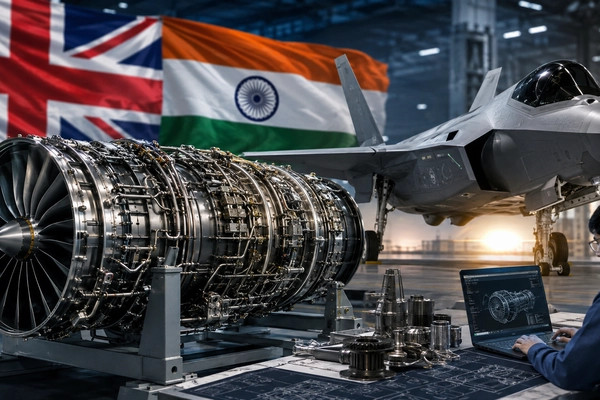
India’s effort to acquire sovereign fighter-engine technology for the Advanced Medium Combat Aircraft has entered a significant phase, with Rolls-Royce proposing a new-generation engine producing more than 120 kN of thrust and designed for eventual growth to around 145 kN. The British aerospace company is offering the programme in partnership with Reliance Industries, with the wider objective of establishing an indigenous combat-engine design, manufacturing and development ecosystem in India.
The proposal goes considerably beyond the conventional manufacture of a foreign-designed engine under licence. Details emerging from the offer indicate that India would receive full transfer of technology and intellectual-property rights associated with the jointly developed engine, potentially allowing the country to modify, improve and evolve the powerplant independently for future combat-aircraft programmes.
For India, such an arrangement could address one of the most persistent technological gaps in its aerospace sector. The country has successfully developed indigenous fighters, helicopters, missiles, radars, electronic-warfare systems and increasingly sophisticated unmanned aircraft, but a high-thrust afterburning turbofan suitable for an advanced fighter remains a major technological frontier.
Rolls-Royce and Reliance Formalise AMCA Engine Partnership
The proposal gained considerably greater weight on 14 August 2026, when Rolls-Royce and Reliance Industries formally announced their strategic intent to work together on the design, development, manufacture and delivery of a sovereign indigenous combat engine for the AMCA programme.
The two companies also intend to explore creation of a dedicated Aerospace Gas Turbine Complex in India, conceived as a centre of excellence encompassing advanced propulsion technologies. Rolls-Royce says the proposed industrial structure would build Indian capability across the entire engine lifecycle — design, development, manufacturing, testing, production and through-life support.
This is an important distinction. Producing engine components or assembling imported modules creates valuable manufacturing competence, but it does not necessarily provide the ability to independently redesign the engine core, increase turbine temperatures, introduce new materials or create improved derivatives.
A genuinely sovereign engine programme would instead require Indian engineers to participate at the deepest levels of propulsion-system development.
More Than 120 kN Initially, With a Path Towards 145 kN
Fresh details reported on 27–28 August 2026 indicate that the Rolls-Royce proposal envisages an initial engine generating more than 120 kN of afterburning thrust.
More significantly, the architecture would reportedly contain sufficient design margin for subsequent evolution towards approximately 145 kN.
That growth potential could become particularly important during the AMCA’s operational lifetime.
Combat aircraft rarely remain at their original weight or electrical-power requirement. New radars, electronic-warfare equipment, additional sensors, weapons, cooling systems and computing hardware progressively increase demands on both the aircraft and its engines. Later-generation variants can consequently require substantially more thrust than the original aircraft.
An engine architecture capable of progressing from the 120-kN class towards 145 kN could therefore provide India with considerable flexibility for heavier or more capable future AMCA variants, rather than forcing an entirely new propulsion programme every time the aircraft evolves.
It is nevertheless important to distinguish between the two figures. The currently reported proposal is not for an initial 145-kN engine. It is for a powerplant producing above 120 kN, with an engineering pathway allowing thrust to be increased towards approximately 145 kN in later development.
Full Intellectual Property Rights Could Be the Bigger Prize
While thrust attracts attention, the most strategically important element of the British offer may ultimately be intellectual-property ownership.
The latest details indicate that India would retain the intellectual-property rights to the jointly developed engine and receive full technology transfer. British officials have also indicated that the core technologies offered under the arrangement would be free from restrictions imposed by the United States’ International Traffic in Arms Regulations, or ITAR.
Such an arrangement could fundamentally change India’s position in combat-aircraft propulsion.
When a country operates an imported engine without ownership of the underlying technology, significant changes normally require cooperation or permission from the original manufacturer. Access to critical design information can also be limited, particularly around turbine metallurgy, hot-section components, control software and manufacturing processes.
Ownership of the intellectual property would potentially give India far greater freedom to produce new variants, incorporate Indian technologies and develop the basic architecture for future aircraft.
It should be noted, however, that Rolls-Royce’s formal 14 August announcement does not itself specify “100% ToT”, the 120–145 kN figures or the precise legal structure of IP ownership. Those details have emerged through subsequent reporting on the proposal. The official company announcement instead describes the objective as creating a sovereign indigenous engine and end-to-end Indian capability.
The Technologies India Needs to Master
Developing a modern fighter engine involves considerably more than assembling compressors, turbines and combustion chambers.
The most difficult technologies lie within the engine’s hot section, where components operate under extraordinary temperatures, rotational loads and pressure. These include advanced single-crystal turbine blades, thermal-barrier coatings, high-temperature alloys, sophisticated cooling passages and extremely precise manufacturing processes.
The ability to manufacture single-crystal turbine blades is particularly important because eliminating conventional grain boundaries allows turbine components to tolerate much greater thermal and mechanical stresses. Higher turbine-entry temperatures can contribute directly to greater engine performance and efficiency.
Reports surrounding the Rolls-Royce offer indicate that India is seeking deep transfer of precisely these types of technologies rather than a conventional assembly arrangement.
Additional areas of sovereign capability would include advanced compressor aerodynamics, combustion technology, afterburner development, engine-control systems, health monitoring, materials science and the ability to undertake complete engine validation and certification within India.
An Indian Gas Turbine Complex Could Extend Beyond AMCA
The proposed Aerospace Gas Turbine Complex could therefore have significance well beyond one fighter aircraft.
Rolls-Royce and Reliance envisage an Indian capability covering design through development, testing, production and lifecycle support, creating infrastructure that could potentially support future military and civilian propulsion programmes.
An advanced combat engine programme would create demand across numerous specialised industries, including precision forging and casting, advanced ceramics, high-temperature metallurgy, bearings, sensors, digital control systems, additive manufacturing and extremely high-accuracy machining.
It would also require sophisticated test facilities capable of validating engines under different temperatures, pressures, altitudes and operating conditions.
Such infrastructure would complement India’s existing expertise at the Gas Turbine Research Establishment in Bengaluru. Defence Minister Rajnath Singh visited GTRE in February 2026 to review India’s military gas-turbine programmes and explicitly stressed the government’s commitment to achieving self-reliance in aero-engine development. He also directed greater attention towards advanced engine technologies required for future aircraft.
Engine Sovereignty at the Centre of AMCA
AMCA represents considerably more than another fighter acquisition programme. It is intended to establish India’s ability to design and manufacture an advanced combat-aircraft ecosystem domestically.
The Ministry of Defence approved the AMCA Programme Execution Model in May 2025, placing the Aeronautical Development Agency in charge of executing the programme through industrial participation. Both Indian private companies and public-sector enterprises were given the opportunity to compete, either independently or through joint ventures and consortia.
The government subsequently confirmed that the programme envisages development of five prototypes followed by series production.
Engine technology therefore occupies a unique position within the programme. India could achieve substantial indigenous content in the airframe, avionics, radar, electronic warfare and weapons, but reliance on an externally controlled engine would leave one of the aircraft’s most strategically important technologies outside national ownership.
The objective behind the next-generation engine effort is consequently not merely to obtain sufficient thrust for AMCA. It is to create the capability to design the next Indian fighter engine after AMCA as well.
Rolls-Royce Faces Competition
Rolls-Royce is not alone in seeking a role in India’s future fighter-engine programme. France’s Safran has also been pursuing cooperation with India for development of an advanced combat-aircraft engine, making the selection strategically important for both India and the competing European propulsion companies.
The decision is therefore likely to depend on considerably more than headline thrust.
India will have to examine the extent of access to hot-section technology, intellectual-property ownership, manufacturing rights, export restrictions, development costs, performance guarantees, upgrade freedom, programme risk and how much engineering knowledge Indian organisations will genuinely acquire during development.
The ability to independently evolve the engine decades after the original programme begins could ultimately be as important as its initial performance.
From Kaveri Experience to a New Generation
India already possesses substantial indigenous gas-turbine expertise as a result of decades of work undertaken through GTRE, including the Kaveri engine programme. Although Kaveri did not become the production powerplant for the Tejas fighter, the programme created valuable expertise in compressors, combustion systems, turbines, afterburners, control systems and engine testing.
That technological foundation remains relevant.
During his February 2026 visit to GTRE, Rajnath Singh witnessed an indigenous engine operating with its afterburner engaged and reviewed India’s broader military gas-turbine development efforts. The government simultaneously emphasised the need to accelerate development of an engine for AMCA through international collaboration while preserving the wider goal of indigenous capability.
India’s objective today is therefore different from simply importing a finished engine. International collaboration is increasingly being viewed as a mechanism for crossing technological barriers while building the capability to undertake subsequent generations domestically.
A Potential Turning Point for Indian Fighter Propulsion
The Rolls-Royce proposal brings together three elements that India has long sought in advanced fighter propulsion: high thrust, technology sovereignty and future growth potential.
An engine beginning above the 120-kN level would provide the performance required for a new generation of combat aircraft, while an architecture scalable towards roughly 145 kN could support increasingly powerful AMCA derivatives. Full Indian ownership of the resulting intellectual property, if incorporated into the final agreement on the terms currently being discussed, would be even more consequential.
No final engine-development contract has yet been announced, and the precise technical, financial and intellectual-property provisions will ultimately depend on negotiations and India’s selection process.
But the establishment of the Rolls-Royce–Reliance partnership on 14 August 2026, followed by disclosure of the proposed thrust range and technology-transfer structure later in the month, has transformed the British offer from a broad expression of interest into a much more clearly defined contender for one of India’s most strategically important aerospace programmes.
You may also like
-
Indian Army Reportedly Moves to Integrate PRABAL Counter-Drone System on Mahindra Armado ALSV
-
India Moves Ahead With Javelin Anti-Tank Missile Acquisition as US Envoy Confirms Procurement Plan
-
India’s Indigenous Sonar Ecosystem Powers New Generation of Indian Navy Warships
-
AGNIT Semiconductors: Building India’s Gallium-Nitride Chip Capability for Radar, Communications and Power Electronics
-
Murshidabad Becomes First West Bengal District to Complete Land Handover for India-Bangladesh Border Fencing
