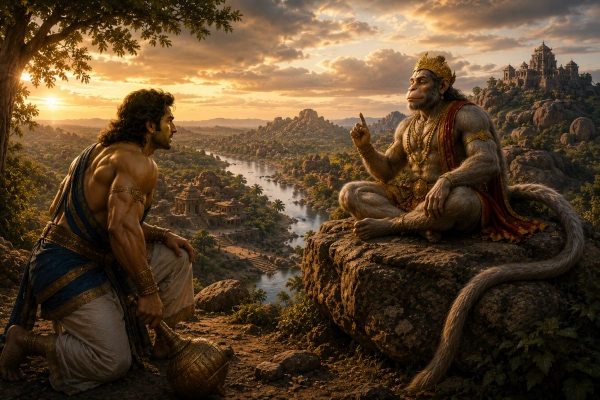
Mahabharata Geography — Kishkindha
Modern geographical correspondence: Hampi, Anegundi and the Tungabhadra region of Karnataka, India
Across the rocky heart of northern Karnataka lies one of the most visually extraordinary landscapes in India. Enormous granite boulders balance upon one another across ridges and valleys, the Tungabhadra winds between rugged hills, cultivated fields fill pockets of fertile ground, and isolated peaks rise suddenly above the river. Around modern Hampi and Anegundi, this landscape has for centuries been identified with Kishkindha, the kingdom of Vali and Sugriva and the country in which Rama first formed his alliance with Hanuman and the vanaras.
Kishkindha belongs primarily to the geography of the Ramayana, but it also occupies a meaningful place within the Mahabharata. During the Vana Parva, the sage Markandeya recounts the story of Rama to Yudhishthira in the celebrated Ramopakhyana. That account specifically names Pampa, Rishyamukha, Kishkindha and Malyavat, recounting Rama’s meeting with Sugriva, the death of Vali and Sugriva’s restoration to the throne. Elsewhere in the Mahabharata, Hanuman himself tells Bhima about his friendship with Sugriva, Sugriva’s exile at Rishyamukha and Rama’s arrival.
For our Mahabharata Geography reconstruction, Kishkindha can therefore be associated most plausibly with the Hampi-Anegundi-Tungabhadra landscape of central Karnataka, while keeping an important distinction in mind. The identification belongs to a very old and powerful sacred-geographical tradition; it is not an archaeological demonstration that a particular surviving structure was the palace of Vali or Sugriva. Karnataka Tourism today explicitly identifies Anegundi with the mythic Kishkindha region, while UNESCO documentation for Hampi records hills bearing the names Anjanadri, Rishyamukha, Matanga and Malyavantha within the broader Tungabhadra landscape.
Kishkindha in the Mahabharata
The Mahabharata’s Ramopakhyana gives remarkably specific geographical details surrounding Rama’s arrival in Kishkindha. After receiving guidance regarding Sugriva, Rama and Lakshmana are directed towards the sacred lake of Pampa, described as lying near the peak of Rishyamukha, where the exiled Sugriva was living with a small group of counsellors. The narrative therefore does not present Kishkindha as an isolated city alone, but as part of a wider landscape consisting of a sacred lake, rocky hills, forested terrain and the stronghold from which Sugriva watched his more powerful brother Vali.
Rama and Lakshmana bathe in the waters of Pampa and proceed towards Rishyamukha. There they see Sugriva and his companions on the mountain, and Sugriva sends the intelligent Hanuman to learn who the two armed strangers are. After Hanuman speaks with them, Rama and Sugriva meet and establish the alliance that will alter both of their destinies. Rama promises to help Sugriva recover Kishkindha from Vali, while Sugriva promises to assist Rama in the search for Sita.
The sequence is geographically important because Pampa, Rishyamukha and Kishkindha appear as closely connected places within one landscape. The modern Hampi-Anegundi region contains precisely such a combination of river, tanks or sacred water bodies, isolated boulder hills and enclosed valleys, which helps explain the durability of the traditional identification.
Pampa — The Sacred Water Before Kishkindha
Before Rama reaches Sugriva, the Mahabharata places him at Pampa, a sacred body of water surrounded by the natural richness of the southern landscape. The episode is more than a simple geographical transition. Pampa represents the place where Rama’s desperate search for Sita begins turning towards the alliance that will eventually make her rescue possible.
Modern sacred tradition identifies Pampa Sarovara near Anegundi with this landscape. Karnataka Tourism describes Pampa Sarovara as a sacred lake near Anegundi and includes it among the principal places associated with the Kishkindha tradition. The modern site contains shrines and retains a strong pilgrimage identity, although the identification belongs to religious tradition rather than being something archaeology can prove from the epic period.
The wider Hampi name itself preserves an intriguing connection with Pampa. Incredible India’s official Hampi description explains the name Hampi through Pampa, traditionally associated with the Tungabhadra and with the goddess Pampa. The connection between Pampa and the surrounding sacred landscape consequently survived far beyond the ancient epic traditions and became embedded in the identity of the region itself.
Rishyamukha — Sugriva’s Refuge
Rishyamukha is one of the most important landmarks in the Kishkindha narrative because it is where Sugriva takes refuge after being driven from his kingdom by Vali. The Mahabharata explicitly remembers this detail twice. In the Ramopakhyana, Rama is directed towards Sugriva near Rishyamukha, while in the separate Bhima-Hanuman dialogue, Hanuman tells Bhima that Sugriva had lived with him at Hrisyamukh or Rishyamukha after his expulsion.
The significance of such a refuge becomes clearer when one looks at the Hampi landscape. This is a country of natural fortresses. Hills consist of enormous granite blocks piled into irregular towers and ridges, while narrow pathways wind between boulders and steep slopes. A relatively small group familiar with the terrain could occupy elevated ground and observe anyone approaching from the plains below.
UNESCO’s documentation of the Hampi cultural landscape specifically records Rishyamukha among the named hills of the region, alongside Matanga, Malyavantha, Hemakuta and Anjanadri. This does not independently prove the epic identification, but it shows how thoroughly the Kishkindha geographical tradition has become attached to the actual topography surrounding Hampi and Anegundi.
Hanuman Meets Rama
The meeting of Rama and Hanuman is one of the most consequential encounters in Indian epic literature, and in the Mahabharata’s own retelling it takes place within this Rishyamukha-Pampa landscape. Sugriva sees the armed brothers approaching and, uncertain of their intentions, sends Hanuman to investigate. Hanuman speaks with them, learns their purpose and brings them to Sugriva.
The landscape therefore becomes the setting for the beginning of a relationship that will eventually lead from Kishkindha to Lanka. Rama gains his greatest ally, Hanuman enters the central Rama story, and Sugriva acquires the support he needs to challenge Vali.
Kishkindha is thus not merely the backdrop to an episode. It is the geographical hinge between Rama’s unsuccessful wandering in search of Sita and the organised southern campaign that follows.
Sugriva and the Kingdom of Vali
According to the epic narrative, Kishkindha is originally ruled by Vali, the extraordinarily powerful elder brother of Sugriva. A conflict between the brothers drives Sugriva into exile, depriving him of both his kingdom and his wife. Rama’s circumstances mirror his in important ways, because Rama too has been driven from his kingdom and separated from his wife.
Their alliance therefore grows from parallel losses. Sugriva needs Rama’s martial power against Vali, while Rama needs Sugriva’s knowledge of the wider southern world and his network of vanara chiefs to locate Sita.
The Mahabharata describes Rama and Sugriva travelling from Rishyamukha towards Kishkindhya, where Sugriva challenges his brother. Vali emerges, and the two fight violently with trees, stones, fists, nails and teeth. Because the brothers are almost impossible to distinguish in combat, Hanuman places a flower garland around Sugriva so that Rama can recognise his ally. Rama then shoots Vali, and Sugriva regains Kishkindha.
The Death of Vali
The Vali episode is one of the most morally debated events within the Rama tradition. Rama kills Vali while the latter is engaged in combat with Sugriva rather than confronting him in a conventional face-to-face duel. The Mahabharata’s Ramopakhyana preserves the event and Vali’s reproach of Rama after the fatal arrow strikes him.
For our geographical reconstruction, however, the description is notable for the physical nature of the fighting. Vali and Sugriva use trees and stones as weapons, leap into the air and grapple at close quarters. The scene fits the epic conception of Kishkindha as a rugged forest-and-hill country rather than an open plain suited primarily to chariot warfare.
The great boulder landscape around Hampi gives this imagery unusual visual force. The country is full of stone outcrops, narrow valleys and hills where enormous blocks appear to have been scattered across the land. Even without claiming that a particular rock witnessed the battle, the terrain helps a modern reader imagine the kind of dramatic environment in which the epic situates Kishkindha.
Sugriva Becomes King
After Vali’s death, Sugriva recovers the throne of Kishkindha. Rama, however, does not immediately enter the city and resume the search for Sita. The rains are beginning, and military movement becomes difficult. The Mahabharata describes Rama staying upon Malyavat hill for four months while Sugriva rules from Kishkindha.
This seasonal pause is a particularly realistic piece of geographical storytelling. Across much of peninsular India, the monsoon could radically alter roads, rivers and military mobility. Streams filled, vegetation thickened and movement of large forces became more difficult.
Rama consequently waits through the rainy season while Sugriva settles into his restored kingdom. The landscape itself imposes a temporary halt on the campaign.
Malyavat and the Monsoon
The Mahabharata later describes Rama remaining on the breast of Malyavat hill, watching the sky and waiting for Sugriva to fulfil his promise after the rains. When Sugriva delays, absorbed in royal life after recovering Kishkindha, Rama sends an angry Lakshmana to remind him of his obligation. Lakshmana enters Kishkindha, and Sugriva reassures him that forces have already been summoned from distant regions.
Modern Hampi sacred geography again provides an intriguing parallel. UNESCO’s older heritage documentation lists Malyavantha among the prominent hills surrounding Hampi, together with Matanga, Rishyamukha and Anjanadri. The names preserve the traditional localisation of the Ramayana landscape across the region.
From the high ground around Hampi today, one can understand why hills mattered so much in epic geography. They provide wide views over the river, cultivated plains and surrounding rocky terrain. A ruler or military force occupying such heights could observe movement across a large area.
The Vanara Army Gathers at Kishkindha
Once Sugriva begins fulfilling his promise, Kishkindha becomes the assembly point for a vast coalition. The Mahabharata describes great vanara chiefs arriving with enormous forces from different directions, including Sushena, Gaya, Gavaksha, Gandhamadana, Panasa, Dadhimukha and Jambavan with the bears. The numbers belong to the deliberately immense scale of epic poetry, but the political idea is clear: Sugriva possesses authority over a widespread network of chiefs capable of mobilising a huge army.
Kishkindha therefore functions as far more than a local stronghold. Once Sugriva returns to power, it becomes the headquarters from which Rama’s search operation is organised across the wider subcontinent.
Parties are sent towards different directions, while Hanuman and Angada eventually join the southern search that discovers Sita’s whereabouts in Lanka. The campaign that will culminate at Setu and Lanka thus begins politically and logistically in Kishkindha.
Hanuman Remembers Kishkindha Before Bhima
Kishkindha becomes even more directly connected with the Mahabharata when Bhima meets Hanuman during the Pandavas’ exile. After Bhima discovers that the apparently old monkey blocking his path is actually Hanuman, Hanuman recounts his earlier life and specifically recalls Sugriva and Vali.
Hanuman tells Bhima that he was the son of the wind god and that the great vanara rulers served Vali and Sugriva. He explains that Sugriva, after being driven out by Vali, had lived with him at Rishyamukha, and he then recounts Rama’s arrival, alliance with Sugriva, defeat of Vali and the later search for Sita.
This passage gives Kishkindha a special place within our series. It is not merely a Ramayana site inserted into a Mahabharata article because of later tradition. A central Mahabharata hero actually hears the Kishkindha story from Hanuman himself within the text.
Through Bhima and Hanuman, the two great Sanskrit epics intersect.
Bhima and Hanuman — Two Sons of Vayu
The meeting possesses another symbolic dimension because both Bhima and Hanuman are sons of Vayu, the wind god. Bhima initially approaches the apparently feeble monkey with characteristic confidence, but he cannot lift Hanuman’s tail and gradually realises that the stranger possesses extraordinary power.
When Hanuman reveals himself, he recounts the events surrounding Rama, Sugriva and the search for Sita. The Mahabharata thereby treats the Kishkindha tradition as part of the remembered heroic past known personally to Hanuman.
The narrative connects the age of Rama with the age of the Pandavas and establishes a continuity of sacred geography. Places such as Rishyamukha and Kishkindha belong to an earlier heroic era, but their memory remains alive within the world inhabited by Bhima.
Anegundi — The Traditional Heart of Kishkindha
Among the modern settlements associated with Kishkindha, Anegundi possesses perhaps the strongest local identification. It lies across the Tungabhadra from Hampi in Karnataka’s Koppal district and occupies a landscape enclosed by rocky hills, fertile fields and river channels.
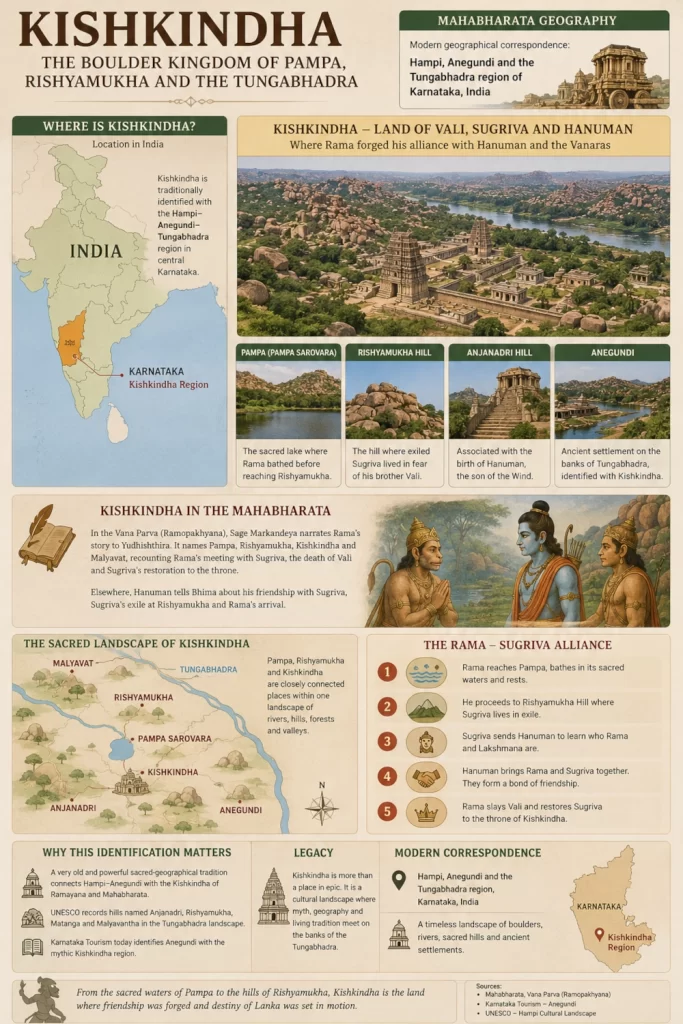
Karnataka Tourism describes Anegundi as the mythic Kishkindha, traditionally identified with Sugriva’s kingdom. The same official account highlights Pampa Sarovara and Anjanadri Hill among the major sacred places surrounding the settlement. Incredible India similarly describes Anegundi as part of the Kishkindha landscape associated with Vali and Sugriva.
Anegundi’s visible buildings belong predominantly to much later historical periods, particularly the Vijayanagara and post-Vijayanagara worlds. They must not be mistaken for surviving structures of an epic-age Kishkindha. What matters for our reconstruction is the landscape beneath those later monuments—the river, hills, boulders and valleys around which the older sacred geography became established.
Anjanadri — The Hill of Hanuman
North of the Tungabhadra near Anegundi rises Anjanadri Hill, traditionally revered as the birthplace of Hanuman. Karnataka Tourism identifies the hill with the Hanuman birth tradition and notes that its summit provides expansive views across fields, rocky hills and the Tungabhadra.
The Mahabharata does not provide a passage declaring the modern Anjanadri Hill to be Hanuman’s birthplace, so the specific localisation should be treated as a later sacred tradition. Nevertheless, the strength of the association has made Anjanadri one of the most important landmarks within the modern Kishkindha pilgrimage landscape.
From its summit, the geography becomes remarkably clear. The Tungabhadra curves across the plains below, fields occupy the flatter country, and granite hills rise in almost every direction. Anegundi lies nearby, while the monumental landscape of Hampi spreads across the opposite side of the river.
It is perhaps one of the best places from which to understand Kishkindha as a geographical whole.
Matanga Hill and the Rocky Country
Another important landmark is Matanga Hill, one of the dominant heights on the Hampi side of the Tungabhadra. Karnataka Tourism describes it as the highest point within Hampi and emphasises the panoramic view it provides over the river and surrounding ruins. UNESCO documentation also lists Matanga among the major hills of the historical landscape.
Matanga belongs strongly to later sacred traditions surrounding Hampi and the Ramayana landscape. Like the other named hills, it demonstrates how the natural topography became woven into religious memory long before the Vijayanagara monuments made Hampi internationally famous.
Seen from above, these hills look less like isolated mountains than immense natural citadels. Their slopes are composed of rounded granite blocks, many of them enormous, with narrow passages and sheltered valleys between them.
Such terrain explains why the idea of a fortified vanara kingdom could attach itself so naturally to this region.
The Tungabhadra — River Through Kishkindha
The Tungabhadra River is the great geographical axis of modern Kishkindha tradition. It flows between Hampi and Anegundi, cutting through the boulder country and creating fertile riverbanks amid an otherwise rugged landscape.
UNESCO describes the Hampi World Heritage landscape as being dominated by the Tungabhadra, craggy hill ranges and open plains. Its documentation also notes that the river and boulder setting remain fundamental to the authenticity of the site.
Older UNESCO reporting specifically records the river’s connection with the name Pampa in the local sacred tradition and lists the surrounding hills connected with Ramayana geography.
This makes the Tungabhadra central to our reconstruction even though the epic’s Kishkindha passages speak more immediately of Pampa, Rishyamukha and surrounding hills. The modern river system binds all of those traditionally identified places into one geographical landscape.
A Natural Fortress of Granite
Few regions in India look as naturally fortified as Hampi and Anegundi. The land is dominated by ancient granite outcrops weathered into extraordinary formations. Great rounded boulders lie upon slopes, stack into towers and create narrow corridors between hills.
UNESCO’s World Heritage description emphasises this dramatic combination of river, craggy hills and open plains as one of the defining features of Hampi. The later Vijayanagara rulers made exceptional use of the terrain, integrating fortifications and urban structures into natural ridges and rocky barriers.
Although those fortifications belong thousands of years after the epic tradition, they demonstrate something enduring about the landscape. A political centre established here could take advantage of natural defences created by the terrain itself.
For a reader trying to imagine Vali’s Kishkindha or Sugriva hiding among rocky heights, the Hampi landscape requires remarkably little imaginative alteration once the later temples and ruined palaces are mentally removed.
Kishkindha Before Vijayanagara
Modern Hampi is internationally famous because it became the capital of the Vijayanagara Empire, particularly between the fourteenth and sixteenth centuries. UNESCO records more than 1,600 surviving features across the protected cultural landscape, including temples, shrines, royal structures, fortifications, roads and water systems.
That magnificent historical city must be kept chronologically separate from Kishkindha. The Virupaksha complex, Vittala Temple, Stone Chariot, royal enclosure and other monumental remains do not belong to the age represented in the Rama story or the Mahabharata.
To imagine Kishkindha, these structures should mentally disappear. What remains is arguably even more evocative: Tungabhadra water, boulder ridges, isolated hills, wooded valleys, caves, cultivated lowlands and open sky.
Those natural features are far older than any surviving monument.
A Landscape Suited to the Vanara Narrative
The Sanskrit word vanara is conventionally rendered as “monkey” or “ape” in English translations, and the epic descriptions frequently give the vanaras explicitly simian characteristics. Attempts to reinterpret them exclusively as a historical human tribe belong to modern speculation and should not be presented as established fact.
For geographical purposes, however, their literary world is clearly connected with forests, mountains, cliffs and extraordinary mobility through difficult terrain. Kishkindha is the ideal centre of such a world.
Its heroes leap between rocks, occupy mountain refuges, fight using trees and stones and communicate through a network of chiefs scattered across distant regions. The landscape is therefore inseparable from the characteristics the texts assign to them.
Hampi’s spectacular granite country provides a remarkably fitting physical setting for that literary geography, which helps explain why the identification has retained such cultural strength.
Kishkindha as the Headquarters of the Search for Sita
After Sugriva assumes the throne, Kishkindha becomes the operational centre for the search for Sita. The Mahabharata describes Sugriva gathering powerful vanara chiefs from different regions before dispatching search parties. Eventually Hanuman, Angada and their companions return after discovering that Sita is in Lanka.
The strategic importance of Kishkindha therefore lies partly in its position within peninsular India. From the Tungabhadra region, routes could radiate towards the western coast, the Deccan, the eastern regions and the deep south.
The southern search ultimately becomes decisive because Hanuman learns Sita’s location, crosses the sea and returns with the information required for Rama’s campaign against Lanka.
In narrative terms, Kishkindha is where grief becomes strategy.
From Kishkindha to Setu
Kishkindha and Setu are geographically connected stages of the same campaign. Kishkindha is the place where Rama gains Sugriva and Hanuman, assembles the vanara coalition and organises the search. Setu is the place where that coalition finally confronts the sea separating it from Lanka.
The Mahabharata’s Ramopakhyana preserves both stages. After the vanara army assembles, Rama and Sugriva eventually lead the great force southwards. The campaign culminates at the ocean, where Nala constructs the crossing that allows the army to reach Lanka.
Seen on a modern geographical reconstruction, the movement is striking. The story proceeds from the Tungabhadra interior of Karnataka towards the southern Tamil coast, linking two major epic landscapes that remain strongly identified with the Rama tradition today.
Rama Returns to Kishkindha
The Mahabharata does not forget Kishkindha after the fall of Lanka. In Markandeya’s narrative, Rama later returns with his allies and once again enters Kishkindha. The text states that he installs Angada as prince-regent before continuing towards Ayodhya.
Kishkindha therefore frames the Lankan campaign. It provides the alliance that makes the expedition possible, and Rama returns there after victory before completing his journey home.
This makes the kingdom more than an intermediate stop between Dandaka and Lanka. It is one of the principal political centres in the southern half of the Rama story.
The Hampi-Anegundi Landscape Today
The modern landscape remains unusually effective at communicating the geographical character attached to Kishkindha. Karnataka Tourism describes Anegundi as lying across the Tungabhadra from Hampi and surrounded by temples, fortifications, Pampa Sarovara and Anjanadri Hill, while Hampi itself is recognised for its immense boulder formations and riverine setting.
The region occupies both banks of the Tungabhadra. Hampi lies principally on the southern side, while Anegundi and Anjanadri occupy the northern landscape in Koppal district. Coracles still provide a visually distinctive means of crossing parts of the river, reinforcing the sense that the Tungabhadra is not merely a boundary but a connector between the two sides.
For our series, the Kishkindha region should therefore encompass both Hampi and Anegundi rather than selecting one settlement alone. The epic geography concerns an entire landscape of interconnected hills and waters.
The Question of Historical Proof
Kishkindha requires the same caution we applied to Setu. A powerful traditional geographical identification should not be confused with archaeological proof of every event narrated in an epic.
There is no inscription discovered at Hampi saying that a particular hill was ruled by Sugriva in a datable Mahabharata or Ramayana period. Nor can the surviving Vijayanagara monuments be attributed to Vali, Hanuman or Rama.
What does exist is a remarkable convergence of textual geography and living sacred geography. The Mahabharata remembers Pampa, Rishyamukha, Kishkindha and Malyavat within one closely connected setting. The Hampi-Anegundi landscape has retained places identified by those names or traditions, while official Karnataka tourism material continues to recognise the region as mythic Kishkindha.
For a geographical series, that makes the identification compelling, provided its traditional character is made explicit.
Kishkindha in the Epic Landscape
Imagine approaching Kishkindha before the later city of Vijayanagara existed. The first impression would be stone. Huge granite hills rise from the plain, their slopes covered with boulders appearing almost impossibly balanced upon one another.
Between them lies green country sustained by water. The river winds between rocky banks, while smaller pools and sacred waters occupy protected hollows. Trees gather thickly in valleys where deeper soil permits them to grow.
High on a ridge, movement can be seen from a great distance.
Sugriva and his companions watch two armed strangers approaching from the direction of Pampa. Unsure whether they have been sent by Vali, Sugriva sends Hanuman down from the heights to discover their purpose.
The strangers are Rama and Lakshmana.
From that meeting the entire southern campaign will unfold.
The Kingdom Among the Boulders
Kishkindha is one of the rare epic landscapes whose modern traditional location possesses a physical character almost perfectly suited to its literary description. The Mahabharata remembers a country of Pampa’s sacred waters, Rishyamukha’s refuge, Kishkindha’s royal struggle and Malyavat’s rainy-season encampment. Around modern Hampi and Anegundi, a corresponding landscape of rivers, boulder hills, valleys and named sacred places remains visible.
For our Mahabharata Geography reconstruction, Kishkindha should therefore be placed in the Hampi-Anegundi region of Karnataka, extending across the Tungabhadra landscape and incorporating the traditional sacred geography around Pampa Sarovara, Rishyamukha, Anjanadri, Matanga and Malyavantha. Its boundaries should remain approximate because Kishkindha belongs to epic geography rather than a historically surveyed territorial state.
Its importance within the Mahabharata is unusually rich despite originating in the Rama story. Markandeya narrates Rama’s arrival at Pampa and Rishyamukha, the alliance with Sugriva, Vali’s death and the restoration of Kishkindha. Hanuman later recounts the same world directly to Bhima, joining the heroic age of Rama to that of the Pandavas.
The later Vijayanagara Empire would transform the same Tungabhadra valley into one of the greatest cities of medieval India, covering the boulder landscape with temples, fortifications, markets and palaces. Yet beneath those magnificent ruins lies an older geographical imagination that is still remarkably easy to perceive. UNESCO itself describes Hampi as a spectacular setting dominated by the Tungabhadra, craggy hills and open plains, while Karnataka’s official tourism tradition continues to identify Anegundi and its surroundings with Kishkindha.
Long before the stone towers of Vijayanagara rose above this valley, Indian epic memory had already filled these hills with another kingdom. It was the country where Sugriva waited in exile, where Hanuman first approached Rama, where Vali fell, and where the scattered vanara chiefs gathered before the search for Sita began.
Kishkindha was the kingdom among the boulders—the rocky heart of the Tungabhadra where Rama found Hanuman and where the road to Lanka truly began.
You may also like
-
Setu — The Sacred Southern Crossing Between Rameswaram and Lanka
-
One Voice – One Resolve – One India: Namami Bharatam Marks 150 Years of Vande Mataram Across the Nation
-
Dravida — The Ancient Tamil Country of Rivers, Temples and the Southern Ocean
-
Pandya — The Southern Kingdom of the Vaigai, Tamiraparani and the Pearl-Rich Sea
-
Chola — The Kaveri Kingdom of Fertile Fields, Ancient Cities and the Eastern Sea
