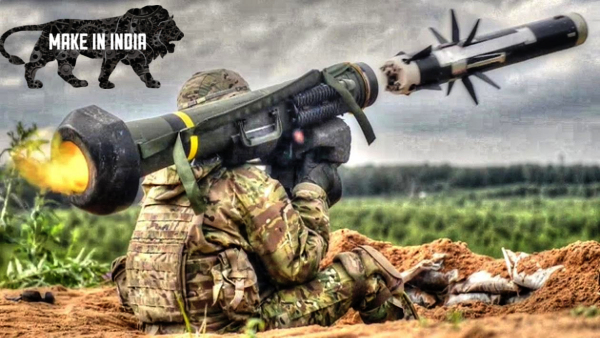
India’s plans to acquire the American FGM-148 Javelin anti-tank guided missile system have received fresh high-level confirmation, adding momentum to a defence programme that could eventually extend beyond direct imports into production cooperation between Indian and American industry.
U.S. Ambassador to India Sergio Gor said on 28 August 2026 that India plans to purchase the battle-tested Javelin anti-tank missile system from the United States. The statement is significant because it provides fresh confirmation that a procurement track first publicly outlined by the two governments in 2025 remains active.
The development should not, however, be interpreted as the announcement of an entirely new programme or confirmation that a final contract has been signed. Washington had already approved a possible Foreign Military Sale of Javelin systems to India in November 2025, while India and the United States had earlier announced their intention to pursue both procurement and co-production of Javelin anti-tank guided missiles in India.
The emerging picture is therefore of a phased programme in which India could initially acquire a relatively limited number of missiles and launch units while the two countries continue discussing a larger industrial arrangement. Such an approach would allow the Indian military to field and evaluate the weapon while potentially creating a pathway towards indigenous production and a broader domestic Javelin ecosystem.
Initial US Approval Covers 100 Javelin Rounds
The most concrete public indication of the initial procurement came on 19 November 2025, when the U.S. State Department approved a possible Foreign Military Sale to India estimated at $45.7 million. The U.S. Defense Security Cooperation Agency subsequently notified Congress of the proposed transaction.
According to the official notification, India requested 100 FGM-148 Javelin rounds, along with one additional Javelin FGM-148 missile described as “fly-to-buy” and 25 Javelin Lightweight Command Launch Units or Block 1 Command Launch Units. The proposed package also included training equipment, missile simulation rounds, technical manuals, lifecycle support, spare parts, integration assistance, tool kits and other logistics and programme-support elements.
The relatively modest quantity is important when assessing the programme. An initial acquisition of around one hundred missiles would not by itself represent a wholesale replacement of India’s existing anti-tank guided missile inventory, but it could provide an operational entry point for the system while larger procurement and production arrangements are developed.
The U.S. approval also represented authorisation for a possible sale, rather than proof that every element of the notified package had already been contracted or delivered. Ambassador Gor’s fresh statement on 28 August 2026 therefore matters because it indicates that India’s intention to acquire the weapon remains active after the congressional notification process.
Procurement Was Announced at the Modi-Trump Summit
The Javelin programme became a formal part of the India-U.S. defence agenda during Prime Minister Narendra Modi’s visit to Washington in February 2025. In their joint statement of 13 February, Prime Minister Modi and U.S. President Donald Trump announced plans for new procurement and co-production arrangements involving both Javelin anti-tank guided missiles and Stryker infantry combat vehicles in India.
The announcement formed part of the broader U.S.-India COMPACT initiative, which sought to expand defence industrial cooperation, technology partnerships and military interoperability. The two governments explicitly placed greater emphasis on co-production rather than limiting the relationship to traditional buyer-seller transactions.
The Javelin programme therefore has two interconnected dimensions. One involves acquiring ready-built missile systems to satisfy military requirements in the near term, while the second concerns establishing some form of production arrangement within India.
How extensive that co-production ultimately becomes remains an important question. Public official documents have confirmed the intention to pursue it, but detailed arrangements concerning localisation levels, technology transfer, Indian workshare and production quantities have not yet been publicly disclosed.
US Again Confirmed Javelin Co-Production in 2026
The co-production objective was reiterated publicly by the United States during the 2026 Shangri-La Dialogue in Singapore. U.S. Defense Secretary Pete Hegseth said Washington had committed to pursuing co-production with India in areas including Javelin anti-tank guided munitions, describing such industrial cooperation as a practical step towards strengthening military readiness.
This statement indicated that co-production had remained on the bilateral defence agenda beyond the original February 2025 announcement. It also fitted a broader shift in India-U.S. defence cooperation towards manufacturing, maintenance, supply-chain integration and sustainment rather than simply importing completed American weapon systems.
For India, this industrial dimension is especially important. New Delhi has increasingly sought to link major overseas defence acquisitions with domestic manufacturing, technology absorption and a stronger indigenous supply chain under the wider Atmanirbhar Bharat and Make in India framework.
Bharat Dynamics Has a Longer History With Javelin
The possibility of manufacturing Javelin systems in India actually predates the latest government-level initiative. Bharat Dynamics Limited, the Ministry of Defence public-sector missile manufacturer, disclosed in its 2019–20 annual report that it had signed a memorandum of understanding with the Javelin Joint Venture of Raytheon and Lockheed Martin for productionising the Javelin missile system in India.
Lockheed Martin separately announced in February 2020 that the Javelin Joint Venture had signed a co-production memorandum of understanding with BDL. The earlier arrangement demonstrated that an industrial foundation for potential Indian involvement had already been explored years before Javelin re-emerged as a major element of bilateral defence cooperation in 2025.
BDL is particularly well placed within India’s defence industrial structure for such cooperation because it was established specifically as the country’s production base for guided weapon systems. The company already manufactures several categories of anti-tank and surface-to-air missiles and has decades of experience working with both DRDO technologies and foreign original equipment manufacturers.
Whether the new India-U.S. co-production arrangement will ultimately use the earlier BDL framework, a modified industrial structure or additional Indian partners has not yet been officially detailed. Nevertheless, the existence of the earlier agreement shows that localisation of Javelin production in India is not a newly conceived idea.
What Makes the Javelin Different
The FGM-148 Javelin is a man-portable, fire-and-forget anti-armour missile system jointly produced by Raytheon and Lockheed Martin. Unlike older anti-tank guided missiles that may require the gunner to continue steering or illuminating the target after launch, Javelin automatically guides itself once the seeker has locked onto the target.
This fire-and-forget capability significantly improves operator survivability. Once the missile has been launched, the firing team can relocate, seek cover, reload or engage another target instead of remaining exposed while manually guiding the missile towards its objective.
The missile can attack using either top-attack or direct-attack trajectories. In top-attack mode, Javelin climbs after launch and then descends onto the upper surface of an armoured vehicle, where protection is generally lighter than across the frontal arc. Direct attack provides another option against targets for which an overhead trajectory is unsuitable.
The system also uses a soft-launch mechanism, which reduces the initial launch signature and permits operation from confined positions such as buildings or bunkers under suitable conditions. This can be particularly valuable for infantry teams operating in urban environments or fortified defensive positions.
Range of Up to Four Kilometres
Current Javelin documentation gives the weapon an engagement envelope of approximately 65 metres to four kilometres in most operational conditions. The missile combines imaging-based fire-and-forget guidance with a tandem-shaped-charge multipurpose warhead designed to defeat heavily protected armoured vehicles, including targets fitted with explosive reactive armour.
The complete missile round weighs less than approximately 15.5 kilograms, allowing the system to remain man-portable while still delivering substantial anti-armour capability. Javelin can also be integrated onto vehicles and remotely operated weapon stations, expanding its potential employment beyond dismounted infantry teams.
Its Command Launch Unit additionally functions as an observation system, providing day and thermal imaging that can support target detection and battlefield surveillance even when a missile is not immediately being fired. This gives the launch unit utility beyond its role as a simple missile launcher.
A Weapon With Extensive Combat Experience
Javelin’s reputation has been strengthened by extensive operational employment. The manufacturers describe it as having more than two decades of combat-proven performance, including thousands of engagements before its particularly visible use during the Russia-Ukraine war.
The system had already been employed in Afghanistan and Iraq, with Raytheon recording more than 5,000 operational engagements in those theatres. Its subsequent prominence in Ukraine demonstrated the continuing relevance of portable precision anti-armour weapons against modern mechanised forces.
Combat experience does not mean that any weapon provides a guaranteed solution against every modern tank or active protection system. Armour technology, countermeasures and tactics continue evolving, but Javelin has established one of the strongest operational records among contemporary infantry anti-tank weapons.
India Already Operates a Diverse Anti-Tank Missile Inventory
Any Indian Javelin acquisition would enter a military already equipped with several types of anti-tank guided weapons. The Indian Army has historically operated systems such as Milan and Konkurs, while India has simultaneously pursued indigenous programmes through DRDO and domestic industry.
Bharat Dynamics itself has decades of experience manufacturing anti-tank guided missiles, beginning with licensed production and later expanding into more advanced guided weapons. The company’s existing industrial base could make a locally manufactured Javelin complementary to India’s indigenous ATGM programmes rather than automatically replacing them.
The Indian requirement is large enough that multiple systems can potentially coexist. Mechanised formations, infantry units, specialised forces and different terrain environments may require varying ranges, launch platforms and engagement profiles, creating room for indigenous and imported weapon families to serve different operational roles.
Particularly Relevant to Mountain and Infantry Warfare
A lightweight fire-and-forget missile has obvious relevance for Indian formations operating in difficult terrain. Mountain warfare places a premium on systems that can be carried by relatively small infantry teams while retaining sufficient precision and lethality against armoured vehicles, fortified positions and other high-value targets.
The Javelin’s ability to attack from above is particularly relevant against main battle tanks because upper armour is normally less substantial than frontal protection. Its thermal sighting and fire-and-forget guidance also reduce the length of time a missile team must remain exposed after engaging a target.
Such characteristics could be valuable in both mountainous areas and more conventional mechanised battlefields. Nevertheless, the Indian Army’s exact deployment plans for the proposed Javelin acquisition have not been officially disclosed, and it would be premature to aIndia Moves Ahead With Javelin Anti-Tank Missile Acquisition as US Envoy Confirms Procurement Planssign the system to particular formations or borders without confirmation.
Initial Acquisition Could Prepare the Ground for Local Production
The combination of a small initial Foreign Military Sales package and repeated commitments to co-production suggests a possible phased approach. India could first introduce Javelin into service through imported rounds and launchers while simultaneously developing the technical, manufacturing and support infrastructure required for larger-scale domestic participation.
Such a sequence is not unusual for sophisticated weapons. Operators need training, maintenance procedures, storage infrastructure, simulation equipment, spares and lifecycle-support arrangements before a missile can become fully integrated into service.
The November 2025 U.S. package reflects this requirement by including much more than the missiles themselves. Training systems, simulation rounds, manuals, refurbishment support, spare parts and technical assistance form part of the proposed acquisition because fielding a precision-guided weapon requires an ecosystem rather than simply delivering ammunition.
If India and the United States subsequently finalise a larger co-production arrangement, experience gained from the initial systems could help inform local manufacturing, quality-control and sustainment requirements.
The Scale of Future Procurement Remains Unknown
The most important unanswered question concerns quantity. The publicly approved U.S. Foreign Military Sales package covers only 100 rounds plus one additional missile and 25 launch units, but India and the United States have repeatedly spoken about Javelin within the context of broader procurement and co-production.
No official announcement has yet established how many missiles India may eventually manufacture or acquire under a larger programme. Similarly, neither government has publicly specified the percentage of Indian content or which components could be produced domestically.
This distinction is important because a small direct purchase and a long-term production programme represent very different levels of defence cooperation. Ambassador Gor’s latest statement confirms movement on acquisition, but the eventual scale of the programme will only become clear when additional contracts or industrial agreements are formally announced.
Javelin Fits a Wider Shift in India-US Defence Cooperation
The prospective acquisition forms part of a much broader expansion of U.S.-origin equipment in Indian service. The February 2025 leaders’ statement cited platforms already integrated into India’s inventory, including C-130J transport aircraft, C-17 strategic airlifters, P-8I maritime patrol aircraft, CH-47F Chinook helicopters, MH-60R Seahawks, AH-64E Apache attack helicopters, Harpoon missiles, M777 howitzers and MQ-9B remotely piloted aircraft.
The difference in the latest phase is the growing emphasis on domestic industrial participation. Both governments have increasingly framed future cooperation around co-production, maintenance, repair, supply chains and technology rather than straightforward acquisition alone.
Javelin is particularly symbolic of that change because discussions about Indian production have persisted for years. A successful programme could therefore provide another test of whether the India-U.S. defence relationship can move from purchasing American systems towards manufacturing sophisticated guided weapons within India.
Global Demand for Javelin Is Rising
Any expanded Indian programme would also unfold against strong international demand for the missile. Lockheed Martin has been increasing Javelin manufacturing capacity, with the company working towards annual production substantially above earlier levels as orders from the United States and international customers grow.
The company reported in 2026 that its production network was being expanded further, illustrating the pressure placed on missile supply chains by increasing global demand for precision anti-armour weapons. This production environment gives local manufacturing additional strategic significance because countries increasingly want dependable domestic or diversified sources of munitions rather than complete dependence on overseas supply chains.
For India, indigenous production could therefore have value beyond cost. Domestic assembly and component manufacture can improve supply security, maintenance capability and the ability to replenish stocks during periods of heightened international demand.
The Next Milestone Will Be the Contract and Production Arrangement
The fresh statement from Sergio Gor is significant, but the next decisive development will be official confirmation of the procurement contract and details of the intended Indian production arrangement. Until those documents emerge, the publicly confirmed programme consists of a U.S.-approved $45.7-million possible FMS package, a bilateral commitment to procurement and co-production, and renewed confirmation that India plans to acquire the weapon.
The progression is nevertheless clear. Javelin moved from years of industry-level discussions into an explicit government-to-government objective in February 2025, received U.S. Foreign Military Sales approval in November 2025, remained part of the bilateral co-production agenda in 2026 and has now received another public confirmation from Washington’s ambassador in New Delhi.
For India, the significance extends beyond adding another anti-tank missile to the inventory. If the co-production component materialises on a meaningful scale, the programme could add another layer to India’s domestic guided-weapons manufacturing capability while giving the armed forces access to one of the world’s most extensively combat-tested man-portable anti-armour systems.
The Javelin programme is therefore increasingly taking shape as a two-track initiative: an immediate acquisition intended to bring the weapon into Indian service, and a potentially much larger industrial partnership aimed at producing and sustaining the missile within India.
Official References
1. U.S. Defense Security Cooperation Agency (DSCA)
India – Javelin Missile System
Date: 19 November 2025
Official U.S. approval for a possible Foreign Military Sale to India covering 100 FGM-148 Javelin rounds, one additional fly-to-buy missile, 25 Javelin Command Launch Units and associated training, spares and support equipment.
https://www.dsca.mil/Press-Media/Major-Arms-Sales/Article-Display/Article/4337533/india-javelin-missile-system
2. The White House
United States–India Joint Leaders’ Statement
Date: 13 February 2025
Official statement confirming plans by India and the United States to pursue new procurement and co-production arrangements for Javelin Anti-Tank Guided Missiles in India.
https://www.whitehouse.gov/briefings-statements/2025/02/united-states-india-joint-leaders-statement/
3. U.S. Department of Defense / U.S. Forces Korea
Remarks by U.S. Defense Secretary Pete Hegseth at the 2026 Shangri-La Dialogue
Date: 2026
Official remarks reiterating U.S.-India plans to pursue co-production of defence capabilities, including Javelin anti-tank guided munitions in India.
https://www.usfk.mil/Media/Press-Products/Speeches-Transcripts/Article/4504884/remarks-by-secretary-of-war-pete-hegseth-at-the-2026-shangri-la-dialogue-in-sin/
You may also like
-
India’s Indigenous Sonar Ecosystem Powers New Generation of Indian Navy Warships
-
AGNIT Semiconductors: Building India’s Gallium-Nitride Chip Capability for Radar, Communications and Power Electronics
-
Murshidabad Becomes First West Bengal District to Complete Land Handover for India-Bangladesh Border Fencing
-
India’s LR-AShM Family Could Reach 3,500 Km as DRDO Develops Extended-Range Hypersonic Variants
-
Indian Composite Manufacturing Gets BrahMos Boost With ₹60-Crore Order to Allen Reinforced Plastics
