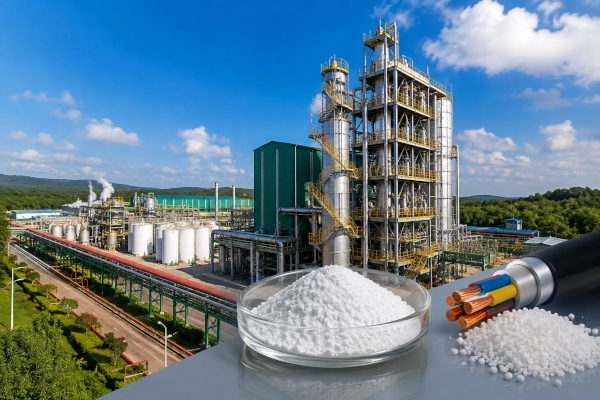
Hindalco Industries has commissioned India’s first manufacturing facility for Superfine Precipitated Aluminium Trihydrate, or PPT ATH, at its long-established specialty alumina complex in Belagavi, Karnataka. The development gives India a domestic source of an advanced halogen-free flame-retardant material that is increasingly important for safer electrical cables, electric vehicles, polymer components, insulation systems and other modern infrastructure applications.
The greenfield facility has an initial production capacity of 30,000 tonnes a year and has been designed for phased expansion to 60,000 tonnes annually as the domestic market develops. Hindalco says the first-phase capacity is sufficient to address almost the entire current domestic requirement from India’s wire and cable industry, potentially replacing a substantial portion of material that previously had to be imported.
The significance of the project extends beyond simply adding another alumina product. Superfine PPT ATH is a highly engineered form of aluminium trihydrate whose particle size, purity, surface properties and processing behaviour have to be carefully controlled. Hindalco’s product portfolio describes the superfine precipitated material as consisting of ultra-fine particles with low electrolyte content, produced through controlled precipitation for use in halogen-free cable compounds, foams, paints and coatings.
A Critical Material for Safer Electrical Cables
One of the most important markets for PPT ATH is Halogen-Free Flame Retardant, or HFFR, cable systems.
Traditional polymer insulation can produce dense smoke and potentially corrosive or hazardous gases during a fire, depending on the materials used. HFFR compounds are designed to reduce this risk by avoiding halogen-based flame-retardant systems while limiting flame propagation and smoke generation.
Aluminium trihydrate is widely used as a mineral flame-retardant additive in such compounds. Hindalco identifies flame retardancy, smoke suppression and halogen-free performance among the principal benefits of its ATH products. The new superfine grade is intended to give compound manufacturers tighter control over dispersion and processing while meeting demanding fire-performance requirements.
This market is becoming more relevant as the amount of electrical cabling used in buildings, transport systems, communication networks and electric vehicles rises rapidly. Fire behaviour becomes especially important in enclosed environments such as residential towers, tunnels, railway coaches, metro systems, data centres and vehicles, where smoke and corrosive gases can create serious hazards even before direct flame exposure becomes critical.
India already has a dedicated national specification for this category. BIS standard IS 17048:2018 covers Halogen Free Flame Retardant cables for working voltages up to and including 1,100 volts, including cables used in power and lighting installations.
The emergence of a domestic source of a key HFFR raw material therefore strengthens an industrial ecosystem extending well beyond the aluminium sector.
InnoSafe Moves Hindalco Further Into Advanced Materials
Hindalco is marketing the new material under its InnoSafe specialty alumina portfolio.
Rather than competing only as a producer of bulk aluminium or conventional alumina, the company has increasingly been moving towards highly engineered materials whose performance depends on particle morphology, chemical purity, thermal behaviour and compatibility with downstream manufacturing processes.
At Belagavi, Hindalco already manufactures more than 120 grades of specialty alumina and hydrates for applications spanning refractories, ceramics, polishing, glass, water treatment and flame-retardant products. The site uses an integrated Bayer-process route that allows control over hydrate purity and particle-size distribution.
The addition of Superfine PPT ATH pushes this capability into a particularly high-value segment. Hindalco says its precipitated hydrate offers enhanced surface characteristics and optimised oil absorption, characteristics that can improve processing performance in polymer systems requiring high levels of flame-retardant filler.
The company also produces fine-ground ATH, low-viscosity grades, surface-modified ATH and low-electrolyte products, showing how a relatively familiar chemical compound can be engineered into different materials for very different industrial requirements.
Technology Developed in India
A major part of the project’s significance is that the manufacturing technology was developed internally.
Hindalco describes the programme as a “flask-to-factory” innovation journey, with the process and product technology developed in-house before being scaled to industrial production. The commercial plant incorporates automated controls around critical process stages and is integrated with the refinery to maintain tight control over feedstock and finished-product quality.
The technological base comes from Hindalco’s long-running Innovation Centre for Alumina at Belagavi. The centre traces its origins to 1979 and has evolved from improving the Bayer process for Indian bauxite into a research centre developing specialty aluminas and hydrates for advanced industrial applications.
This is important from a Make in India perspective. Import substitution in advanced materials requires more than installing production equipment. The critical capability lies in mastering process chemistry, controlling particle characteristics, adapting the material to customer formulations and repeatedly producing the same specification at commercial scale.
Hindalco’s move from laboratory development through pilot work and finally industrial manufacturing demonstrates precisely that progression.
Project Was Already Moving Through Customer Qualification
The August 2026 announcement follows an earlier operational milestone.
In its Q4 FY2025-26 earnings presentation released in May 2026, Hindalco had already listed its “Precipitate Hydrate” project as commissioned, with customer qualification in progress. The latest announcement therefore represents the transition of that project into a clearly defined commercial Superfine PPT ATH manufacturing platform with an announced 30,000-tonne capacity and domestic-market strategy.
This qualification stage is particularly important for specialty materials. Cable-compound manufacturers and other industrial customers generally need to validate a new raw material against processing behaviour, electrical properties, mechanical performance and fire-safety requirements before incorporating it into commercial formulations.
The project is consequently not simply about tonnes of installed capacity; it is about establishing an indigenous material that downstream manufacturers can qualify for safety-critical applications.
From Cables to EVs, Insulation and Composites
Although HFFR wires and cables are expected to provide the immediate domestic market, the applications are considerably broader.
Hindalco identifies potential use of its specialty ATH products in cable compounds, electrical and electronic products, composites, paints and coatings, aluminium composite panels, batteries and adhesives. Its latest announcement additionally identifies polymer insulators, thermal insulation and emerging electric-vehicle applications.
The EV connection is particularly noteworthy. Electric vehicles incorporate large quantities of high-voltage cabling, polymer insulation, electronic assemblies and battery-related materials packed into confined spaces. Materials capable of improving thermal and fire performance therefore become increasingly valuable as vehicle electrification expands.
The same trend is visible in renewable-energy installations, high-density buildings, railways, telecommunications and industrial electrical systems. As infrastructure becomes more electrified, the market for safer insulating and flame-retardant materials expands with it.
A Specialty Alumina Plant Powered Entirely by Renewable Energy
The environmental profile of the project is another unusual feature.
Hindalco states that the PPT ATH facility operates using 100% renewable energy sourced from biomass, solar and wind, and describes it as the world’s only specialty alumina facility operating completely on renewable energy. Since this is a company claim, the distinction should be understood in that context, but Hindalco’s broader decarbonisation programme at Belagavi is independently documented across its corporate disclosures.
The company’s August filing reports that the Belagavi refinery achieved greenhouse-gas intensity of just 0.44 tonnes of CO₂ equivalent per tonne of alumina on a year-to-date FY2025-26 basis.
Hindalco has progressively introduced biomass, solar and wind energy at the complex. Its official Belagavi profile notes that a large biomass boiler supplies roughly 40% of steam requirements, while hybrid wind and solar capacity has enabled periods during which the site operated completely on green electricity.
For an advanced material increasingly marketed into electrification, mobility and sustainable infrastructure, lowering the carbon intensity of its manufacture gives the project an additional strategic advantage.
Moving India Up the Specialty-Materials Value Chain
The larger importance of the Belagavi project lies in India’s transition from importing high-performance additives to developing and producing them domestically.
India already possesses a large aluminium industry, a major cable manufacturing base and rapidly expanding electrical and mobility markets. The missing pieces increasingly lie in specialised intermediate materials whose performance requires sophisticated processing rather than simply abundant raw materials.
Superfine precipitated ATH fits exactly into this category.
The new facility combines Indian bauxite and alumina capabilities, domestic research, precision precipitation technology, automated manufacturing and a growing downstream market for fire-safe polymers. At its initial 30,000-tonne annual capacity, it is intended to cover almost all existing domestic demand from the wire and cable sector; expansion to 60,000 tonnes provides room for growth as HFFR adoption widens.
For Hindalco, the project strengthens a strategy of moving further downstream into products where performance and intellectual property carry greater value than commodity volume alone.
For India, it creates an indigenous supply chain for an increasingly important fire-safety material.
The result is a relatively small plant by the standards of the global metals industry, but one with disproportionate strategic significance. By producing Superfine PPT ATH domestically through in-house technology and renewable-powered manufacturing, the Belagavi facility represents the kind of advanced-materials capability that can turn Atmanirbhar Bharat from import substitution into genuine technological self-reliance.
Source:
Hindalco Industries Limited — Stock Exchange Press Release, 27 August 2026, titled “Hindalco Commissions India’s First Superfine PPT ATH Plant, Strengthening India’s Self-Reliance in Cable Fire Safety.” The NSE attachment filename is HINDALCOIND_27082026093827_press_release_intimation_merged_signed.pdf. Official NSE filing PDF
You may also like
-
India to Track Challenges Faced by Women Entrepreneurs in New National Business Survey
-
India Updates Vehicle Rules to Strengthen E85 and E100 Flex-Fuel Technology
-
Bengaluru Startup Paar Autonomy Develops AI-Powered Drone Systems for GPS-Denied Environments
-
Adani Green Energy Expands Battery Storage to 6.63 GWh at Khavda, Strengthening India’s Renewable Power Infrastructure
-
Sigma Advanced Systems Secures Fresh ₹973 Crore NATO Artillery Ammunition Order
