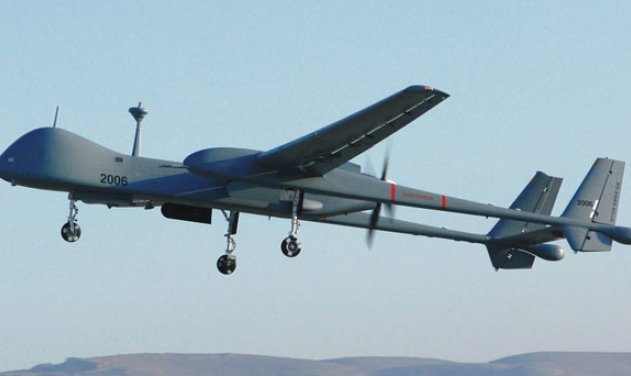
The Indian Army has initiated a comprehensive programme to restore two accident-damaged Heron Remotely Piloted Aircraft Systems, seeking to return the valuable long-endurance surveillance platforms to operational service instead of retiring the damaged airframes.
The Army issued the formal repair tender covering two accident-damaged RPAs operated by its unmanned aviation units. The programme carries a planned work period of up to 365 days and includes extensive structural repair, aircraft integration, ground testing and eventual flight validation.
The aircraft involved have been identified as Heron Tail Nos. 332 and 345, both of which require considerably more than routine maintenance.
Heron No. 332 is reported to have suffered damage following an impact involving the runway environment. Its recovery programme includes assessment of the forces experienced during the accident, preparation of engineering repair instructions and structural work involving the fuselage and wing assemblies.
The central wing section as well as the left and right outboard wing structures are included within the repair scope. Once restoration is completed, installed equipment will be integrated and the aircraft subjected to ground acceptance tests, weight-and-balance verification and a performance flight test before it can be accepted back into service.
Tail No. 345 requires structural work involving the fuselage, wings and engine cowling. Its propulsion package is also part of the restoration effort, with the aircraft expected to receive a serviceable overhauled engine, a new propeller and associated components before undergoing integration and flight testing.
The programme reportedly involves Israel Aerospace Industries’ MALAT division, the original manufacturer of the Heron family, together with Indian industrial participation. OEM engineering support is particularly important where damaged load-bearing structures must be repaired and subsequently cleared for safe flight.
The RFP indicates that the restoration programme is focused largely on repairing the aircraft structures and propulsion-related areas rather than replacing their complete electronic architecture. This could allow the Army to recover two expensive surveillance assets without undertaking full replacement procurement.
Heron aircraft have formed an important part of India’s long-endurance intelligence, surveillance and reconnaissance capability for years. Their endurance allows them to remain airborne for extended periods while carrying electro-optical and other surveillance payloads, making them especially valuable for monitoring large areas and difficult terrain.
For the Indian Army, restoring damaged Herons can therefore provide a comparatively efficient way of preserving fleet strength while newer unmanned systems are progressively inducted. Large MALE-class remotely piloted aircraft represent substantial investments not only in the air vehicles but also in sensors, ground-control infrastructure, satellite communications and trained personnel.
The programme also demonstrates the growing importance of sophisticated maintenance, repair and overhaul capability for unmanned aircraft. As India’s inventory of large military UAVs expands, the ability to conduct structural restoration, propulsion overhaul and system integration within an India-supported maintenance ecosystem will become increasingly important.
Successful completion of the repair programme would return two otherwise unavailable surveillance platforms to the Army’s operational inventory while extending the usable life of its existing Heron fleet. It represents a practical effort to maximise the availability of high-value ISR assets as unmanned surveillance becomes increasingly central to operations along India’s land borders.
You may also like
-
DRDO Seeks Indigenous Ca-DTPA and Zn-DTPA Medical Countermeasures for Radiological Emergencies
-
Indian Army and DRDO Forge Joint Framework to Accelerate Futuristic Military Technologies
-
India and Vietnam Deepen Coast Guard Cooperation as Maritime Partnership Expands in Indo-Pacific
-
India Seeks 25 Military Training Models Including J-20, J-35, DF-17, DF-41 and Type 055 Destroyer
-
India’s Fourth Arihant-Class SSBN S4* Targets End-2026 Sea-Trial Completion Ahead of 2027 Induction
