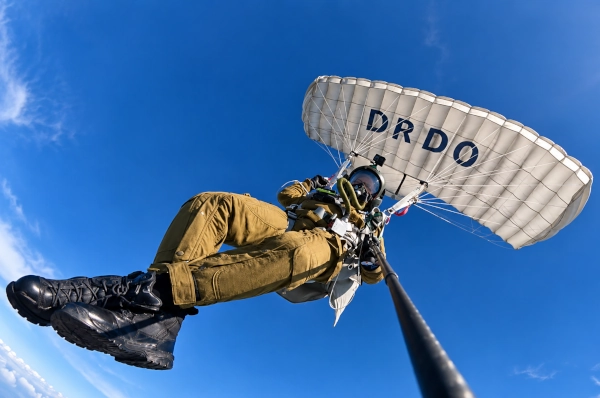
India’s indigenous high-altitude airborne capability has recorded another significant milestone with the Defence Research and Development Organisation successfully testing its Military Combat Parachute System (MCPS) at the Nyoma-Mudh Drop Zone in Ladakh under extreme cold and high-altitude conditions.
The trial was conducted on August 26, 2026, with test jumpers from DRDO’s Aerial Delivery Research and Development Establishment (ADRDE), Agra, executing a jump from 22,000 feet above mean sea level while temperatures were around minus 15 degrees Celsius.
The test team comprised Wing Commander Rahul Jha, Chief Test Jumper; Master Warrant Officer R. J. Singh, VM(G); and Master Warrant Officer Vivek Tiwari. They carried the complete MCPS configuration along with associated indigenous equipment required for high-altitude military parachuting.
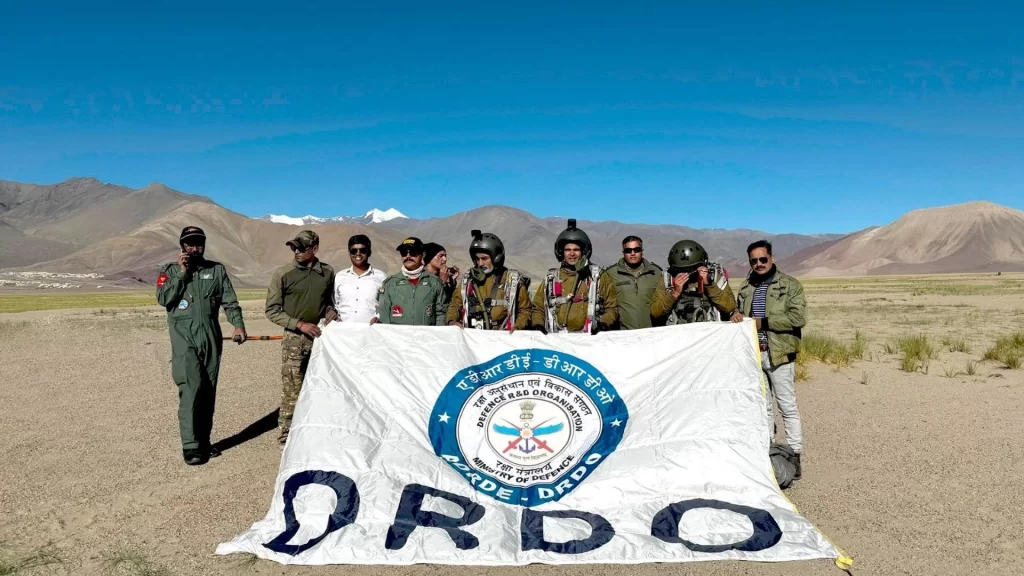
During the descent, the parachute was deployed at approximately 20,000 feet, after which the three jumpers navigated to the drop zone and landed safely at an elevation of around 13,700 feet.
The trial is particularly significant because Nyoma-Mudh is among the world’s highest-altitude operational environments. At such elevations, thin air, low temperatures, reduced oxygen availability and difficult terrain create challenges for both parachute performance and human endurance.
The test therefore examined more than the parachute canopy itself. The jumpers used an indigenous para computer, oxygen system and specialised jumpsuits, demonstrating the integrated equipment package required to conduct military free-fall operations at extreme altitude.
MCPS has been developed to provide Indian military personnel with greater flexibility during high-altitude airborne missions. The system offers improved steering and controlled descent characteristics, enabling trained parachutists to exit aircraft at high altitude, navigate over significant distances and approach designated landing zones with greater precision.
The latest Nyoma trial follows an important earlier milestone in October 2025, when MCPS successfully completed a combat free-fall jump from 32,000 feet. That demonstration established the system’s capability for deployment at altitudes above 25,000 feet and represented a major step towards indigenous high-altitude military parachuting capability.
The August 2026 test addressed a different operational challenge. Rather than simply demonstrating a very high aircraft exit altitude, the Nyoma trial tested the complete system in the severe environmental conditions associated with an exceptionally high-altitude landing zone.
Such capability can be particularly relevant for specialised airborne forces operating in mountainous terrain, where conventional landing zones, road access and helicopter operations may be constrained. High-altitude parachute insertion can provide another means of deploying personnel into difficult operational areas.
The indigenous MCPS programme also reduces reliance on imported specialised parachuting equipment. Its combination of the parachute, navigation assistance, oxygen equipment and protective clothing reflects the growing ability of India’s defence research ecosystem to develop complete systems rather than isolated components.
Successful testing at Nyoma therefore represents another step in validating MCPS for demanding operational environments. By demonstrating reliable deployment, controlled descent and safe landing under extreme high-altitude conditions, DRDO has strengthened India’s indigenous capability for specialised military airborne operations.
REFERENCE:
Defence Research and Development Organisation (DRDO), Ministry of Defence, Government of India
Military Combat Parachute System (MCPS)
DRDO official product page:
https://drdo.gov.in/drdo/en/offerings/transfer-of-technologies/military-combat-parachute-system-mcps
For the earlier officially confirmed 32,000-ft MCPS test, use:
Press Information Bureau, Ministry of Defence — 15 October 2025
“Military Combat Parachute System, indigenously developed by DRDO, successfully tested at 32,000 feet altitude”
You may also like
-
India Moves Closer to Major UK-Made Thales LMM Missile Deal for Indian Army
-
India Develops Indigenous Real-Time Health Monitoring Technology for Fighter Aircrew
-
HAL-Safran Sign Final Contract for 3,500–4,000 shp Aravalli Engine to Power IMRH and DBMRH
-
DRDO Advances Plans for New Trisonic Wind Tunnel at RCI Hyderabad for Advanced Aerospace Testing
-
Ahmedabad-Based Gridbots Develops Indigenous BRUTE-TLH Tactical Load Hauler for Battlefield Logistics
