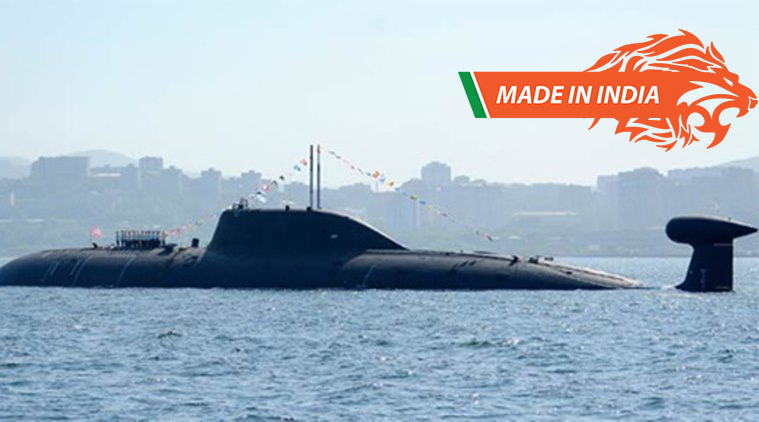
India’s fourth indigenous nuclear-powered ballistic missile submarine, S4*, is progressing through sea trials as the country moves toward completing the first generation of its Arihant-class strategic submarine fleet. Current programme assessments indicate that the submarine could complete its trial programme around the end of 2026, potentially clearing the way for induction into service during 2027.
The International Institute for Strategic Studies confirmed in May 2026 that S4* had been launched in October 2024 and was undergoing sea trials. The submarine is also expected to eventually receive the name INS Arisudan, although that name has not yet been formally announced by the government.
Sea Trials Began in Late 2025
S4* was quietly launched from the Ship Building Centre at Visakhapatnam on October 16, 2024, continuing the expansion of India’s highly classified Advanced Technology Vessel programme. The submarine followed INS Arihant and INS Arighaat and represents a further evolution of India’s domestically designed SSBN architecture.
The vessel reportedly sailed from Visakhapatnam for sea trials in late December 2025. Reporting at the time suggested that the testing programme could last approximately one year, placing potential completion toward the end of 2026 and making an induction during 2027 technically plausible.
Sea trials for a nuclear-powered ballistic missile submarine are considerably more demanding than those of a conventional vessel. They involve progressive validation of propulsion, manoeuvring characteristics, underwater endurance, navigation, communications, sensors, acoustic performance and other onboard systems before the submarine can be accepted for operational service.
Testing of strategic weapon-related systems and integration would form another critical part of establishing the submarine’s eventual operational capability.
A Larger Evolution of the Arihant Design
S4* is widely assessed to be significantly more capable than INS Arihant, the first submarine produced under India’s indigenous SSBN programme.
Reports describe the submarine as an enlarged or stretched development of the Arihant design, with displacement estimated at around 7,000 tonnes. The increase in hull size allows greater space for strategic missile systems and represents an important step toward a more capable and sustainable sea-based nuclear deterrent.
The submarine is associated with the indigenous K-4 submarine-launched ballistic missile, which has a reported range of approximately 3,500 kilometres. Earlier reporting following the submarine’s launch said S4* had been configured around the K-4 rather than the much shorter-ranged K-15 carried by the original Arihant.
This represents a major improvement in deterrence flexibility. A longer-range missile allows an SSBN to threaten strategic targets while remaining farther from potentially hostile anti-submarine forces, reducing the need to operate close to an adversary’s coastline.
S4* has also been reported to have a substantially larger missile capacity than the original Arihant, although detailed specifications of the submarine and its strategic payload have never been formally released.
India’s SSBN Fleet Continues to Expand
India currently operates INS Arihant and INS Arighaat, with the latter commissioned on August 29, 2024.
The next submarine, commonly identified as S4 or Aridhaman, has also been progressing toward operational service. Navy Chief Admiral Dinesh K Tripathi confirmed in December 2025 that Aridhaman was in the final stages of trials and would be commissioned soon. S4* follows it as the fourth hull in the programme.
Once both newer submarines enter operational service, India would possess a substantially larger SSBN force than it did during the initial years of the Arihant programme.
The importance of that expansion lies in availability as much as raw numbers. Nuclear ballistic missile submarines require periods of maintenance, training and refit. A larger fleet improves the ability to keep at least one submarine available for strategic patrol while others undergo maintenance or preparation.
That is fundamental to developing a more resilient sea-based leg of India’s nuclear triad.
Strengthening India’s Survivable Nuclear Deterrent
SSBNs are among the most strategically important military platforms because their ability to remain concealed beneath the ocean makes them extremely difficult to locate and destroy.
For India, a credible SSBN capability provides an assured retaliatory option if land-based missile forces and nuclear-capable aircraft were ever threatened in a first strike.
The Arihant programme therefore represents far more than an indigenous submarine-building effort. It combines nuclear-reactor technology, submarine design, specialised metallurgy, sonar, underwater communications, missile integration and strategic command-and-control systems within one of the most technically demanding defence programmes undertaken by India.
IISS assesses that India’s SSBN capability continues to develop, although it has not yet reached the type of mature continuous-at-sea deterrent posture maintained by the longest-established nuclear submarine powers. Expanding the number and capability of Indian SSBNs is an important part of closing that gap.
S4* Bridges India Toward a New Generation
S4* is also significant because it represents the culmination of the current Arihant-family development path rather than the endpoint of India’s strategic submarine ambitions.
The experience accumulated through building and operating successive Arihant-derived submarines provides India with the technological and industrial foundation required for larger future SSBNs carrying longer-range ballistic missiles.
Each successive boat has allowed improvements in indigenous content, submarine construction, reactor integration, weapons capacity and operational knowledge. The result is the gradual emergence of a domestic strategic-submarine ecosystem that India did not possess when the Advanced Technology Vessel programme began.
The completion of S4*’s trials would therefore mark an important transition. India would move from developing its initial SSBN fleet toward operating a broader and increasingly capable force while preparing for the next generation of strategic submarines.
If the currently reported schedule holds, late 2026 could see S4* complete the bulk of its sea-trial programme, followed by preparations for induction in 2027. Until an official announcement is made, those dates remain indicative rather than fixed.
Nevertheless, the fact that the submarine is already undergoing sea trials confirms that one of India’s most consequential indigenous defence programmes has moved another step closer to operational maturity.
You may also like
-
C-DOT Sharpens 6G, Quantum and Cybersecurity Push as India Targets Leadership in Trusted Telecom
-
India and Vietnam Deepen Coast Guard Cooperation as Maritime Partnership Expands in Indo-Pacific
-
India Seeks 25 Military Training Models Including J-20, J-35, DF-17, DF-41 and Type 055 Destroyer
-
India Readies Final BrahMos Systems for Philippines as Three-Battery Deal Nears Completion
-
India Targets 100 New Ships in Five Years to Reduce $75 Billion Foreign Freight Dependence
