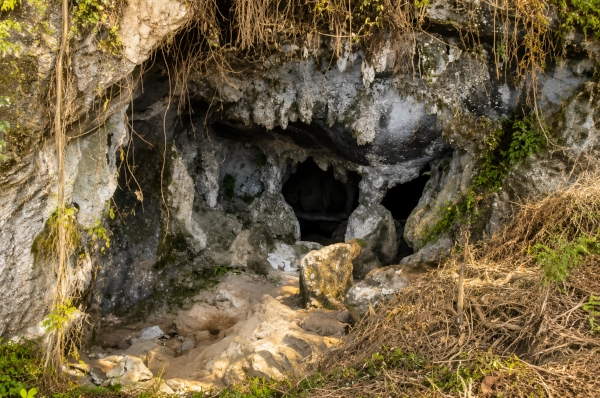
A remote rock shelter in eastern Nagaland has produced some of the strongest archaeological evidence yet that prehistoric communities were living, making pottery and experimenting with agriculture in the Naga Hills around 3,500 years ago, opening a new window into one of the least explored chapters of India’s ancient past.
The discovery comes from Leilo Kaa, a rock shelter in the Chiphur area of Noklak district near the India-Myanmar frontier. A joint team from Nagaland University’s Department of History and Archaeology and the Government of Nagaland’s Department of Art and Culture conducted the first preliminary archaeological cave expedition in the district in March 2026. The wider survey identified and mapped five caves and four rock shelters across the rugged limestone terrain of the Naga Hills Ophiolite Belt.
The breakthrough came on 15 March 2026, when researchers examining an eroded section inside Leilo Kaa noticed pottery and part of a ground stone implement protruding from the sediment. What initially appeared to be a small fragment led to a much richer archaeological deposit containing cord-marked pottery, ground stone tools, hearth features, animal remains and carbonised plant material.
Scientific dating subsequently established the importance of the site. Samples analysed using Accelerator Mass Spectrometry at Beta Analytic Laboratory in Florida placed occupation at Leilo Kaa at approximately 3,500 years before the present. Another nearby site, the Kathso Kaa cave, produced a date of around 1,000 years ago, indicating that caves and shelters in the region continued to be used across a very long span from prehistoric into historical times.
The plant remains are among the most intriguing finds. Archaeologists identified carbonised foxtail millet, Setaria italica, and Job’s tears, Coix species, alongside evidence of hunting and use of wild animals. Their presence suggests that the inhabitants were not dependent solely on hunting and gathering but may have practised an early form of cultivation adapted to the mountainous environment.
This combination is important because the transition from hunting and gathering to food production remains poorly understood across much of Northeast India. Unlike the Indus region, Gangetic plains or central Indian rock shelters, the archaeological record of the eastern Himalayan and Indo-Myanmar borderlands remains comparatively thin. Dense forests, steep terrain, heavy rainfall and historically limited excavation have left enormous areas archaeologically underexplored.
The Noklak discoveries begin to fill part of that gap. Rather than showing an empty frontier between the better-known prehistoric cultures of the Indian subcontinent and Southeast Asia, Leilo Kaa points towards communities occupying and adapting to this mountainous zone thousands of years ago.
The cord-marked pottery recovered from the sites is particularly significant. Similar ceramic traditions are known across parts of eastern and Southeast Asia, while ground stone tools also occur widely in prehistoric communities across the broader region. These parallels do not by themselves prove migration from any particular direction, but they strengthen the case for viewing the Naga Hills as part of a much larger prehistoric cultural landscape extending across modern national borders.
Professor Tiatoshi Jamir of Nagaland University, who led the research, has argued that the prehistory of Northeast India cannot be understood solely within the boundaries of present-day India. The Naga Hills occupy a natural geographic position between South and Southeast Asia, making them potentially important for understanding the movement of people, technologies, crops and ideas across the region.
This wider context gives the discovery significance well beyond Nagaland. Archaeologists have long debated how prehistoric populations moved through Northeast India and how farming traditions spread between eastern India, southern China, Myanmar and Southeast Asia. Securely dated archaeological sites are essential for testing such theories, and until recently Nagaland had relatively few scientific dates from prehistoric cave deposits.
Leilo Kaa therefore offers something particularly valuable: an archaeological context containing datable organic material together with pottery, stone technology, food remains and evidence of human activity. Each category can provide a different part of the story. Pottery can reveal manufacturing traditions and cultural connections, stone tools can show technological choices, animal bones can reconstruct hunting practices, and plant remains can provide clues about the emergence of cultivation.
Even the surviving food residues on pottery are being studied. Researchers hope such material may eventually reveal what people cooked and consumed, helping reconstruct everyday life rather than simply establishing when the site was occupied.
The geography of the discovery adds another layer of importance. Noklak lies close to the India-Myanmar border within a mountainous zone that would have been crossed by people long before modern frontiers existed. Valleys, ridgelines and river systems could have provided routes through which communities moved between the Brahmaputra basin, the Naga Hills and areas farther east.
Archaeological investigation of such landscapes could eventually clarify whether Northeast India functioned primarily as a corridor, as a long-term settlement zone, or as both at different periods. The evidence from Leilo Kaa suggests that people were not merely passing through. Hearths, pottery, food remains and tools indicate repeated domestic activity within the shelter.
The excavation is equally notable for the role of local communities. The Chiphur Village Council supported the expedition, while village elders and local people helped researchers navigate difficult terrain and identify sites. Jamir’s team has emphasised that much of Nagaland’s archaeological heritage lies on community or privately controlled land, making local participation essential for both discovery and conservation.
Young members of the Khiamniungan Naga community are also being introduced to archaeological field methods, an approach that could eventually create locally based custodians capable of helping document and protect prehistoric sites. In a region where archaeological landscapes can be remote and difficult for outside institutions to monitor continuously, community involvement may prove crucial.
The research remains at an early stage. The team intends to complete laboratory analyses and publish the results in peer-reviewed scientific journals. Researchers also plan to revisit other Nagaland cave sites using technologies such as LiDAR, archaeogenetics and geoscientific analysis, potentially allowing them to reconstruct prehistoric landscapes, population relationships and changing environments in far greater detail.
The State Museum under Nagaland’s Department of Art and Culture and Nagaland University are also planning a public exhibition of the finds in October 2026, which should bring the material before a wider audience.
The importance of Leilo Kaa should therefore be expressed carefully. It does not prove that humans first entered Northeast India exactly 3,500 years ago, nor does it establish the origin of the people who occupied the shelter. What it provides is scientifically dated evidence of a prehistoric community living in this part of Nagaland roughly three and a half millennia ago, together with unusually rich clues about its food, technology and environment.
That alone is significant. For too long, the prehistoric map of India has appeared most detailed in the northwest, Gangetic basin, Deccan and central Indian rock-shelter regions, while the Northeast remained comparatively blank.
The discoveries at Noklak suggest that the blank spaces reflect a shortage of archaeological investigation rather than an absence of ancient human history. As more caves, shelters and settlements are scientifically excavated, the Naga Hills may prove to have preserved a far deeper record of migration, adaptation, early cultivation and cultural exchange between South and Southeast Asia than previously recognised.
You may also like
-
Dasharna in the Mahabharata: The Ancient Kingdom of Vidisha and Eastern Malwa
-
13th-Century Tamil Inscription Reveals Jewish Merchants Helped Build Hall at Shiva Temple in Krishnagiri
-
India Begins National Push to Preserve Tribal Languages and Digitally Transform Tribal Museums
-
Malava in the Mahabharata: The Ancient Warrior People Behind the Malwa Region
-
Avanti in the Mahabharata: The Ancient Kingdom of Ujjain and the Malwa Region
