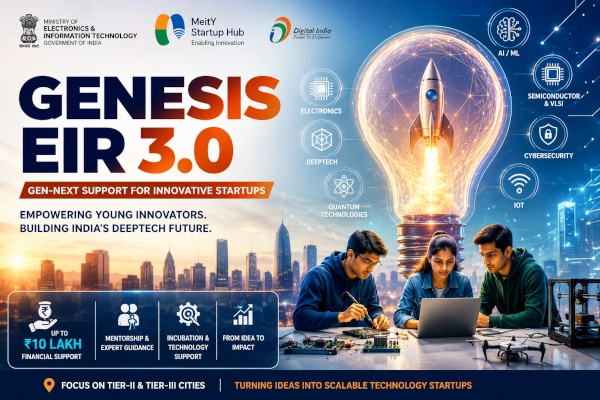
India is expanding support for early-stage technology entrepreneurship through GENESIS Entrepreneur-in-Residence (EIR) 3.0, a national programme designed to help innovators convert promising ideas into prototypes, products and eventually scalable technology companies.
The third cohort has been launched by the Ministry of Electronics and Information Technology through the MeitY Startup Hub, with particular emphasis on nurturing innovation beyond India’s traditional metropolitan startup centres. Selected innovators can receive financial assistance of up to ₹10 lakh, along with incubation, mentorship, product-development assistance and connections to India’s wider technology ecosystem.
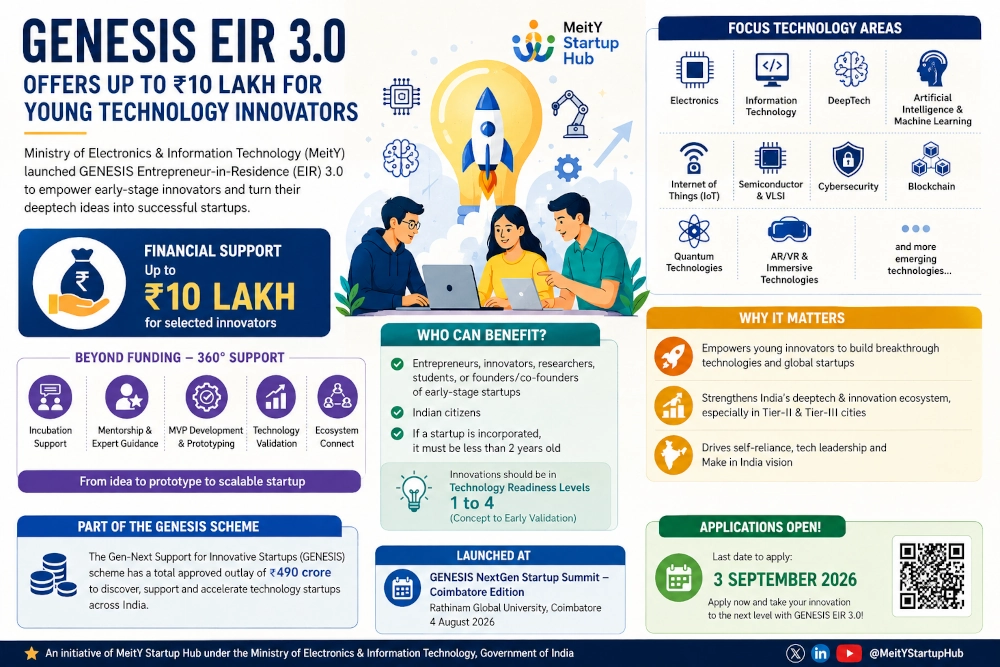
GENESIS EIR 3.0 targets some of the technology areas that are becoming increasingly important for India’s future industrial and strategic capabilities. These include electronics, information technology, DeepTech, artificial intelligence and machine learning, Internet of Things, semiconductor and VLSI technologies, cybersecurity, blockchain, quantum technologies, and AR/VR and immersive technologies.
The programme is aimed at innovators who are still at a relatively early stage of development. Eligible technologies should broadly fall within Technology Readiness Levels 1 to 4, ranging from an initial concept and proof of concept to prototypes, minimum viable products and early validation. This makes the programme particularly relevant to students, researchers and technical innovators who may have a strong technological idea but have not yet built a mature commercial enterprise.
Applicants must be Indian citizens and can include entrepreneurs, innovators, researchers, students or founders and co-founders of young startups. If a startup has already been incorporated, it must be less than two years old when the application is submitted. The scheme is particularly intended to strengthen startups based in Tier-II and Tier-III cities, one of the central objectives of the broader GENESIS programme.
Financial support is only one part of the initiative. Selected participants will gain access to participating GENESIS incubators, one-to-one mentorship, expert guidance, support for developing minimum viable products, technology validation, prototyping and business growth. The programme also seeks to connect innovators with industry participants, startup networks and other parts of the commercialisation ecosystem.
This structure addresses one of the most difficult stages in technology entrepreneurship: the gap between having a technically promising concept and demonstrating that it can become a usable product. Many advanced technology projects require laboratory access, engineering support and repeated prototyping well before they are mature enough to attract conventional investors. GENESIS EIR attempts to provide that early bridge.
The initiative is part of the larger Gen-Next Support for Innovative Startups, or GENESIS, scheme, which has a total approved outlay of ₹490 crore. GENESIS has been designed to discover, support and accelerate technology startups, particularly in smaller Indian cities, through EIR support, pilot funding, investment assistance and dedicated DeepTech funding mechanisms.
Its Tier-II and Tier-III focus is important for India’s wider innovation strategy. The country’s technical talent is increasingly distributed across engineering colleges, universities, research laboratories and emerging startup clusters outside Bengaluru, Hyderabad, Delhi-NCR, Mumbai and other established technology centres. Providing capital and incubation closer to these innovators can allow promising technologies to develop without requiring founders to relocate immediately to major startup hubs.
GENESIS EIR 3.0 can also contribute to India’s broader push for technological self-reliance. Areas such as semiconductors, embedded systems, AI, cybersecurity, electronics and quantum technologies increasingly influence industrial competitiveness, digital infrastructure and strategic autonomy. Encouraging Indian founders to build intellectual property and technology companies in these fields can gradually strengthen domestic capability across critical technology supply chains.
The programme was formally launched at the GENESIS NextGen Startup Summit – Coimbatore Edition, held at Rathinam Global University on August 4, 2026. Applications for the third cohort remain open until September 3, 2026.
GENESIS EIR 3.0 therefore represents more than a small startup grant programme. By combining early capital with technical incubation, mentorship and commercialisation support, it seeks to create a pathway through which India’s students, researchers and young technology founders can transform locally developed ideas into viable DeepTech ventures.
For India’s expanding Make in India and technology-indigenisation ecosystem, programmes of this kind can help ensure that the next generation of Indian innovation is not concentrated only in established startup centres but emerges from universities, laboratories and entrepreneurial communities across the country.
Official Source:
Press Information Bureau (PIB), Government of India
Ministry of Electronics & Information Technology
“GENESIS EIR Cohort-3 offers up to ₹10 lakh support to young technology innovators”
Published: 24 August 2026
https://www.pib.gov.in/PressReleasePage.aspx?PRID=2302611
You may also like
-
Apollo Micro Systems Launches ShauryAstra to Develop Indigenous Long-Range Weapons and Unmanned Combat Platforms
-
Aule Space Reaches TRL-6 With Satellite Docking Technology as India’s Orbital-Servicing Ecosystem Expands
-
India Post Rolls Out Upgraded Dak MITRA and Dak Sewa Apps as Digital Modernisation Expands Nationwide
-
HoverIt Builds 55,000-Sq-Ft Lucknow Facility to Scale Indigenous Divyastra Loitering Munition Production
-
BEL Confirms Microwave Directed-Energy Weapon Prototype Ready as DRDO-BEL System Advances Through Evaluation
