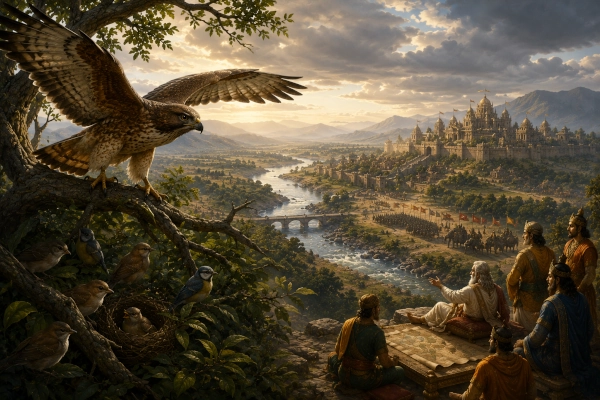
The Kurukshetra War had ended, but Yudhishthira discovered that winning a kingdom was far easier than understanding how to preserve one. Surrounded by the destruction left by eighteen days of war, he repeatedly questioned Bhishma about kingship, diplomacy, enemies and the difficult choices a ruler must make when his kingdom is weaker than those around it.
Bhishma lay upon his bed of arrows, his body broken but his mind still possessing the accumulated wisdom of generations. He understood Yudhishthira’s concern. A king might be righteous and loved by his subjects, yet righteousness alone could not prevent a more powerful neighbour from marching across his borders. Courage was necessary, but courage without judgement could destroy the very people a king had sworn to protect.
To explain this reality, Bhishma repeatedly drew Yudhishthira’s attention to the behaviour of animals and birds. The natural world, he explained, revealed a harsh truth about power. Strong creatures preyed upon weaker ones, and among human beings too, a powerful ruler could consume a weaker kingdom if its king failed to remain alert. Elsewhere, Bhishma compared frightened subjects to small birds trembling at the sight of a hawk, creating one of the most vivid images in his teachings on political power.
The Hawk Above the Forest
Imagine a peaceful woodland at the edge of a prosperous kingdom. Small birds lived among its branches, building nests, feeding their young and moving together through the trees. They were swift and observant, but none possessed the strength of the great hawk that circled high above them.
The hawk did not need to attack every bird it saw. Its power rested partly in the knowledge that it could attack. When its shadow passed across the forest floor, smaller birds disappeared beneath leaves and branches. They understood instinctively that challenging the hawk in open sky would not prove their courage. It would merely deliver them into its talons.
A foolish bird might look upward and say, “Why should I hide? The sky belongs to me as much as it belongs to him.” It might fly directly towards the hawk in a display of defiance. The sentiment would sound brave, but the result would be predictable.
A wiser bird would behave differently. It would watch where the hawk flew, remain close to shelter and wait until danger passed. It might travel with other birds so that many eyes watched the sky. It would learn which branches were too thick for the hawk to enter and which times of day were safest for gathering food.
The wise bird was not a coward. It simply understood the difference between courage and self-destruction.
Bhishma wanted Yudhishthira to understand that kingdoms lived under the same law.
When a Small Kingdom Faces a Great Power
A king might possess only a few fortified towns, a modest treasury and an army considerably smaller than that of his neighbour. Across the frontier might stand a ruler commanding thousands of horses, elephants, chariots and experienced soldiers.
If the weaker king allowed pride to determine policy, he might challenge the stronger ruler simply to prove that he was independent. His soldiers would march enthusiastically, his drums would sound and his banners would rise above the battlefield. Yet if the difference in strength were overwhelming, bravery could quickly become disaster.
The army might be destroyed in a single campaign. Fortresses could fall. Crops might burn, villages might be abandoned and the king’s own subjects would bear the consequences of a decision made for his reputation.
Bhishma therefore told Yudhishthira that when a ruler examined his own position and found himself weak, he should consult wise counsellors and make peace with a stronger enemy when circumstances required it. He even taught that a wise king might make peace when he was not entirely weak if such an agreement produced a greater advantage.
Peace, in this teaching, was not automatically surrender. It could be a weapon of survival.
The Small Bird Does Not Challenge the Hawk in Open Sky
Bhishma’s political wisdom rejected the idea that every conflict should immediately become a war. The smaller kingdom had to understand terrain, alliances, timing, internal stability and the ambitions of neighbouring rulers before drawing the sword.
A king who knew that his enemy possessed overwhelming strength could make peace and preserve his army. He could strengthen his fortifications, fill his granaries, improve relations with neighbouring states and wait for the political situation to change.
Perhaps the great enemy would later become involved in another war. Perhaps one of his allies would abandon him. Perhaps internal disputes would weaken his court. Perhaps the smaller kingdom would meanwhile gain allies of its own.
What looked like retreat today could create the conditions for independence tomorrow.
The small bird survived because it did not meet the hawk where the hawk was strongest.
Know Your Own Strength First
One of Bhishma’s most important principles was that a king must understand himself before judging his enemies. He told Yudhishthira that a ruler should first conquer his own senses and then seek to conquer his foes. A man unable to control anger, pride, fear and desire could not reliably command a kingdom.
This lesson becomes especially important for a weaker ruler. Humiliation can provoke anger, and anger can tempt a king into a war he cannot win.
A neighbouring emperor might send an arrogant message demanding tribute. Ministers might urge immediate retaliation because they feared appearing weak. Warriors might declare that death was preferable to dishonour.
Bhishma’s king had to hear them without becoming their prisoner.
He had to ask harder questions. How many soldiers were actually ready for war? How much grain was stored inside the fortresses? Were the border chiefs loyal? Could allies be trusted? Did the enemy face rebellion elsewhere? Could negotiations divide the opposing coalition? Would delaying the conflict strengthen or weaken his own position?
Only after answering such questions could a ruler act intelligently.
The hawk possessed superior wings and talons. The smaller bird possessed observation, mobility and the ability to disappear before the strike arrived.
Each had to understand its own strengths.
A Kingdom Must Keep Its Eyes Open
Bhishma repeatedly warned against heedlessness. A king could become vulnerable not merely because he lacked soldiers but because he stopped paying attention.
The ruler therefore needed information. Bhishma advised kings to maintain networks of carefully chosen spies who could observe ministers, provincial chiefs, public places and even the activities of enemy agents. Information allowed the ruler to recognise danger before it reached the palace gates.
The principle resembles a flock of smaller birds watching the sky. One bird feeding on the ground might fail to notice the approaching predator. A hundred alert birds could detect movement long before the hawk descended.
For a kingdom, intelligence performed the same function.
A ruler who knew that enemy troops were gathering near his frontier gained time to reinforce his forts. A ruler who discovered negotiations between hostile neighbours could seek allies of his own. A ruler who detected disloyalty among his commanders could act before rebellion began.
Strength was therefore not measured only in elephants, horses or swords. Knowledge itself was a form of power.
Choose the Moment
Bhishma did not teach permanent submission to stronger powers. His advice was far subtler. A weaker king might temporarily make peace, but he should continue watching circumstances and preparing himself.
Political strength constantly changed.
The great hawk that dominated the sky in the morning might become exhausted by evening. Storm clouds might prevent it from hunting. Another predator might enter its territory. The smaller birds that could not confront it under ordinary circumstances might suddenly find themselves free to move.
Kingdoms behaved in much the same way.
A powerful monarch might suffer a succession crisis. His army might be campaigning hundreds of kilometres away. His treasury might be exhausted. Two of his allies might quarrel. A neighbouring ruler might suddenly become willing to join a coalition against him.
The wise king waited for such changes.
He did not mistake patience for permanent weakness.
Alliances Are the Shelter of the Weak
One small bird exposed upon an open branch was vulnerable. A flock moving together possessed greater security, and a bird hidden among thick branches enjoyed protection the hawk could not easily overcome.
For kingdoms, alliances performed a similar function.
A weak ruler surrounded by powerful states could rarely afford isolation. He needed friends who possessed something he lacked. One ally might provide soldiers, another access to trade, another control of a mountain pass, and another simply the deterrence created by its name.
Bhishma repeatedly emphasised the importance of judging friends and enemies according to circumstances. In times of danger, even a former enemy could become useful. In the Shanti Parva, when Yudhishthira asks how a weak ruler surrounded by many enemies can survive, Bhishma explains that circumstances can turn enemies into friends and friends into enemies. A ruler must therefore consider time, place and necessity rather than allowing permanent hatred to dictate his decisions.
This was not an argument for disloyalty. It was a warning against political blindness.
Even an Enemy Can Become a Temporary Friend
Bhishma gives this principle its most memorable form elsewhere in the Shanti Parva through the story of the mouse Palita and the cat Lomasha. The two were natural enemies, yet when both faced immediate dangers, they temporarily cooperated and survived.
After the danger passed, the mouse wisely refused to pretend that their natural hostility had disappeared forever. Bhishma’s conclusion was that a weak and intelligent being could survive among powerful enemies by recognising when temporary peace served mutual interests.
The lesson perfectly complements the image of the hawk and the smaller birds.
A small kingdom did not survive by trusting everyone. Neither did it survive by treating everyone as an eternal enemy.
It survived by understanding which danger mattered most at that particular moment.
Pride Can Destroy a Kingdom
Bhishma’s political teaching repeatedly places responsibility for survival upon the king’s judgement. A ruler who fought unnecessary wars merely to satisfy his pride placed his personal reputation above the lives of his subjects.
Consider two rulers confronted by the same powerful neighbour.
The first declares that negotiation would dishonour his crown. He insults the enemy’s envoy, orders his army across the frontier and fights in terrain selected by the stronger power. His soldiers are surrounded, his commanders are killed and the road to his capital lies open.
The second ruler accepts a temporary treaty. His enemies laugh and call him weak. He ignores them. During the years of peace, he repairs his fortresses, builds his treasury, trains new soldiers, secures mountain routes and forms friendships with two neighbouring kingdoms.
Five years later, the once-powerful enemy attempts another invasion. This time three armies stand against him instead of one.
Which king was truly courageous?
For Bhishma, the answer would depend not upon who shouted the loudest but upon who preserved his kingdom.
The Strong King Must Also Be Cautious
Bhishma did not direct his warnings only towards weaker rulers. The hawk itself could become careless.
A powerful king who believed that no smaller kingdom could threaten him might neglect his borders, mistreat allies or allow ministers to become corrupt. His strength could create arrogance, and arrogance could produce exactly the openings his enemies needed.
Bhishma warned that even a strong ruler must remain attentive to both subjects and foes. If he became heedless, enemies could fall upon him when opportunity appeared.
Political power therefore carried its own danger.
The stronger the hawk became, the more tempting it was to believe that nothing in the forest mattered.
That belief could eventually destroy it.
The King Must Not Become the Hawk to His Own People
Bhishma also used the image of small birds fearing a hawk in a very different and morally important context. He warned that when justice collapsed under an unrighteous ruler, the king’s own subjects would become frightened like small birds at the sight of a hawk. A kingdom governed in that manner would eventually fall apart.
This transforms the metaphor.
The king must understand predatory power when dealing with foreign enemies, but he must never become a predator towards his own people.
If officials steal property, judges favour the powerful and ordinary people fear approaching the court, the ruler has corrupted the very purpose of kingship. The population begins to see its own government as something from which it must hide.
Such a king may still possess soldiers and fortresses, but internally his kingdom is already weakening.
The smaller birds should fear the enemy hawk beyond the frontier, not the ruler who has promised to protect their nests.
Strength Without Dharma Is Fragile
Bhishma therefore balanced political realism with dharma. He understood perfectly well that stronger states often preyed upon weaker ones. He advised kings to use intelligence, treaties, alliances, fortifications and carefully chosen military action.
Yet he never reduced kingship to naked power.
A king existed to protect his subjects. His strength was justified only when it served that responsibility. Conquest achieved by unrighteous means ultimately weakened both ruler and realm, while injustice inside the kingdom destroyed the loyalty upon which lasting power depended.
The successful ruler therefore needed two qualities that might initially appear contradictory: the realism to understand power and the discipline to restrain it.
Without realism, he became prey.
Without restraint, he became the predator his own people feared.
Bhishma’s Lesson to Yudhishthira
As Yudhishthira listened beside the battlefield, Bhishma’s lesson extended far beyond birds in a forest. Kurukshetra itself had demonstrated what happened when pride, rivalry and failed diplomacy were allowed to grow until war became unavoidable.
A ruler could not choose the world in which his kingdom existed. Some neighbours would be stronger. Some would be ambitious. Some friendships would fail, while unexpected alliances might become necessary.
What the ruler could control was his response.
When weak, he should not rush blindly into the talons of the hawk. He should watch, negotiate, strengthen his defences and seek allies. When circumstances changed, he should recognise the moment. When strength finally came into his hands, he should remember how vulnerable the weak had once appeared to him.
Above all, he should ensure that his own subjects never looked upon their king with the terror of little birds seeing a predator overhead.
The Meaning of the Story
The image of the hawk and the smaller birds captures one of the deepest principles of Bhishma’s Rajadharma. Power cannot be ignored merely because the weaker side wishes the world were equal. A smaller kingdom that behaves as though it possesses the strength of an empire invites destruction.
Yet weakness does not mean helplessness.
Intelligence can compensate for limited military strength. Diplomacy can buy time. Alliances can change the balance of power. Fortifications can make conquest expensive. Information can reveal an enemy’s vulnerabilities. Patience can allow circumstances to accomplish what an army cannot.
The smaller bird survives not because the hawk suddenly becomes merciful, but because the bird understands the sky.
Bhishma’s lesson is therefore not simply “the strong defeat the weak.” His teaching is more demanding and more useful: the weak must understand power better than the strong can afford to ignore it.
That is why the smaller kingdom must know when to speak, when to yield, when to form an alliance, when to strengthen itself quietly and, finally, when the right moment has come to stand its ground.
In Bhishma’s world of kingship, survival itself could be an act of wisdom—and sometimes the ruler who refused an unnecessary battle showed greater courage than the ruler who charged into one.
You may also like
-
The Birds and the Destruction of Their Forest Home: A Mahabharata Lesson on Foresight, Leadership and the Duty to Protect
-
Chanakya’s Warning for Modern India: Why Internal Disorder Is the Cheapest Weapon Against a Rising Power
-
The Jackal Who Remembered a Former Life: The King Who Learned That Conduct Matters More Than Birth
-
The Vulture and the Jackal: When Wisdom and Hope Hid the Motive of Hunger
-
India’s Medical Colleges More Than Double Since 2014 as MBBS Seats Rise 177%
