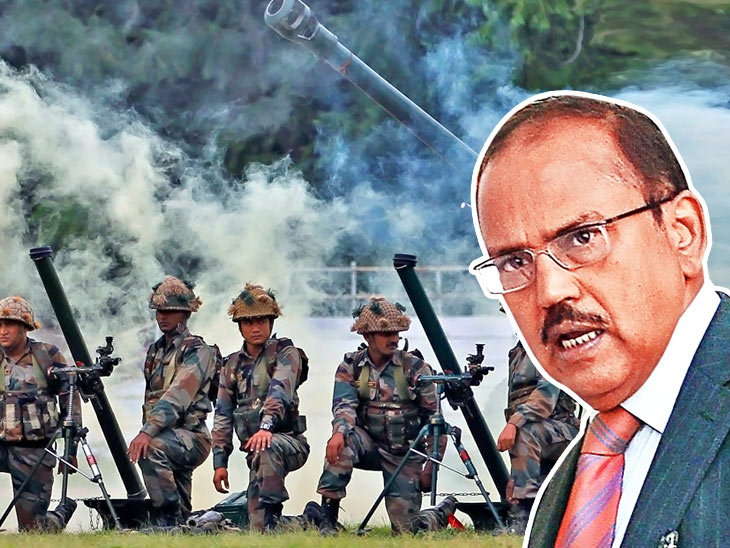
National Security Adviser Ajit Doval is set to hold a fresh round of boundary negotiations with Chinese Foreign Minister Wang Yi in Beijing as India and China continue efforts to stabilise their relationship and prevent renewed tensions along the Line of Actual Control.
Doval is scheduled to arrive in Beijing on Monday, with the 25th round of Special Representatives talks expected to take place on Tuesday. Both officials serve as their respective countries’ designated Special Representatives for negotiations on the India-China boundary question, a mechanism established in 2003 to address the long-running dispute and manage recurring tensions along the frontier.
The talks assume additional importance because they come only weeks before the BRICS summit in New Delhi on September 12-13. Chinese President Xi Jinping is expected to participate, although his visit has not yet been formally confirmed. His presence would create another opportunity for Prime Minister Narendra Modi and Xi to hold high-level discussions on the future direction of bilateral relations.
India and China have gradually resumed political and diplomatic engagement following the prolonged deterioration in ties that began with the border confrontation in 2020. Although several rounds of military and diplomatic negotiations have helped reduce tensions at a number of friction points, New Delhi continues to maintain that normal bilateral relations depend fundamentally on peace and stability along the frontier.
External Affairs Minister S Jaishankar reiterated this position ahead of the Doval-Wang meeting, stressing that the condition of the border will continue to influence the broader relationship. India has consistently argued that sustained peace and tranquillity along the Line of Actual Control remain essential for restoring confidence and allowing cooperation in other areas to progress.
The Beijing talks are also taking place against the backdrop of recent reports of increased Chinese military activity in areas facing Arunachal Pradesh. India has maintained that developments along the border are treated with the highest seriousness and that both sides must continue using military and diplomatic channels to prevent local incidents from escalating.
China has maintained that the border situation remains generally stable and has highlighted continued communication between the two countries through established mechanisms. The 36th meeting of the Working Mechanism for Consultation and Coordination on India-China Border Affairs recently resulted in both sides agreeing to maintain diplomatic and military contact and work toward preserving peace in border areas.
The Special Representatives mechanism remains one of the highest-level channels available to the two governments for addressing the boundary question. While it has not produced a final settlement, it has provided a structured political framework for managing differences, reviewing developments along the frontier and exploring measures aimed at maintaining stability.
Arunachal Pradesh remains one of the most sensitive elements of the territorial dispute. China continues to claim the Indian state as part of what it describes as South Tibet and has repeatedly issued its own names for locations in the region. India has firmly rejected these claims and maintains that Arunachal Pradesh is an integral and inalienable part of the country.
New Delhi has also dismissed Chinese objections to India’s standardisation of names for geographical locations in Arunachal Pradesh, stressing that attempts to rename places cannot alter the state’s sovereign status. The issue continues to underline the depth of the unresolved territorial differences between the two countries despite the recent improvement in diplomatic engagement.
The forthcoming Doval-Wang meeting is therefore expected to focus on maintaining stability along the frontier, strengthening communication mechanisms and sustaining the political momentum generated by recent high-level contacts. It also provides both sides with an opportunity to prepare the ground for possible leadership-level engagement during the BRICS summit.
For India, the central objective remains unchanged: progress in the wider relationship must be accompanied by durable peace along the border. The Beijing talks will consequently serve as an important test of whether the recent improvement in India-China engagement can translate into greater predictability and stability along one of Asia’s most sensitive frontiers.
You may also like
-
Bengaluru Startup Paar Autonomy Develops AI-Powered Drone Systems for GPS-Denied Environments
-
Sigma Advanced Systems Secures Fresh ₹973 Crore NATO Artillery Ammunition Order
-
India Advances Indigenous Defence and Space Technologies Through Naval Innovation, Drones and Advanced Electronics
-
Thales Seeks Indian Partnerships for Next-Generation Missiles, Radars and Electronic Warfare Systems
-
Indian and Australian Armies Conduct Jungle and Coastal Warfare Drills in AUSTRAHIND 2026
