India has launched a major expansion of its defence-industrial infrastructure with five new projects worth approximately ₹3,500 crore across Garden Reach Shipbuilders & Engineers Limited (GRSE) and Yantra India Limited (YIL). The projects are designed to expand warship construction, ship repair, heavy forging and strategic metallurgical capabilities while reducing dependence on imported defence components.
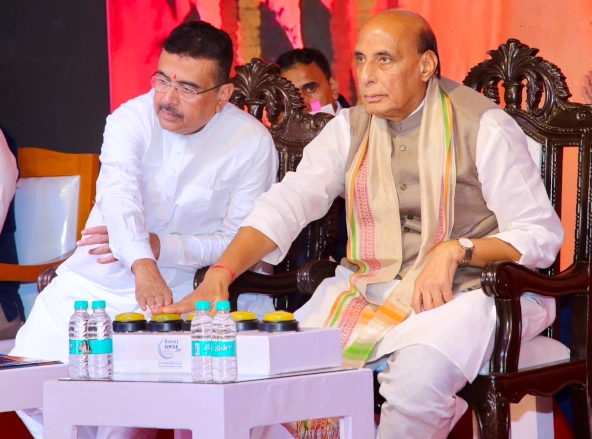
Defence Minister Rajnath Singh and West Bengal Chief Minister Suvendu Adhikari carried out the Bhumi Pujan for the projects virtually from GRSE Bhavan in Kolkata on August 23. Three of the projects are being undertaken by GRSE at Raichak, Shalimar and Kidderpore, while YIL is establishing two major forging facilities at its Metal and Steel Factory at Ishapore. Together, the investments represent one of the more significant recent capacity additions to India’s state-owned defence manufacturing ecosystem.
The largest component of the programme is GRSE’s planned shipbuilding complex at Raichak in South 24-Parganas. The company intends to invest more than ₹2,500 crore to transform a 32-acre riverside property into a major shipbuilding hub. The site has a 356-metre waterfront, an existing 96-metre jetty and a draught of around eight to ten metres, giving GRSE substantially greater flexibility for the construction and movement of larger vessels.
Once developed, the Raichak facility will be capable of constructing warships measuring up to 200 metres in length. This is strategically important because it will give GRSE the infrastructure required to compete for larger future naval programmes, including next-generation destroyers. The yard will also be able to construct commercial vessels of up to 60,000 tonnes deadweight, placing Supramax-class ships within its planned production envelope.
The planned infrastructure at Raichak includes a 200-metre dry dock, 200-metre slipway, 200-metre ship-launching pad and two jetties measuring 120 metres and 86 metres. Dedicated facilities for block fabrication, consolidation, hull repair, storage and administration will support an integrated shipbuilding workflow. Such infrastructure could allow GRSE to handle larger ships while simultaneously increasing the number of vessels under construction or repair.
GRSE is also expanding its presence at Shalimar in Howrah. The company has taken the four-acre Timber Pond facility on a 30-year lease and plans to invest nearly ₹100 crore in transforming it into a modern shipbuilding and repair facility for medium-sized vessels. The programme includes restoration of a 130-metre dry dock, construction of a new 120-metre slipway, shoreline protection, a new dry-dock gate, gantry crane and supporting fabrication and workshop infrastructure.
A third GRSE project will be developed at the Damodar facility at Kidderpore Docks in Kolkata. Located alongside dry docks already being used by GRSE for repair and refit work, the site will receive investment of around ₹70 crore. It is intended to support repair of medium-sized vessels while also providing capacity for construction of electric ferries and other small craft. Together, Raichak, Timber Pond and Damodar will broaden GRSE’s capacity across large warship construction, commercial shipbuilding, repair, refit and smaller specialised vessels.
The expansion comes as GRSE moves beyond its traditional production footprint. The shipbuilder has constructed more than 800 vessels and is currently building next-generation offshore patrol vessels expected to contain more than 80 percent indigenous content. The new facilities are intended to give the company the physical capacity required to pursue larger domestic naval orders as well as international shipbuilding opportunities.
Parallel to the shipbuilding expansion, YIL is investing more than ₹750 crore in two advanced forging projects at Metal and Steel Factory Ishapore. These facilities are particularly important because high-grade forgings form the foundation of several critical defence systems, including artillery guns, ammunition, naval weapons and other heavy military equipment.
The first project involves a new 3,000-ton Heavy Duty Hydraulic Open Die Forging Press equipped with two integrated rail-bound manipulators. It will replace a 2,650-ton press that has been operating since 1976. Scheduled for completion within 26 months, the new system is expected to improve precision and production reliability for critical gun barrels, ammunition components and heavy defence forgings.
YIL is also establishing an advanced Radial Forging Plant at an estimated cost of ₹473.84 crore. Scheduled for execution over 30 months, the facility will introduce modern radial-forging technology at Ishapore and expand the company’s ability to manufacture superalloy forgings, hollow tubes used for aerial bombs, components for future ordnance systems, high-strength railway axles and nuclear-reactor components.
The radial-forging plant will incorporate Industry 4.0 manufacturing systems and high-precision production technologies. More importantly from a defence perspective, it will create a domestic source for strategic forgings that have traditionally represented a difficult and technologically demanding segment of the military supply chain. Greater indigenous forging capability could reduce exposure to foreign suppliers for components used in artillery, naval weapons and future weapons programmes.
The combined GRSE and YIL programme therefore goes beyond a conventional factory expansion. GRSE is building the infrastructure necessary to handle larger and more complex warships, while YIL is strengthening the upstream metallurgical base required to manufacture critical weapon components. Together, the investments connect two essential parts of the defence-production chain: the ability to build sophisticated platforms and the ability to manufacture the high-grade materials and components that go inside them.
The shipbuilding expansion also comes at a time when India is seeking a larger share of the global naval, commercial shipbuilding and maintenance market. Rising international demand for vessels, combined with capacity constraints and high production costs in several traditional shipbuilding nations, could create opportunities for Indian yards with modern infrastructure, skilled manpower and competitive production costs. GRSE’s expanded facilities could therefore support not only Indian Navy requirements but also export-oriented construction and ship-repair programmes.
For the Indian Navy, the most strategically significant element is the scale of the Raichak project. A yard capable of constructing warships up to 200 metres long substantially widens the range of naval platforms that GRSE can pursue. The ability to compete for future destroyer-class programmes would strengthen India’s multi-yard naval production base and provide additional capacity as the Navy progressively replaces older ships and expands its surface fleet.
The ₹3,500-crore programme consequently represents an investment in both industrial capacity and strategic autonomy. By expanding large-warship construction, ship repair, precision forging and advanced metallurgy at the same time, India is strengthening the industrial infrastructure required to sustain increasingly indigenous naval and land-warfare programmes. If executed as planned, the projects could give GRSE and YIL significantly greater roles in the next generation of Indian warships, artillery systems and advanced defence equipment while also improving India’s ability to compete in international defence and shipbuilding markets.
You may also like
-
Bengaluru Startup Paar Autonomy Develops AI-Powered Drone Systems for GPS-Denied Environments
-
Adani Green Energy Expands Battery Storage to 6.63 GWh at Khavda, Strengthening India’s Renewable Power Infrastructure
-
Sigma Advanced Systems Secures Fresh ₹973 Crore NATO Artillery Ammunition Order
-
India Advances Indigenous Defence and Space Technologies Through Naval Innovation, Drones and Advanced Electronics
-
Thales Seeks Indian Partnerships for Next-Generation Missiles, Radars and Electronic Warfare Systems
