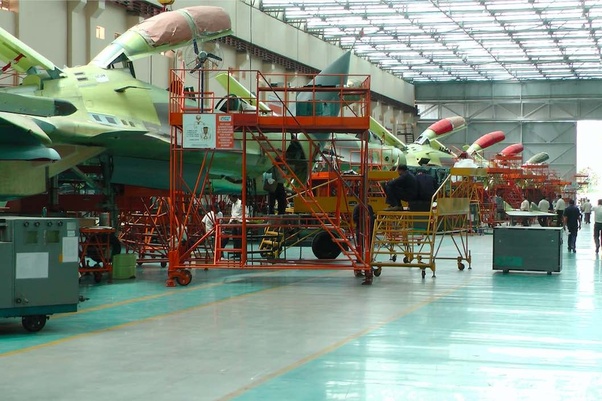
India’s Tejas fighter manufacturing programme is preparing to introduce advanced robotic drilling technology that could substantially automate one of the most demanding stages of aircraft wing production. Hindustan Aeronautics Limited (HAL) is implementing a robotic drilling and inspection system for LCA Tejas wings, with the immediate focus on accelerating production of the Tejas Mk1A.
The programme brings industrial robotics, precision metrology, automated inspection and aerospace tooling into a single manufacturing process. If successfully implemented, it could reduce the amount of manual work involved in assembling Tejas wings while delivering greater consistency from one aircraft to the next.
The technology may also have implications beyond the Mk1A. Companies involved in the programme say the robotic platform could later be adapted for more advanced Indian combat aircraft, including the Tejas Mk2 and Advanced Medium Combat Aircraft (AMCA). However, such future applications should currently be regarded as potential extensions rather than confirmed production decisions.
HAL Moves to Automate Tejas Wing Production
HAL sought a specialised robotic solution for the design, development, supply, installation and proving of a robotic drilling system for LCA aircraft wings. A tender for the requirement was floated in early 2026, confirming that the project forms part of HAL’s effort to modernise the Tejas manufacturing process.
An international consortium led by ADD Engineering Components (India) Pvt. Ltd. is now working on the programme. UK-based True Position Robotics is providing expertise in automated aerospace drilling, inspection and precision positioning. German and Indian engineering specialists are also participating in the project.
True Position Robotics announced its involvement on August 12, 2026, stating that the new system would support HAL’s Tejas Mk1A wing production. The company described the programme as an effort to increase manufacturing speed without compromising the dimensional accuracy and structural quality required for combat aircraft.
Thousands of Precision Holes in Every Aircraft
Wing assembly represents a particularly suitable area for automation because of the enormous number of drilling operations involved.
According to True Position Robotics, approximately 8,000 holes are required in each Tejas wing, giving roughly 16,000 holes across the two wings of one aircraft. Around 3,200 holes per wing fall within the present robotic drilling scope.
These are not comparable to ordinary industrial drilling operations. The Tejas uses extensive carbon-fibre composite structures alongside metallic components. Each hole must meet tight dimensional and positional tolerances while avoiding damage to the composite layers.
Incorrect drilling can cause defects such as delamination, while inconsistencies in countersinking can affect how fasteners sit against the aircraft surface. Combat aircraft structures also experience high aerodynamic and manoeuvre loads, making manufacturing repeatability particularly important.
Traditionally, much of this drilling has relied on skilled technicians and manually operated equipment. Automating a large portion of the process offers HAL an opportunity to shorten manufacturing cycles while simultaneously improving repeatability.
Less Than 60 Seconds Per Hole
HAL has set demanding performance targets for the new robotic system.
The system is expected to complete the drilling and countersinking operation for an individual hole in less than 60 seconds. Positional accuracy must remain within approximately ±0.30 mm. It must also prevent delamination of the carbon-fibre structure and conduct the process without using liquid coolant on the composite material.
Automation will extend beyond simply moving a drill into position.
The planned sequence incorporates surface clamping, alignment, drilling, countersinking, measurement and inspection. The robot will therefore perform several operations that would otherwise require separate manual interventions.
Automated inspection is especially significant. Instead of treating quality verification as a completely separate stage, the manufacturing cell can measure and assess the completed hole as part of the same production sequence.
This creates a digital record of the manufacturing process while allowing engineers to identify deviations much earlier.
Targeted at Around 20 Wing Sets Annually
The system is initially being configured around a production requirement of approximately 20 complete Tejas wing sets per year, according to True Position Robotics. The architecture is also intended to allow production capacity to increase later if required.
This comes as HAL expands the broader Tejas manufacturing ecosystem.
India has already created multiple LCA production lines and increasingly distributes major structural work among private-sector suppliers. Companies now manufacture assemblies including wings, rear fuselages, centre fuselages, air intakes, fins and rudders for the programme.
The Ministry of Defence said in 2025 that HAL had established a fourth LCA Mk1A production line while developing an increasingly distributed national supply chain. HAL has provided private-sector suppliers with jigs, fixtures, tooling and technical expertise to manufacture major aircraft structures.
Robotic drilling represents another stage in that industrial evolution. Increasing production is no longer simply a matter of adding workers or assembly lines. Advanced automation can help each production line complete complex structures faster and with greater consistency.
Tejas Mk1A Production Requirements Continue to Grow
The scale of India’s Tejas requirement makes manufacturing improvements increasingly important.
The Indian Air Force placed its original order for 73 Tejas Mk1A fighters and 10 trainers in 2021. A further contract signed in September 2025 covers 68 fighters and 29 trainers, according to the Department of Defence Production.
Together, these programmes are creating a much larger production run than the earlier Tejas Mk1 batches.
HAL therefore needs an industrial system capable of producing aircraft continuously rather than through relatively small manufacturing batches. Greater automation, subcontracting of structural modules and multiple assembly lines are all part of that transition.
As of February 2026, HAL said five Mk1A aircraft were fully ready for delivery and another nine had already been built and flown, with engine availability affecting completion of the latter aircraft.
The robotic drilling project should therefore be viewed as part of a wider effort to strengthen long-term production capacity rather than as a solution to a single short-term delivery issue.
A Six-Axis Robotic Manufacturing Cell
The system being developed for HAL uses an industrial robotic architecture capable of accurately positioning the drilling equipment around the aircraft structure.
A six-axis robot can move and orient its drilling head in several directions, allowing it to approach curved aircraft surfaces at the required angle. Sensors and metrology equipment can determine the precise location and orientation of the structure before the machining sequence begins.
Once positioned, the end effector can clamp against the surface, drill the required hole, perform countersinking and measure the finished feature.
Such systems are particularly valuable when aircraft contain large numbers of repeated but extremely precise fastening points.
Unlike fixed-purpose machines, robotic manufacturing cells can also potentially be reprogrammed for different structural components. That flexibility becomes increasingly valuable as India’s combat aircraft industry moves toward several aircraft types being manufactured simultaneously.
Technology Could Move Beyond Tejas Mk1A
The immediate customer for the robotic drilling system is the Tejas Mk1A production programme. However, the industrial capability being created could have a considerably longer life.
True Position Robotics says the technology has the potential to be adapted for future Indian aircraft programmes, specifically mentioning Tejas Mk2 and AMCA.
That distinction is important. HAL, ADA or the Ministry of Defence have not publicly confirmed that this particular robotic cell has already been selected for Mk2 or AMCA production. The consortium is describing the platform’s potential scalability.
Nevertheless, the possibility is technically significant.
Both Tejas Mk2 and AMCA will require India to manufacture increasingly complex aerospace structures at higher levels of precision. AMCA, in particular, will place stringent demands on structural alignment, surface quality and manufacturing consistency because of its stealth-oriented airframe.
Automated drilling, robotic assembly, digital metrology and integrated inspection could therefore become increasingly important as these programmes transition from prototypes into series production.
From Aircraft Manufacturing to Digital Manufacturing
The importance of the HAL programme extends beyond the time saved while drilling holes.
Modern aerospace production increasingly combines robotics with digital engineering. A manufacturing cell can receive structural geometry from a digital model, determine the actual position of the component through metrology, adjust the robot’s movement accordingly and record the results of each operation.
This creates a much tighter connection between aircraft design, manufacturing and inspection.
The approach also reduces dependence on large quantities of specialised manual work for repetitive manufacturing tasks. Skilled technicians remain essential, but automation allows them to focus increasingly on system supervision, specialised assembly, troubleshooting and quality control.
Repeatability becomes another major advantage. Once engineers validate the process, the robotic system can execute the same programmed operation thousands of times under closely controlled parameters.
Building the Industrial Base for India’s Next Fighters
India’s combat aircraft programmes are moving into a period where manufacturing capability will become almost as important as aircraft design.
The Department of Defence Production identifies ADA and HAL’s Aircraft Research and Design Centre as the designing and manufacturing agencies associated with the LCA programme, while HAL remains the principal production organisation for Tejas aircraft.
For decades, India concentrated heavily on acquiring the ability to design indigenous fighters and manufacture their structures. The next challenge is producing increasingly sophisticated aircraft in larger numbers and predictable production cycles.
HAL’s robotic drilling programme is a relatively specialised piece of equipment, but it reflects that larger transformation.
Automating thousands of precision operations on composite fighter wings can shorten manufacturing cycles, improve repeatability, strengthen quality control and generate manufacturing data that can feed back into future production.
Tejas Mk1A will be the immediate beneficiary. If the technology proves successful and is adapted to later programmes, the same industrial expertise could eventually become part of the manufacturing ecosystem supporting Tejas Mk2, AMCA and other future Indian military aircraft.
India’s next leap in indigenous fighter aviation may therefore come not only from new radars, engines and weapons, but also from the increasingly automated factories that build the aircraft themselves.
You may also like
-
India to Train 600 Nigerian Army Soldiers in Specialised Jungle and Mountain Warfare
-
ICAR Scientists Develop Indigenous Protective Gloves for Cotton Farmers, Sign Commercial Manufacturing Agreement
-
India Moves Towards Five-Year Assured Orders for Defence Startups Under New Procurement Reforms
-
BHEL–Coal India Joint Venture Begins Construction of ₹25,016 Crore Indigenous Coal Gasification Project in Odisha
-
Zen Technologies Introduces Indigenous Hyper-Strike Falcon AI-Guided Counter-Drone Interceptor
