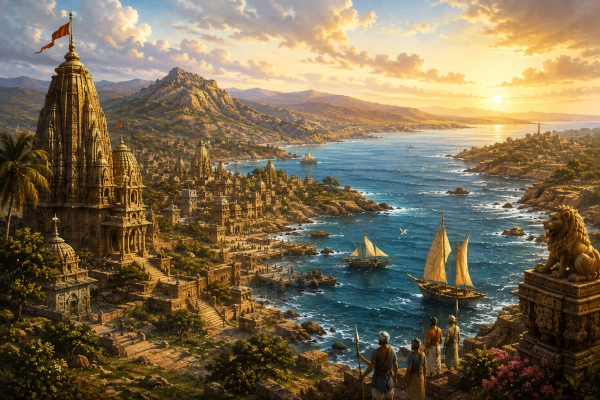
The ancient Saurashtra kingdom, also written as Surashtra in several English translations of the Mahabharata, occupied the western peninsula of Gujarat extending into the Arabian Sea. Its broad geographical identity survives remarkably well in the modern Saurashtra or Kathiawar Peninsula, making it one of the Mahabharata regions that can be connected with a recognisable modern landscape with considerable confidence.
Saurashtra appears at several important points in the Mahabharata. Sahadeva entered the kingdom during the campaigns undertaken before Yudhishthira’s Rajasuya sacrifice, where he brought its ruler Akriti under his authority. Warriors from Saurashtra later appear at Kurukshetra in a force commanded by the Yadava general Kritavarman, while after the war Arjuna again travelled through the country while following Yudhishthira’s Ashvamedha horse.
The region also belonged to the wider western Indian landscape associated with some of the Mahabharata’s most famous places. Prabhasa, Dvaravati or Dvaraka, Raivataka and the western seacoast all appear prominently in narratives involving Krishna, Arjuna, Balarama and the Yadavas. However, Saurashtra should not automatically be treated as identical to the neighbouring ancient region of Anarta, nor should Dvaraka be presented without qualification as the capital of Saurashtra. The Mahabharata and later geographical traditions use these western regional names in ways that sometimes overlap but are not always identical.
Saurashtra at a Glance
| Feature | Identification |
|---|---|
| Ancient Name | Saurashtra / Surashtra |
| Approximate Modern Region | Kathiawar or Saurashtra Peninsula |
| Modern State | Gujarat |
| Country Today | India |
| Mahabharata Ruler | Akriti |
| Major Epic Association | Western coastal kingdom associated with the wider Yadava political world |
| Rajasuya Period | Sahadeva brought King Akriti under Yudhishthira’s sovereignty |
| Kurukshetra Reference | Saurashtra warriors fought in the Kaurava formation under Kritavarman |
| Post-War Reference | Arjuna entered the country of the Saurashtras while following the Ashvamedha horse |
| Important Associated Sites | Prabhasa, Raivataka and Dvaravati/Dvaraka in the wider western Gujarat landscape |
| Capital | Not securely identified in the Mahabharata |
| Modern Geographical Identification | Saurashtra/Kathiawar Peninsula of Gujarat |
Where Was Ancient Saurashtra?
The most convincing modern identification places ancient Saurashtra on the Kathiawar Peninsula of present-day Gujarat. Historical and archaeological literature has long used Saurashtra as an ancient name for this peninsula, which projects westward into the Arabian Sea between the Gulf of Kachchh and the Gulf of Khambhat. An Archaeological Survey of India study similarly describes Kathiawar as the region originally known as Saurashtra.
On a modern map, the region broadly corresponds to the peninsula containing places such as Rajkot, Jamnagar, Dwarka, Porbandar, Junagadh, Somnath, Amreli and Bhavnagar, together with adjoining areas. These modern cities and districts should be used as geographical reference points rather than treated as precise boundaries of an ancient kingdom.
The Mahabharata itself provides useful confirmation that Saurashtra belonged to India’s western coastal world. During Arjuna’s Ashvamedha journey, the text explicitly says that he entered the country of the Saurashtras and then travelled through places including Prabhasa and Dvaravati, before the sacrificial horse continued along the coast of the western ocean.
For mapping purposes, the safest reconstruction is therefore to shade the Kathiawar Peninsula of Gujarat as the approximate Saurashtra region, without drawing rigid political frontiers that the epic itself does not provide.
A Peninsula Surrounded by the Sea
Saurashtra possesses a geography very different from the inland kingdoms of Kuru, Panchala, Matsya or Chedi. The peninsula extends far into the Arabian Sea, giving it a long coastline and a naturally maritime character. Historical descriptions of Kathiawar emphasise how the peninsula is surrounded by water on most sides and connected with the Gujarat mainland through its northern and north-eastern approaches.
This geography helps explain why the Mahabharata repeatedly associates the wider region with journeys along the western ocean, sacred coastal tirthas and the maritime city of Dvaraka. The sea is not merely a distant geographical boundary in these narratives. It forms part of the physical setting in which the western Yadava world developed.
The landscape itself is varied. Coastal plains surround an interior containing hills, grasslands and historically important mountain systems, particularly the Girnar or Raivataka landscape near Junagadh. These geographical features make Saurashtra one of the Mahabharata regions where mountains, sacred places and the sea appear within the same comparatively compact area.
Saurashtra and Anarta Should Not Be Automatically Combined
One of the most important points when reconstructing western India from the Mahabharata is the relationship between Saurashtra and Anarta. Both names are strongly associated with Gujarat, and later traditions sometimes use geographical descriptions that overlap. However, they should not simply be presented as two interchangeable names for exactly the same kingdom.
Later historical evidence clearly distinguishes them. The famous second-century CE Junagadh inscription of the Western Kshatrapa ruler Rudradaman I lists Anarta and Saurashtra separately among the regions under his authority. Historical scholarship consequently often identifies Saurashtra primarily with Kathiawar while placing Anarta farther toward northern Gujarat, although textual traditions can use the names more broadly.
The Mahabharata similarly makes it safer to treat Saurashtra as a distinct geographical identity. Its references to a ruler of Saurashtra, warriors of Saurashtra and the country of the Saurashtras show that the name possessed an independent political and regional meaning.
For a Mahabharata map, Saurashtra should therefore be centred on the Kathiawar Peninsula, while Anarta can be shown as a related western region whose precise limits and relationship with the Yadava territories changed across different traditions.
Who Ruled Saurashtra in the Mahabharata?
The clearest named ruler associated directly with Saurashtra in the Mahabharata is King Akriti.
During the campaigns undertaken before Yudhishthira’s Rajasuya sacrifice, the Pandava brothers travelled in different directions to secure political recognition and tribute from the rulers of Bharat. Sahadeva was assigned a major campaign through southern and western regions.
The Sabha Parva states that Sahadeva, after defeating several rulers, brought Akriti, king of Saurashtra, under his authority. The same passage describes Akriti as connected with the Kausikas and records that Sahadeva remained in Saurashtra while conducting further diplomatic activity.
This reference is particularly valuable because it shows that Saurashtra was not merely the name of a vague coastal population. The text presents it as a recognisable kingdom with its own ruler during the political world preceding the Rajasuya.
Sahadeva Enters Saurashtra
Yudhishthira’s decision to perform the Rajasuya Yajna required the Pandavas to establish that other rulers recognised his imperial authority. His brothers therefore undertook extensive campaigns across the subcontinent, combining military action with diplomacy and the collection of tribute.
Sahadeva’s campaign carried him through a wide range of regions. After encounters with rulers in central India, the Sabha Parva records that he reached Saurashtra and brought King Akriti under his sway. The victory incorporated the western kingdom into the network of rulers acknowledging Yudhishthira before the Rajasuya.
The episode confirms Saurashtra’s political importance. A kingdom situated on Gujarat’s western peninsula was not outside the political calculations centred on Indraprastha and Hastinapura. It formed part of the wider system of alliances, tribute and sovereignty that connected distant regions of ancient Bharat.
Sahadeva Sends a Message to Rukmi
The Saurashtra passage contains another interesting detail. While Sahadeva was staying in the kingdom, he sent an ambassador to Rukmi, ruler of Bhojakata and brother of Rukmini.
Rukmi occupied a complicated position within the political world surrounding Krishna. Although Krishna had carried away and married Rukmini, relations with her brother remained tense. Nevertheless, the Mahabharata states that Rukmi and his son recognised Sahadeva’s authority, remembering their connection with Krishna.
Saurashtra consequently appears not only as a military destination but as a base from which Sahadeva conducted further diplomacy. This suggests that the region occupied a useful position within the network connecting western India with Avanti, Vidarbha and other territories farther inland.
Saurashtra and the Yadava World
Any discussion of Saurashtra in the Mahabharata must also consider the powerful Yadava presence in western India. Krishna, Balarama, Satyaki, Kritavarman, Ugrasena and the Vrishni, Andhaka and Bhoja clans dominate many narratives connected with the western seaboard.
However, the Yadavas should not be treated as a single politically unified kingdom. Their clans contained several powerful leaders who sometimes made different political choices. This becomes especially clear during the Kurukshetra War, when Satyaki fought for the Pandavas while Kritavarman fought for the Kauravas.
The Saurashtra reference in the Bhishma Parva places warriors from the region alongside Vrishni and Bhoja forces commanded by Kritavarman. This creates a direct military connection between at least one Saurashtra contingent and the Yadava commander who supported Duryodhana.
Saurashtra Warriors at Kurukshetra
When the two great armies were arranged before the beginning of the Kurukshetra War, the Mahabharata describes numerous regional contingents occupying different positions.
Among the Kaurava forces was a large formation protected by warriors belonging to the Vrishni and Bhoja races together with warriors of Saurashtra. The text describes the Saurashtra fighters as armed and familiar with the use of weapons, while the overall contingent was commanded by Kritavarman.
This is one of the clearest military references to Saurashtra in the entire epic. It demonstrates that fighters identified specifically with the region participated in the great war and that at least this contingent fought on the Kaurava side.
It would nevertheless be too broad to describe every ruler or clan in the Saurashtra-Yadava world as Kaurava-aligned. Krishna supported the Pandavas, Satyaki fought fiercely for them and other Yadava leaders took different positions. The western political landscape was therefore divided, just as several other ancient kingdoms contained competing dynastic loyalties.
Kritavarman and the Saurashtra Connection
Kritavarman was one of the most important Yadava warriors to support Duryodhana. A member of the Bhoja branch of the Yadavas and the son of Hridika, he commanded a substantial force during the Kurukshetra War and survived the eighteen-day conflict.
The presence of Saurashtra warriors within his formation is geographically logical because Kritavarman belonged to the broader western Yadava political network centred around Dvaraka and neighbouring territories. The Mahabharata’s battlefield description therefore provides an important connection between the regional population of Saurashtra and the great Yadava military houses.
Kritavarman’s story also continues beyond Kurukshetra. He was later present at Prabhasa, where hostility between him and Satyaki helped ignite the catastrophic fighting that destroyed the Yadava clans. The same western landscape that had supplied warriors to Kurukshetra eventually became the setting for the destruction of Krishna’s own people.
Prabhasa: The Great Sacred Site of Western Saurashtra
Among the most important Mahabharata locations associated with the Saurashtra landscape is Prabhasa, traditionally identified with the region around modern Prabhas Patan and Somnath in Gujarat.
Prabhasa appears repeatedly throughout the epic. During Arjuna’s pilgrimage, he travels among the sacred places along the western ocean and arrives at Prabhasa. Krishna learns of his arrival and comes to meet him there, after which the two companions travel to Raivataka.
The Shalya Parva also presents Prabhasa as a major tirtha associated with Soma and the western ocean. Balarama begins part of his pilgrimage there, and the text explains the sacred traditions connected with the place.
Prabhasa consequently provides one of the strongest anchors for placing the Mahabharata’s western sacred geography within modern Saurashtra.
Prabhasa and the End of the Yadavas
Prabhasa becomes even more important near the end of the Mahabharata.
In the Mausala Parva, ominous signs appear in Dvaraka and the Yadavas decide to travel to a sacred place. The Vrishnis and Andhakas proceed with their families to Prabhasa and establish temporary camps there on the seacoast.
The gathering ends catastrophically. Alcohol, old grievances and the curse hanging over the Yadava clan combine to produce a violent confrontation. Satyaki insults Kritavarman over actions committed during and after the Kurukshetra War, and the quarrel escalates until the Yadava warriors begin killing one another.
Prabhasa therefore stands at both the sacred and tragic centre of the Mahabharata’s western geography. It is a place of pilgrimage visited by Arjuna and Balarama, yet it also becomes the setting for the effective destruction of the Vrishni, Andhaka and Bhoja warrior clans.
Raivataka and the Western Yadava Landscape
Another important landmark is Raivataka Mountain, closely associated in the Mahabharata with Krishna and the Yadavas.
When Arjuna reaches Prabhasa during his pilgrimage, Krishna meets him there and the two proceed together to Raivataka. The mountain later appears as the setting for elaborate Yadava festivals, and the Ashvamedha Parva describes the hill decorated with lamps, garlands, stalls, music and large gatherings of the Vrishni people.
Traditional geographical scholarship has often connected Raivataka with the Girnar mountain complex near modern Junagadh, although the exact identification should be presented as traditional rather than archaeologically certain. The association is important because Girnar lies firmly within the modern Saurashtra Peninsula.
For an article map, Raivataka can therefore be shown near the Junagadh-Girnar region, preferably with wording such as “Raivataka — traditionally associated with Girnar.”
Arjuna, Krishna and the Road from Prabhasa to Raivataka
The Adi Parva provides a particularly useful glimpse of the geographical relationship between the western sites. Arjuna reaches Prabhasa while visiting tirthas along the western ocean. Krishna then travels to meet him, and the two friends proceed together to Raivataka.
This episode belongs to the wider narrative that eventually leads to Arjuna’s marriage with Subhadra, Krishna’s sister. Raivataka thus becomes part of one of the most important family connections between the Pandavas and the Yadavas.
The episode also demonstrates that these places were not isolated sacred names. Within the narrative they form part of a connected travel landscape through which Krishna, Arjuna and the Yadavas move.
Dvaraka and Saurashtra
No location is more famous in the western Mahabharata landscape than Dvaravati or Dvaraka, the city associated with Krishna and the Yadavas.
Modern Dwarka lies on the western edge of Gujarat’s Saurashtra Peninsula, making the geographical association immediately attractive. Yet a historically careful reconstruction should distinguish between the modern identification of the region and the more complicated ancient political terminology.
The Mahabharata frequently associates Dvaraka with the Vrishnis and Andhakas, while other traditions describe it in connection with Anarta. Later historical evidence also distinguishes Saurashtra and Anarta as separate territorial names. It is therefore safer to describe Dvaraka as a major Yadava centre within the wider western Gujarat landscape rather than simply declaring it the unquestioned capital of Saurashtra.
This distinction makes the geographical reconstruction stronger rather than weaker because it respects the fact that ancient regional identities rarely correspond perfectly with modern administrative boundaries.
Was Dvaraka the Capital of Saurashtra?
Unlike Chedi, where the Mahabharata explicitly identifies Suktimati as a royal centre, the epic does not provide an equally clear statement naming Dvaraka as the capital of Saurashtra under King Akriti.
The Ashvamedha route is especially important in this respect. The text describes Arjuna entering the country of the Saurashtras, travelling through Gokarna and Prabhasa and then reaching the city of Dvaravati, where he is welcomed by Ugrasena and Vasudeva.
Because Saurashtra and Dvaravati are separately named within the travel sequence, a map should avoid converting an association into a certainty that the Mahabharata itself does not explicitly state.
The most responsible entry for the kingdom’s capital is therefore: Capital — not securely identified in the Mahabharata.
Arjuna Returns to Saurashtra During the Ashvamedha
Saurashtra appears again after the Kurukshetra War when Yudhishthira performs the Ashvamedha sacrifice.
Arjuna follows the sacrificial horse across large parts of Bharat, confronting rulers who challenge Yudhishthira’s sovereignty and accepting the submission of those who allow the horse to pass. During this enormous journey, the horse eventually leads him to the western coast.
The Ashvamedha Parva explicitly states that Arjuna proceeded to the country of the Saurashtras. From there the journey continued through Gokarna and Prabhasa before reaching Dvaravati, which was protected by the heroes of the Vrishni race.
This post-war reference is particularly valuable because it independently confirms Saurashtra as a recognised geographical country within the epic.
The Ashvamedha Horse Reaches Dvaravati
When Yudhishthira’s sacrificial horse entered Dvaravati, some young Yadavas attempted to seize or challenge the animal. Such an action could have forced Arjuna into battle because the horse represented Yudhishthira’s imperial claim.
The elders prevented a confrontation. Ugrasena intervened, and he and Vasudeva received Arjuna respectfully. After being honoured by his Yadava relatives, Arjuna resumed his journey with the sacrificial horse.
The episode shows that political relations between Hastinapura and the western Yadavas remained close after Kurukshetra despite the fact that Yadava warriors had fought on both sides of the war.
It also provides an unusually clear travel sequence connecting Saurashtra with the western coast, Prabhasa and Dvaravati.
Saurashtra and the Western Ocean
The sea is one of the defining elements of Saurashtra’s Mahabharata geography.
Arjuna’s pilgrimage takes him through holy places along the western ocean before he reaches Prabhasa. His later Ashvamedha expedition again moves through Saurashtra and Dvaravati before the horse continues along the coast of the western sea.
The Mausala Parva similarly places the Yadavas at Prabhasa on the seacoast during the final days of their clan.
These repeated references make Saurashtra different from many inland Mahabharata kingdoms. Its political geography cannot be separated from its coastline. The Arabian Sea formed part of the region’s identity, communications and sacred landscape.
Saurashtra as a Recognisable People and Country
The Mahabharata uses Saurashtra in ways that indicate both a territory and its inhabitants.
Sahadeva encounters a king of Saurashtra, demonstrating political organisation. The Bhishma Parva identifies warriors of Saurashtra, showing a regional military identity. The Ashvamedha Parva then describes the country of the Saurashtras, confirming a recognised territorial designation.
Taken together, these references provide a stronger basis for geographical reconstruction than a single isolated mention would.
Saurashtra was therefore not merely a later name projected backwards onto Gujarat. The name itself belongs directly to the textual geography of the Mahabharata.
Saurashtra in the Wider Geography of Western Bharat
Ancient Saurashtra occupied a strategic position on the western edge of the subcontinent. To its north and north-east lay other regions of Gujarat and Rajasthan, while central Indian kingdoms such as Avanti and Malava lay farther east. To the south-east, coastal routes continued toward regions later associated with Lata and the northern Konkan.
This location allowed Saurashtra to participate in both inland and maritime networks. The peninsula stood at the meeting point of routes connecting western ports with Rajasthan, Malwa, the Narmada region and the wider Gangetic political world.
The Mahabharata reflects these connections through Sahadeva’s campaign, the Yadava alliances and Arjuna’s extensive journeys. Saurashtra appears geographically distant from Hastinapura, yet politically and dynastically it remains deeply connected to the central story.
Saurashtra and Modern Kathiawar
The ancient name has survived with unusual strength.
The peninsula became widely known as Kathiawar in later historical periods, particularly after the rise of the Kathi communities and during the princely-state era. Yet Saurashtra remained an important geographical name and returned to political prominence after Indian independence when the former princely states of Kathiawar were consolidated into the United State of Saurashtra.
Today, Saurashtra remains the familiar name for the peninsular portion of Gujarat. Although modern cultural Saurashtra cannot be assumed to reproduce every boundary of the Mahabharata kingdom, the continuity of the regional name is significant.
Few ancient Mahabharata geographical names remain so immediately recognisable on a modern Indian map.
Ancient Saurashtra and Modern Geography
| Ancient Geography | Modern Reference |
|---|---|
| Saurashtra / Surashtra | Kathiawar or Saurashtra Peninsula |
| Modern State | Gujarat |
| Western Boundary | Arabian Sea |
| Major Sacred Site | Prabhasa — modern Prabhas Patan/Somnath region |
| Major Yadava Centre | Dvaravati/Dvaraka — western Gujarat |
| Raivataka | Traditionally associated with Girnar near Junagadh |
| Major Modern Reference Cities | Rajkot, Jamnagar, Dwarka, Porbandar, Junagadh, Somnath, Amreli and Bhavnagar |
| Ancient Capital | Not securely identified |
| Country Today | India |
For mapping purposes, the geographical identification can therefore be expressed broadly as:
Saurashtra → Kathiawar Peninsula → Gujarat → India.
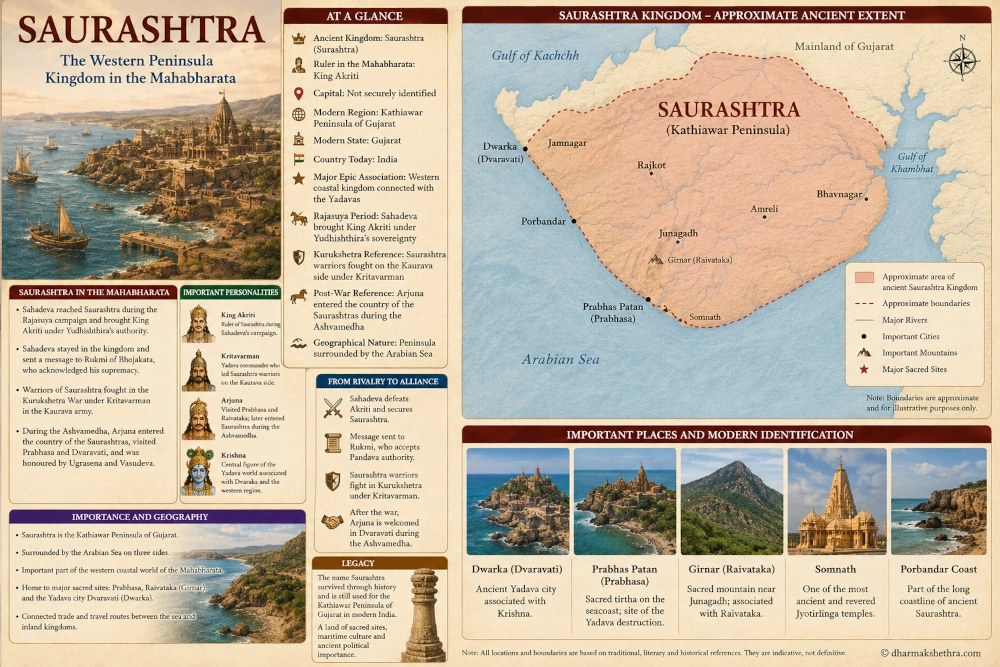
The map should emphasise the peninsula itself while separately marking Prabhasa, Dvaraka and Raivataka/Girnar as major Mahabharata locations in the wider Saurashtra landscape.
Where Should Saurashtra Be Shown on a Map?
A Mahabharata map of Saurashtra should shade the broad Kathiawar Peninsula rather than a single modern district. The highlighted area should extend across western peninsular Gujarat between the Gulf of Kachchh, Arabian Sea and Gulf of Khambhat.
Several reference points can help modern readers understand the region. Dwarka should be marked on the western coast, Porbandar farther south-east along the Arabian Sea, Junagadh and Girnar in the southern interior, Prabhas Patan/Somnath on the southern coast and Rajkot in the central part of the peninsula.
These cities do not represent the precise frontiers of Akriti’s Saurashtra kingdom. They simply allow readers to understand where the ancient region lay in relation to modern Gujarat.
How Should Dvaraka Be Labelled?
Dvaraka deserves special care because of its enormous importance in Krishna’s story.
The best label would be:
Dvaravati / Dvaraka — Major Yadava city associated with Krishna; located in the wider western Gujarat-Saurashtra landscape.
This distinction also preserves the separate importance of Anarta, another ancient western region strongly connected with Dvaraka in textual traditions.
How Should Raivataka Be Labelled?
Raivataka can be shown within the southern Saurashtra landscape near the modern Girnar region, but the identification should remain appropriately cautious.
A useful map label would be:
Raivataka — Sacred mountain associated with Krishna and the Yadavas; traditionally identified with the Girnar hills near Junagadh.
This allows the article to connect ancient narrative geography with a recognisable modern landmark without presenting a traditional identification as absolute archaeological certainty.
Important Personalities Associated with Saurashtra
King Akriti
Akriti is the ruler directly identified with Saurashtra during Sahadeva’s pre-Rajasuya campaign. Sahadeva brought him under Yudhishthira’s authority, establishing Saurashtra’s place within the network of kingdoms acknowledging the Pandava emperor. The Sabha Parva’s reference to Akriti is particularly important because it provides Saurashtra with a named ruler rather than presenting it only as a geographical region.
Krishna
Krishna is not explicitly described in the relevant passages as king of Saurashtra, yet no figure is more important to the wider Mahabharata geography of western Gujarat. Dvaraka, Prabhasa and Raivataka are all closely connected with Krishna and the Yadava world, placing much of his later political and family life within the broader Saurashtra landscape.
Kritavarman
Kritavarman provides Saurashtra with its clearest military connection to the Kurukshetra War. The Bhishma Parva places Saurashtra warriors in a major Kaurava formation commanded by him alongside Vrishni and Bhoja fighters. He later survives the war and returns to the Yadava world before dying during the catastrophe at Prabhasa.
Arjuna
Arjuna repeatedly enters the western landscape. During his earlier pilgrimage he reaches Prabhasa and travels with Krishna to Raivataka. Many years later, while protecting Yudhishthira’s Ashvamedha horse, he explicitly enters the country of the Saurashtras and continues through Prabhasa to Dvaravati.
Saurashtra’s Place in the Mahabharata
Saurashtra appears at three different stages of the Mahabharata’s political narrative, and each reference reveals something different about the kingdom.
Before the Kurukshetra War, Sahadeva reaches Saurashtra during the campaigns for Yudhishthira’s Rajasuya and brings King Akriti under Pandava imperial authority. This establishes the region as a recognised western kingdom within the political geography of Bharat.
During the war itself, warriors of Saurashtra appear in the Kaurava army under Kritavarman, showing that political loyalty in the region was more complicated than Sahadeva’s earlier Rajasuya submission might suggest.
After the war, Arjuna returns during the Ashvamedha campaign. His route through Saurashtra, Prabhasa and Dvaravati demonstrates that the western region remained politically important within Yudhishthira’s restored imperial order.
From King Akriti to Krishna’s Western World
Saurashtra is particularly interesting because its significance in the Mahabharata extends beyond its own ruler.
King Akriti establishes its independent political identity, but the wider region becomes inseparable from the extraordinary Yadava world surrounding Krishna. Dvaraka stands on its western maritime frontier, Raivataka forms part of Yadava social and religious life, and Prabhasa becomes one of the epic’s most consequential sacred locations.
This makes Saurashtra different from a kingdom such as Chedi, whose narrative is largely organised around its royal dynasty. The story of Saurashtra is geographical as much as dynastic.
Its coastline, sacred places, mountains and Yadava cities collectively make the peninsula one of the most important western landscapes of the Mahabharata.
From the Mahabharata to Modern Gujarat
Today, the ancient political kingdom ruled by Akriti has disappeared, but the geographical name Saurashtra remains very much alive.
Modern travellers crossing the Kathiawar Peninsula move through many of the landscapes traditionally connected with the epic. Dwarka remains one of India’s most sacred pilgrimage centres. Prabhas Patan and Somnath preserve the ancient name of Prabhasa, while the Girnar mountains rise above Junagadh in the region traditionally associated with Raivataka.
The modern cities, highways and district boundaries belong to a much later age, but the peninsula beneath them corresponds remarkably closely to the ancient geographical identity remembered as Saurashtra.
When the Mahabharata describes Sahadeva staying in the kingdom of Saurashtra, warriors from Saurashtra marching under Kritavarman or Arjuna entering the country of the Saurashtras, the broad landscape behind those passages can therefore be sought in the Kathiawar Peninsula of present-day Gujarat.
The Legacy of Saurashtra
Saurashtra deserves attention as much more than the region surrounding Krishna’s Dvaraka. The Mahabharata recognises it as a kingdom with its own ruler, as the homeland of warriors who participated in the Kurukshetra War and as a distinct country through which Arjuna travelled after the conflict.
Its geographical importance is equally striking. The peninsula contains or lies immediately around some of the epic’s most significant western locations. Prabhasa connects Saurashtra with Arjuna’s pilgrimage, Balarama’s sacred journey and the final destruction of the Yadavas. Raivataka connects it with Krishna, Subhadra and the social world of the Vrishnis. Dvaraka places the larger region at the centre of Krishna’s political power.
The name itself survived long after the epic age and remains attached to the same broad peninsula today. Historical boundaries undoubtedly shifted, and ancient Saurashtra should never be drawn as though it precisely matched modern districts. Yet the underlying geographical connection is unusually strong.
Seen on a modern map, Saurashtra belongs to the Kathiawar Peninsula of Gujarat, extending into the Arabian Sea in western India. Within the Mahabharata, however, it was far more than a distant coastal kingdom. It stood within the interconnected political world of the Pandavas and Yadavas, supplied warriors to Kurukshetra and contained the sacred western landscape in which some of the final and most powerful events of Krishna’s age unfolded.
You may also like
-
From Mahabharata to Santoor: PM Modi’s Gifts Showcase India’s Civilisational Ties with Central Asia
-
Anarta in the Mahabharata: The Yadava Country of Northern and Central Gujarat
-
India to Help Restore Ancient Buddhist Heritage Sites of Fayaz Tepa and Kara Tepa in Uzbekistan
-
Dandaka in the Mahabharata: The Vast Forest Realm of Central India
-
New Excavations Begin at Kashmir’s 2,000-Year-Old Zehanpora Buddhist Site
