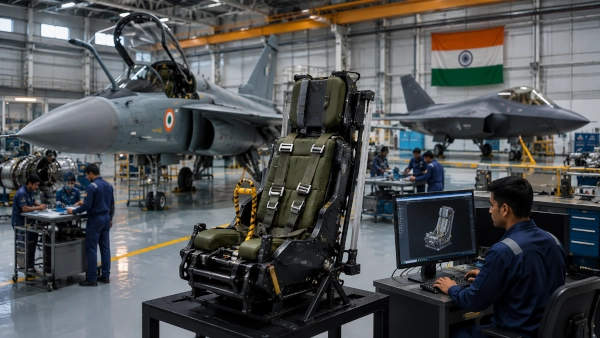
India is advancing the development of its first indigenous fighter-aircraft ejection seat, targeting one of the few critical aviation technologies that the country still sources from overseas. DRDO documents place ejection-seat indigenisation among the technologies being developed alongside future combat-aircraft programmes such as the Tejas Mk2 and Advanced Medium Combat Aircraft, while a successful high-speed escape-system test in December 2025 demonstrated that India now possesses sophisticated domestic infrastructure for validating such systems.
The programme represents an important but often overlooked part of India’s effort to increase indigenous content in future fighter aircraft.
Modern ejection seats are among the most safety-critical systems aboard a combat aircraft. They must detect or respond to an emergency, propel the pilot clear of the aircraft, stabilise the seat, deploy recovery systems and separate the aircrew safely across a wide range of altitudes and speeds.
India has historically depended on foreign suppliers for this capability. The current Tejas fleet, for example, uses the British Martin-Baker IN16G/Mk16 family of ejection seats. Martin-Baker itself confirms that Tejas aircraft are fitted with Mk16 seats and that India is one of the company’s largest military customers.
DRDO is now attempting to establish this technology domestically.
DRDO Confirms Indigenous Ejection-Seat Development
The indigenous programme is not merely a reported proposal.
DRDO’s own technology roadmap for 2021–2030 states that the organisation is working on India’s first indigenous aircraft ejection seat, alongside advanced parachute systems and technologies for future platforms such as the LCA Mk2, Twin Engine Deck Based Fighter and AMCA.
A separate official CEMILAC document provides an even clearer connection with India’s future fighter programmes.
The Centre for Military Airworthiness and Certification states that it is providing certification coverage for AMCA and LCA AF Mk-2, among other advanced aircraft, and specifically identifies the ejection seat as one of the critical technologies being indigenised by DRDO laboratories. The same document lists landing gear, flight-control actuators, control sticks, radomes and stealth materials among other technologies undergoing domestic development.
This establishes that ejection-seat indigenisation forms part of the wider technology-development and certification ecosystem being prepared for India’s next generation of combat aircraft.
High-Speed Rocket-Sled Test Marks Major Milestone
India demonstrated an important element of this capability on December 2, 2025, when DRDO successfully conducted a high-speed rocket-sled test of a fighter-aircraft escape system at the Terminal Ballistics Research Laboratory in Chandigarh.
The test was carried out jointly by DRDO, the Aeronautical Development Agency and Hindustan Aeronautics Limited.
During the trial, a fighter-aircraft forebody was accelerated along a rocket-sled track under controlled conditions. The test validated three crucial stages of an emergency escape:
- canopy severance;
- ejection sequencing;
- complete aircrew recovery.
The Ministry of Defence described dynamic rocket-sled testing as considerably more complex than stationary tests because it evaluates the escape system under conditions closer to those experienced by a moving fighter aircraft.
The successful test also placed India among a relatively small group of countries possessing advanced in-house dynamic escape-system testing capability.
More Than Simply Building a Seat
Developing an ejection seat is considerably more complicated than manufacturing its metal structure.
A modern fighter escape system must combine propulsion, sequencing, pilot restraint, parachute deployment, emergency oxygen and survival equipment into a package that can operate within fractions of a second.
The system must also function under radically different circumstances.
A pilot may need to eject from an aircraft standing or moving slowly on the runway — the so-called zero-zero requirement — or from a fighter travelling at high speed and altitude.
The forces imposed on the human body during ejection must remain survivable, while the seat must clear the cockpit and aircraft structure reliably.
The canopy system must work in precise coordination with the seat. Depending on the aircraft design, the canopy may be jettisoned or physically severed immediately before the pilot leaves the cockpit.
Failures in timing measured in fractions of a second can have fatal consequences.
That explains why certification and dynamic testing are such major parts of the programme.
Tejas Mk2 and AMCA Raise the Stakes
The requirement becomes particularly important as India progresses with Tejas Mk2 and AMCA.
Tejas Mk2 is intended to become a larger and substantially more capable medium-weight fighter than the current Tejas Mk1/Mk1A.
AMCA will take India into an even more demanding category as the country’s first indigenous fifth-generation stealth fighter.
Both programmes aim to increase domestic control over critical aircraft systems.
An Indian-designed and certified ejection system would therefore reduce another important foreign dependency within the cockpit.
For AMCA, the challenge becomes even greater because the escape system must be integrated into a stealth aircraft whose cockpit geometry, canopy, pilot visibility and external shaping all affect the overall design.
The seat must also interface correctly with the aircraft’s life-support equipment, helmet-mounted systems and emergency oxygen arrangements.
India Is Already Localising Pilot Life-Support Technologies
The ejection-seat programme is part of a broader effort to indigenise fighter-aircraft life-support equipment.
In March 2025, DRDO successfully conducted high-altitude trials of an indigenous Integrated Life Support System for the Tejas.
The system includes an On-Board Oxygen Generating System along with ten line-replaceable units such as a breathing regulator, emergency oxygen system, oxygen sensor and anti-G valve.
The Ministry of Defence said the system had achieved approximately 90% indigenous content and could potentially be adapted for other aircraft.
Together, an indigenous life-support system and ejection seat would give India considerably greater control over the complete pilot-survival chain aboard future fighters.
Reducing Dependence on Martin-Baker
British manufacturer Martin-Baker has supplied India with ejection seats for decades.
Its systems are used across several aircraft operated by the Indian Air Force and Navy, including Tejas, Hawk, Jaguar and Rafale variants. Martin-Baker stated in 2020 that India already operated more than 1,000 of its ejection seats across the two services.
The company’s products have also demonstrated their effectiveness in Indian service. Martin-Baker confirmed that the pilot of an IAF Tejas involved in a crash near Jaisalmer successfully escaped using an IN16G seat.
India’s indigenous programme therefore is not about replacing an ineffective system. It is about acquiring sovereign capability in a highly specialised technology presently controlled by a foreign manufacturer.
That distinction matters for long-term defence self-reliance.
Strategic Benefits Extend Beyond Import Substitution
Domestic production would offer India several advantages.
The first is supply-chain security. Future fighter fleets could require hundreds of seats, replacement components and periodic overhaul support across several decades.
An indigenous system would reduce exposure to overseas supply disruptions and export controls.
The second benefit concerns aircraft development itself.
If Indian engineers control the design and interfaces of the seat, it becomes easier to adapt it for future cockpit configurations, pilot equipment and aircraft variants without depending on an overseas original-equipment manufacturer.
A third advantage could emerge in fighter exports.
Foreign-origin subsystems can require additional approvals before an Indian aircraft is sold to another country. Increasing indigenous content reduces those complications and gives India greater flexibility when offering combat aircraft overseas.
Certification Remains the Crucial Hurdle
The programme has made significant progress, but one distinction remains important.
The December 2025 rocket-sled test officially validated a fighter-aircraft escape system and the associated dynamic testing capability. The Ministry of Defence did not state that a final production-standard indigenous ejection seat for Tejas Mk2 or AMCA had already completed certification.
India therefore still has to complete the development, qualification and airworthiness process before an indigenous seat can enter frontline service.
CEMILAC will play a central role because every safety-critical component must demonstrate that it meets stringent military airworthiness requirements before it can be installed aboard an operational fighter.
The December test nevertheless represents an important foundation for that process.
Closing One of India’s Remaining Fighter Technology Gaps
India has gradually reduced foreign dependence across combat-aircraft technologies.
Indigenous radars, electronic warfare systems, flight-control computers, mission software, oxygen-generation equipment, actuators and weapons are increasingly entering Indian fighter programmes.
The ejection seat represents another difficult technology on that list.
DRDO has officially identified the capability for indigenous development. CEMILAC is already preparing certification support for critical technologies associated with LCA Mk2 and AMCA, and India has demonstrated the ability to perform sophisticated high-speed escape-system tests domestically.
The next major milestone will be the successful qualification and certification of the indigenous seat itself.
When that objective is achieved, future Indian fighters could move one step closer to a fully domestic pilot-survival system — reducing dependence on imported equipment while creating an advanced aerospace capability that only a limited number of countries currently possess.
For Tejas Mk2 and AMCA, the significance extends well beyond one cockpit component. An indigenous ejection seat would represent another critical technology moving from foreign dependency into India’s own aerospace-industrial base.
You may also like
-
ICAR Scientists Develop Indigenous Protective Gloves for Cotton Farmers, Sign Commercial Manufacturing Agreement
-
India Moves Towards Five-Year Assured Orders for Defence Startups Under New Procurement Reforms
-
BHEL–Coal India Joint Venture Begins Construction of ₹25,016 Crore Indigenous Coal Gasification Project in Odisha
-
Zen Technologies Introduces Indigenous Hyper-Strike Falcon AI-Guided Counter-Drone Interceptor
-
L&T and Germany’s SCHOTTEL Expand Partnership for Controllable Pitch Propeller Systems in Indian Shipbuilding
