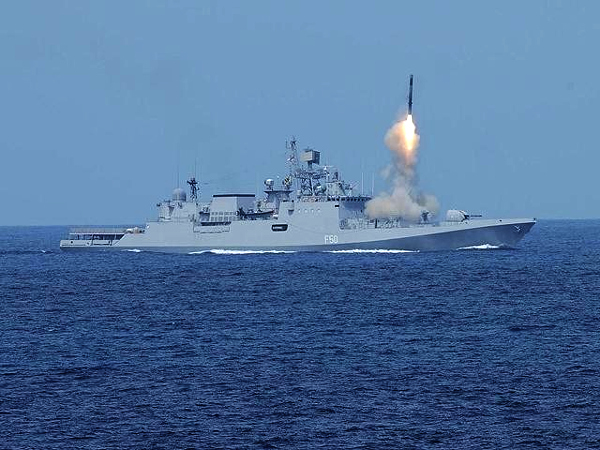
BrahMos has evolved into the Indian Navy’s principal long-range maritime strike weapon, providing surface ships with the ability to attack both enemy vessels and land targets at extended ranges.
The Ministry of Defence formally described the shipborne BrahMos system in 2024 as the Navy’s “primary weapon for maritime strike operations” aboard various frontline warships. It signed a ₹19,518.65-crore contract with BrahMos Aerospace for additional missiles and another ₹988.07-crore contract for shipborne BrahMos systems. The missiles are intended to meet the Navy’s combat and training requirements.
The scale of these procurements makes clear that BrahMos will remain central to Indian surface warfare for years to come.
BrahMos Already Spread Across Frontline Fleet
BrahMos integration across the Navy began well before the latest modernisation push.
As early as 2017, the Ministry of Defence stated that the majority of the Navy’s frontline ships, including vessels of the Kolkata, Ranvir and Teg classes, were capable of launching BrahMos.
Since then, the missile has become standard equipment aboard India’s newer generations of destroyers and frigates.
The Project 15A Kolkata-class destroyers carry BrahMos surface-to-surface missiles, while the newer Project 15B Visakhapatnam class continues the same heavy maritime-strike capability.
The Navy’s latest Project 17A Nilgiri-class stealth frigates are also configured with BrahMos. Official Navy information on ships such as INS Taragiri and INS Dunagiri identifies the missile as a core part of their weapon suite.
The recently commissioned INS Mahendragiri can likewise be equipped with BrahMos, according to Defence Minister Rajnath Singh at its July 2026 commissioning.
Older Shivalik Frigates Being Brought Into the Network
The Navy is not relying solely on new construction.
In January 2023, the Defence Acquisition Council formally approved procurement of BrahMos launchers and fire-control systems for the Shivalik-class frigates.
The same approval also covers BrahMos systems for the Navy’s planned Next Generation Missile Vessels. The Ministry of Defence said the systems would strengthen the ships’ ability to conduct maritime strikes and engage hostile warships.
This upgrade is particularly significant because it shows the Navy is pursuing BrahMos integration across existing combatants as well as newly built ships.
Talwar and Tushil-Class Frigates Carry BrahMos
The Russian-origin Talwar-family frigates represent another major component of the BrahMos-equipped fleet.
The government specifically approved indigenous BrahMos missiles as the primary weapon for the additional Project 1135.6 frigates ordered from Russia and India.
INS Tushil and INS Tamal have since joined the Navy. INS Tamal’s official commissioning information confirms that the ship carries BrahMos for anti-ship and land-attack missions.
Two more related frigates are being built at Goa Shipyard under the Triput programme, further increasing the number of BrahMos-capable combatants.
A Common Strike Weapon Across Multiple Classes
Standardising BrahMos across numerous warship classes offers several operational advantages.
Ships operating together in a naval task group can employ a common long-range strike weapon, simplifying ammunition management, training and logistical support.
It also gives commanders the ability to distribute offensive firepower across a larger number of platforms rather than concentrating it aboard a few specialised ships.
BrahMos provides both anti-ship and land-attack capability, allowing a destroyer or frigate to threaten hostile naval forces while also engaging high-value targets ashore from stand-off distances.
Its supersonic speed further reduces the time available for an adversary to detect and respond to an incoming attack.
BrahMos Becoming a Defining Weapon of India’s Surface Fleet
The Navy’s modernisation programme is increasingly creating a family of surface combatants with common indigenous weapons, sensors and combat-management systems.
Project 15B destroyers, Project 17A frigates, the Tushil/Triput family and future missile vessels are all being built or configured around powerful long-range surface-strike capability.
At the same time, older frontline ships are receiving launcher and fire-control upgrades.
Taken together, these developments support the conclusion that BrahMos is becoming the standard offensive missile across the core of India’s surface combat fleet.
By the end of the decade, the Indian Navy is likely to field a significantly larger number of BrahMos-capable destroyers, frigates and missile vessels, giving it a distributed supersonic strike capability across the Indian Ocean and beyond.
Official Sources
Ministry of Defence, March 1, 2024: ₹19,518.65-crore BrahMos missile contract and ₹988.07-crore shipborne BrahMos system contract for the Indian Navy.
Ministry of Defence, January 10, 2023: Approval for BrahMos launchers and fire-control systems for Shivalik-class frigates and Next Generation Missile Vessels.
Ministry of Defence, June 19, 2026: Confirmation that Project 17A frigate INS Dunagiri carries BrahMos surface-to-surface missiles.
Ministry of Defence, April 21, 2017: Official statement confirming BrahMos capability aboard the majority of the Navy’s frontline ships at the time.
Ministry of Defence, 2018–19: Approval and construction information confirming BrahMos as the primary strike weapon aboard Project 1135.6 follow-on frigates.
You may also like
-
ICAR Scientists Develop Indigenous Protective Gloves for Cotton Farmers, Sign Commercial Manufacturing Agreement
-
India Moves Towards Five-Year Assured Orders for Defence Startups Under New Procurement Reforms
-
BHEL–Coal India Joint Venture Begins Construction of ₹25,016 Crore Indigenous Coal Gasification Project in Odisha
-
Zen Technologies Introduces Indigenous Hyper-Strike Falcon AI-Guided Counter-Drone Interceptor
-
L&T and Germany’s SCHOTTEL Expand Partnership for Controllable Pitch Propeller Systems in Indian Shipbuilding
