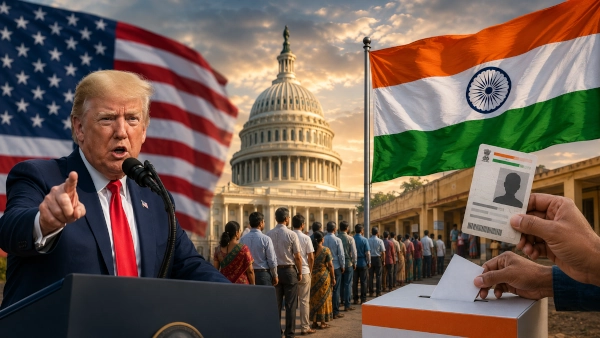
US President Donald Trump has cited India’s electoral system while renewing his campaign for tougher voter-identification and citizenship-verification requirements in the United States, bringing the functioning of the world’s largest democracy into an increasingly contentious American debate over election rules.
Trump used India as an example while again pressing the US Congress to approve the Safeguard American Voter Eligibility Act, commonly called the SAVE America Act.
Trump Invokes India’s Massive Election
According to the account of Trump’s comments, the US President referred to India’s most recent Lok Sabha election and highlighted both the enormous number of votes cast and the requirement for voters appearing at polling stations to establish their identity.
The scale cited by Trump is broadly supported by official Election Commission of India data.
The ECI’s official Atlas of the 2024 Lok Sabha Election records 97.98 crore electors and 64.64 crore votes cast, including 64.21 crore votes through Electronic Voting Machines and 42.82 lakh postal votes. Overall voter turnout stood at 66.10 percent.
In other words, approximately 646 million votes were cast in India’s 2024 parliamentary election, making Trump’s reference to roughly 646 million voters consistent with the Election Commission’s official figures.
Trump also referred to India’s comparatively limited use of postal voting. ECI statistics show that only 42.82 lakh of the 64.64 crore votes recorded in the 2024 election were postal ballots, a small fraction of the overall vote.
What India Actually Requires at the Polling Station
There is an important distinction in describing India’s voter-identification rules.
Indian electors who have been issued an Electors Photo Identity Card, or EPIC, are expected to produce it for identification at the polling station. However, an elector who cannot produce an EPIC is not automatically prevented from voting solely for that reason.
For the 2024 Lok Sabha election, the Election Commission authorised 12 alternative photographic identity documents, including Aadhaar, a driving licence, passport, PAN card, pension document, MNREGA job card and other recognised government-issued photo documents. The elector’s name must also appear on the relevant electoral roll.
The ECI explained that these identification rules are intended to prevent impersonation and establish the identity of the person appearing to vote. The Commission also noted that EPICs had been issued to approximately 100 percent of India’s electors.
Therefore, it is more precise to say that India requires voters appearing at polling stations to establish their identity using an approved photographic document, rather than saying that every Indian voter must necessarily possess and present only a voter ID card.
White House Has Already Been Using India as an Example
Trump’s latest reference to India is not an isolated comparison.
The White House has established a dedicated page promoting the SAVE America Act. As part of its case for stronger election-verification requirements, the administration specifically refers to India and Brazil when comparing American electoral procedures with those of other major democracies.
The White House argues that the United States should require stronger identification and citizenship verification and says Trump wants Congress to pass legislation establishing national standards. It has presented voter ID, proof of citizenship and restrictions on mail voting as key elements of its election-integrity agenda.
The comparison with India has therefore become part of the administration’s wider political argument that a large democracy can operate extensive identification requirements without preventing mass electoral participation.
What Is the SAVE America Act?
The current SAVE America Act, H.R. 7296, was introduced in the US House of Representatives on January 30, 2026. The official bill text describes it as legislation amending the National Voter Registration Act to require documentary proof of US citizenship for registration in federal elections.
Its provisions go further than citizenship verification alone.
The legislation states that an individual voting in a federal election would have to present an eligible photo-identification document. For in-person voting, the voter would present the physical document when voting. The bill also contains identification requirements applying to absentee ballots.
The legislation lays out several methods of proving US citizenship, including passports, certain government identification documents, birth records, naturalisation certificates and other recognised citizenship documents.
Republican supporters argue that these measures would strengthen confidence in elections and ensure that only eligible US citizens register and vote in federal contests. Republican Senator Chuck Grassley has described proof of citizenship at registration and government-issued photo identification at voting as the two central elements of the legislation.
Bill Has Struggled to Clear the Senate
The legislation has faced a much more difficult path in the US Senate.
House Republicans have repeatedly attempted to advance SAVE America provisions through different legislative vehicles. According to an official July 23 statement from Congressman Clay Higgins, versions or provisions of the measure had been sent to the Senate through several routes, including standalone legislation and amendments attached to other bills.
The Senate’s official Daily Press record shows that on February 11, 2026, Republican Senator Rick Scott sought unanimous consent for the Senate to pass H.R. 7296 once received from the House, but Democratic Senator Ed Markey objected.
Trump has continued pressing Senate Republicans to secure passage as the United States moves closer to the November 3, 2026 midterm elections.
Democrats Warn of Barriers for Eligible Voters
The proposal remains politically divisive.
Democratic senators and voting-rights advocates argue that requiring documentary proof of citizenship could create additional obstacles for eligible American citizens who do not possess passports or readily accessible birth or naturalisation records.
Democratic Senators Mark Warner and Tim Kaine said in an official March statement that they support reasonable measures to strengthen confidence in elections but believe the SAVE America Act would impose unnecessarily burdensome requirements on eligible voters. They have also objected to its provisions concerning voter-roll reviews and penalties for election officials.
Supporters reject that criticism and argue that the legislation provides several forms of acceptable documentation and mechanisms for people who lack the standard documents to establish citizenship. Senator Grassley has said states would retain procedures for applicants who cannot immediately present one of the principal forms of documentary proof.
The dispute therefore reflects a wider American political divide between election-security measures and concerns about voter access.
India’s System Is Not Identical to the US Proposal
Although Trump is using India to support his argument, the two systems should not be treated as identical.
India’s polling-station identification rules primarily establish that the person appearing at the booth is the elector whose name appears on the electoral roll. The Election Commission accepts several types of photographic identification for this purpose.
The SAVE America Act would introduce a separate federal requirement for documentary proof of US citizenship when registering to vote, in addition to photographic identification when voting.
Thus, India’s voter-ID arrangements provide a useful international comparison for identity verification, but they are not a direct legal equivalent of every provision contained in the American proposal.
US Ambassador to India Backs Trump’s Comparison
The India comparison was subsequently reinforced by US Ambassador to India Sergio Gor.
Responding publicly to Trump’s comments, Gor noted that roughly 646 million votes were cast in India’s last general election and supported the President’s call for Congress to pass the SAVE America Act. His statement aligns closely with the official ECI figure of 64.64 crore votes cast in the 2024 Lok Sabha election.
The ambassador’s intervention elevated the reference and brought the Indian electoral comparison directly into official US diplomatic messaging in India.
India’s Election Management Draws Attention in US Political Debate
India regularly conducts elections on a scale unmatched anywhere else in the world.
The 2024 Lok Sabha election covered 543 parliamentary constituencies and more than 10.52 lakh polling stations, serving an electorate approaching 98 crore people. Despite that scale, ECI data show that more than 64 crore votes were successfully recorded.
Trump is now using that logistical achievement to make a domestic political argument in the United States: that requiring voters to establish their identity is compatible with very high levels of democratic participation.
Whether Congress ultimately adopts Trump’s preferred national rules remains uncertain. The SAVE America Act has encountered significant resistance in the Senate and remains caught in the broader partisan dispute over how the United States should balance election security, federal standards and voter access.
India’s election system has unexpectedly become part of the American debate. The world’s largest electoral exercise is now being cited by a US President as evidence in his campaign to reshape federal voting rules ahead of the 2026 midterm elections.
Sources
Election Commission of India — Atlas of Lok Sabha Elections 2024: Confirms 97.98 crore electors, 64.64 crore votes cast, 42.82 lakh postal votes and 10.52 lakh polling stations.
Election Commission of India — Identification Order for the 2024 General Election: Details the EPIC requirement and the 12 alternative photographic documents accepted for voter identification.
The White House — SAVE America Act: Sets out the Trump administration’s case for the legislation and specifically uses India as an international comparison.
US Government Publishing Office — H.R. 7296: Official legislative text of the 2026 SAVE America Act, including documentary citizenship and photo-ID provisions.
US Senate — February 11, 2026 proceedings: Records the attempt to secure unanimous consent for the legislation and the objection that prevented it.
Akashvani News, Government of India — August 18, 2026: Confirms Trump’s comments citing India’s electoral identification system and his renewed call for passage of the legislation.
You may also like
-
Defence Accounts Department Launches SAKSHAM Integration, PRISM and Revamped National Compilation System
-
India Simplifies Foreign Guest Reporting for Hotels Under New Immigration Framework
-
India Signs UN Convention Against Cybercrime as Global Digital Security Cooperation Expands
-
Australian PM Albanese Credits Modi as India’s Energy Access Expands on Historic Scale
-
Ashwini Vaishnaw Warns India’s Semiconductor Industry to Prepare for Cyberattacks and Disruption
