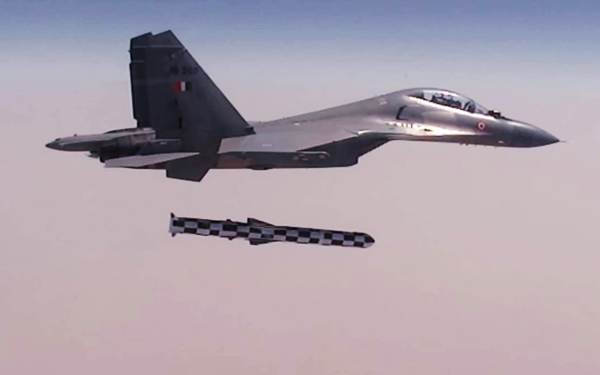
India is preparing one of the most ambitious combat-aircraft modernisation programmes in its history. The Indian Air Force’s Su-30MKI, already its principal heavy fighter, is being prepared for a major transformation under what is widely known as the “Super Sukhoi” programme.
The objective goes far beyond extending the life of an ageing aircraft. India plans to replace several legacy systems with modern Indian radar, electronic warfare, navigation, avionics and weapons. Hindustan Aeronautics Limited will serve as the principal Indian integrator, while DRDO and domestic industry will provide many of the technologies. The Defence Acquisition Council formally granted Acceptance of Necessity for indigenous upgrading of Su-30MKI aircraft through HAL on November 30, 2023.
The programme could eventually create an aircraft very different from the Su-30MKI that entered Indian service more than two decades ago. Its enormous airframe, payload capacity, endurance and electrical space provide India with something smaller fighters cannot easily offer: room for powerful sensors, large weapons and continuing technological evolution.
The Su-30MKI remains the backbone of Indian air power
The Su-30MKI is a twin-engine, two-seat heavy multirole fighter designed around long range, large payload and exceptional manoeuvrability. India has also developed a substantial domestic ecosystem around the aircraft through decades of licensed production, overhaul, component manufacturing and weapon integration.
That ecosystem is still expanding. In December 2024, the Ministry of Defence signed a contract worth approximately ₹13,500 crore for another 12 Su-30MKIs and associated equipment. These aircraft are being manufactured by HAL at Nashik and will contain 62.6% indigenous content, according to the Ministry of Defence.
The government has separately committed to the aircraft’s long-term propulsion support. In September 2024, the Ministry of Defence signed a contract with HAL worth more than ₹26,000 crore for 240 AL-31FP engines. HAL’s Koraput division will manufacture them, with an average indigenous content of more than 54%. HAL is scheduled to supply 30 engines annually over eight years.
These decisions indicate that India does not view the Su-30MKI as an aircraft approaching retirement. The fighter is being sustained for decades of further service while the IAF simultaneously introduces Tejas variants and prepares for future aircraft such as AMCA.
Super Sukhoi is increasingly an Indian upgrade
Earlier concepts for modernising the Su-30MKI relied heavily on Russian technologies. The programme now taking shape is much more strongly centred on Indian systems.
The 2023 DAC announcement specifically stated that the Su-30MKI upgrade would be carried out indigenously through HAL. The government also said domestic acquisition would reduce dependence on foreign original equipment manufacturers.
This shift is particularly important because modern combat aircraft are defined increasingly by sensors, electronic warfare, software, datalinks and weapons rather than the basic aerodynamic platform alone.
A Su-30MKI equipped with modern Indian electronics can therefore evolve independently of the original Russian avionics architecture in several critical areas. India would also gain much greater freedom to integrate future domestic weapons without waiting for extensive foreign modifications.
Virupaksha AESA: the new eyes of the Super Sukhoi
The centrepiece of the upgrade is the Virupaksha Active Electronically Scanned Array radar, under development by DRDO for the Su-30MKI.
At Aero India 2025, DRDO officials confirmed that Virupaksha had been designed specifically for the Su-30MKI upgrade programme. The radar has a 950-mm antenna containing approximately 2,400 transmit-receive modules. It uses Gallium Nitride, or GaN, technology.
GaN allows high power output and efficient signal reception while managing the considerable thermal demands created by a powerful fighter radar. The physical size of the Su-30MKI’s nose gives Indian engineers considerably more antenna area than would be available on a light fighter.
Virupaksha is also being designed as a true multimode sensor. DRDO told Janes that it can support air-to-air, close-combat, air-to-ground, air-to-sea and navigation modes. It is designed to measure a target’s range, azimuth, elevation and relative velocity.
Importantly, DRDO has not publicly disclosed the radar’s operational detection range. Claims assigning precise 300-km or 400-km fighter-detection ranges to Virupaksha should therefore be treated cautiously until official performance figures emerge. DRDO has, however, confirmed that the radar includes advanced electronic counter-countermeasures for operation in heavily contested electromagnetic environments.
The first phase of the Super Sukhoi effort has widely been reported as covering 84 aircraft, with Virupaksha replacing the existing Russian-origin N011 Bars radar.
That change alone could fundamentally alter how the Su-30MKI fights beyond visual range.
A major electronic-warfare transformation
Radar is only one part of survivability in modern air combat. The ability to detect hostile emitters, recognise missile threats and disrupt enemy radars is becoming equally important.
In December 2024, the Defence Acquisition Council approved an Electronic Warfare Suite for the Su-30MKI. The government said the package would include External Airborne Self-Protection Jammer pods, a Next Generation Radar Warning Receiver and associated equipment.
The Ministry of Defence explicitly stated that the system is intended to protect Su-30MKIs from enemy radars and associated weapons while they conduct missions against targets defended by air-defence systems.
This capability is particularly significant for suppression and destruction of enemy air defences.
A powerful fighter carrying long-range weapons must still survive long enough to reach its launch position. Modern jammers, radar-warning receivers and missile-warning systems provide the aircraft with a better understanding of the electromagnetic battlefield and more options for defeating or avoiding hostile engagement.
Navigation designed for a jamming environment
Another upgrade has emerged across the wider Su-30MKI fleet.
In May 2026, the Defence Ministry reportedly issued a Request for Proposal for advanced anti-jamming and anti-spoofing multi-constellation satellite-navigation antennas for the Su-30MKI fleet. The requirement covered 300 antenna systems and support equipment.
The proposed system is intended to operate with several navigation constellations, including India’s NavIC, along with GPS, GLONASS, Galileo, BeiDou and GAGAN.
This may sound less dramatic than a new radar or missile, but it addresses one of modern warfare’s fastest-growing threats.
Satellite-navigation jamming can deny positioning information. Spoofing can be even more dangerous because it attempts to feed false positional data to a platform. A combat aircraft able to cross-check several constellations while resisting interference is better suited to operations inside a dense electronic-warfare environment.
The weapons are becoming increasingly Indian
The Super Sukhoi is also emerging as a major carrier of India’s indigenous and jointly developed stand-off weapons.
The most visible example is BrahMos.
The air-launched BrahMos is already deployed on the Su-30MKI and gives the fighter the ability to attack important land and maritime targets from stand-off distances. BrahMos Aerospace describes the air-launched version as an operational weapon deployed on the IAF’s frontline Su-30MKI strike fighter.
Integrating such a heavy missile required major mechanical, electrical and software modifications to the aircraft. The first successful air launch from a Su-30MKI took place in November 2017.
The Su-30MKI has also become a principal test and launch platform for DRDO’s anti-radiation missile family.
India successfully tested the Rudram anti-radiation missile from a Su-30MKI in October 2020. DRDO designed the weapon to detect and attack hostile radar and other radio-frequency emitters from stand-off ranges, giving the IAF an indigenous capability for Suppression of Enemy Air Defence missions.
A further RudraM-II air-to-surface missile was successfully flight-tested from an IAF Su-30MKI in May 2024. The Defence Ministry described it as an indigenously developed solid-propelled weapon designed to neutralise several categories of enemy assets.
Combining such weapons with a modern AESA radar and improved electronic warfare could turn the upgraded Su-30MKI into one of India’s most important platforms for penetrating or dismantling sophisticated enemy air-defence networks.
From fighter to long-range weapons truck
The Su-30MKI has another advantage that cannot easily be recreated on smaller fighters: size.
Its heavy airframe can carry substantial fuel and weapons. That allows the aircraft to perform air-superiority missions on one day and long-range strike, maritime attack or electronic-warfare support on another.
The arrival of more Indian missiles could make this characteristic even more valuable.
The aircraft could operate as a forward sensor platform, long-range missile carrier and escort aircraft within the same force package. Smaller fighters could operate alongside it, while airborne early-warning aircraft and ground networks provide additional targeting information.
Virupaksha and a modern mission-computer architecture would become particularly important in this environment because the fighter must process and share far more information than earlier generations of Su-30MKI avionics were designed to handle.
The engine question
One part of the programme remains especially interesting: propulsion.
The main Indian Super Sukhoi plan is centred on sensors, avionics, electronic warfare and weapons rather than replacing the AL-31FP engine. Meanwhile, Russia has reportedly offered India the more powerful AL-41 as part of discussions over a possible separate upgrade path for other Su-30MKIs.
That reported proposal should not be confused with an approved Indian acquisition.
India has already committed more than ₹26,000 crore to manufacturing 240 additional AL-31FP engines through HAL. That programme is specifically intended to sustain the operational capability of the existing Su-30 fleet.
An AL-41 re-engining programme would therefore represent a separate and much more complex decision involving integration, certification, logistics and cost.
As of August 2026, it should be treated as an option under discussion rather than as a confirmed element of the Indian Super Sukhoi configuration.
Russia may still have a role
Greater indigenisation does not mean Russian participation will disappear completely.
The Su-30MKI remains an aircraft of Russian design. India and Russia also continue defence-industrial cooperation around the platform. A Government of India review of defence ties in 2026 noted continued support for the upgrade of the Su-30MKI.
Reports in February 2026 also indicated that the IAF was examining a possible parallel Russian-assisted modernisation route because the indigenous programme could require several years for development, certification and fleet implementation.
Such a parallel route has not yet reached the same official acquisition stage as the HAL-led programme. According to that report, a separate proposal would still require Acceptance of Necessity before progressing through procurement procedures.
India could therefore ultimately adopt a mixed approach: indigenous modernisation for a substantial portion of the fleet, while selectively using Russian assistance where it offers operational or schedule advantages.
Operation Sindoor strengthened the case for long-range air power
The relevance of platforms capable of delivering stand-off weapons became even clearer after Operation Sindoor in May 2025.
The Ministry of Defence subsequently confirmed that the Indian Air Force struck Pakistani airbases, command-and-control centres, air-defence systems and other military infrastructure during the operation. The government has also officially stated that BrahMos missiles were among the Indian systems employed during Operation Sindoor.
The exact aircraft-to-target combinations used in individual strikes have not all been officially disclosed. It is therefore preferable not to attribute every reported BrahMos strike specifically to the Su-30MKI without official confirmation.
Nevertheless, the operational lesson is straightforward. Modern air forces increasingly seek to detect targets at long range, penetrate contested electromagnetic environments and release precision weapons without unnecessarily exposing aircraft to dense enemy air defences.
Those are precisely the areas in which the Super Sukhoi programme is intended to strengthen the Su-30MKI.
A bridge to India’s future combat fleet
India will eventually field more advanced indigenous fighters. Tejas Mk1A will strengthen the light-fighter force. Tejas Mk2 is intended to occupy a heavier class, while AMCA will introduce indigenous stealth technology.
But those aircraft will arrive progressively.
The Su-30MKI already exists in large numbers, already has trained pilots and maintenance infrastructure, and already supports some of India’s most powerful air-launched weapons. Replacing that entire capability quickly would be extremely expensive and operationally disruptive.
Modernising the aircraft therefore gives India a way to retain mass while the next generation of fighters enters service.
The Super Sukhoi does not need to become a stealth fighter to remain relevant. Its role can instead evolve towards powerful sensors, electronic warfare, long-range missiles and networked operations.
From Russian-origin fighter to Indian combat system
The most important aspect of the Super Sukhoi programme may ultimately be technological rather than aerodynamic.
The airframe will remain recognisably Sukhoi. The AL-31FP engines will continue powering the principal Indian configuration. Its thrust-vectoring and large twin-tail design will remain.
But the systems that allow the aircraft to see, understand, communicate and attack are becoming increasingly Indian.
Virupaksha provides the new radar architecture. Indian electronic warfare systems will improve survivability. New navigation equipment will strengthen resistance to jamming and spoofing. BrahMos and the Rudram family provide powerful stand-off strike options. HAL, DRDO and Indian industry will increasingly control integration and future development.
That is what makes the Super Sukhoi programme strategically significant.
India is not merely extending the life of an imported fighter. It is gradually turning a Russian-origin airframe into an Indian-controlled weapons and sensor platform capable of evolving alongside the country’s own defence-industrial ecosystem.
If the programme proceeds successfully through approval, flight testing and fleet implementation, the Su-30MKI could remain one of the IAF’s most formidable combat aircraft well into the era of indigenous fifth-generation fighters.
sources
Ministry of Defence / Press Information Bureau: DAC Acceptance of Necessity for indigenous Su-30MKI upgrade, November 30, 2023.
Ministry of Defence / PIB: Contract for 12 additional Su-30MKI aircraft, December 12, 2024.
Ministry of Defence / PIB: Contract for 240 AL-31FP engines, September 9, 2024.
Ministry of Defence / PIB: Electronic Warfare Suite for Su-30MKI approved by DAC, December 3, 2024.
DRDO officials at Aero India 2025 / Janes: Virupaksha AESA configuration and Su-30MKI application.
DRDO / Ministry of Defence: Rudram and RudraM-II Su-30MKI flight tests.
BrahMos Aerospace: Air-launched BrahMos integration with Su-30MKI.
Current programme-status reporting: The New Indian Express, February 25, 2026; Times of India, May 27, 2026.
You may also like
-
Astra Microwave Expands Counter-Drone Capabilities with Layered Detection and Neutralisation Systems
-
MDL Begins Development of Indigenous Lithium-Ion Battery System for Project-75(I) Submarines
-
Tarang Shakti Delegates from 28 Countries Visit HAL and BEL to Explore India’s Defence Manufacturing Ecosystem
-
India’s 114 Rafale Fighter Jet Programme Moves Towards Final Decision with Focus on Indigenous Integration
-
Embraer and Mahindra Identify Nagpur as Potential C-390 Millennium Assembly Hub in India
