Long before King Nala and Princess Damayanti stood before one another, their names had already crossed forests, rivers and royal courts.
Nala had heard of the extraordinary beauty and virtues of Damayanti, daughter of King Bhima of Vidarbha. Damayanti, in turn, had heard travellers and visitors speak of Nala, the noble ruler of Nishadha. Neither had seen the other, yet admiration had quietly begun to grow in both hearts.
Then, on an ordinary day in a royal garden, something extraordinary happened.
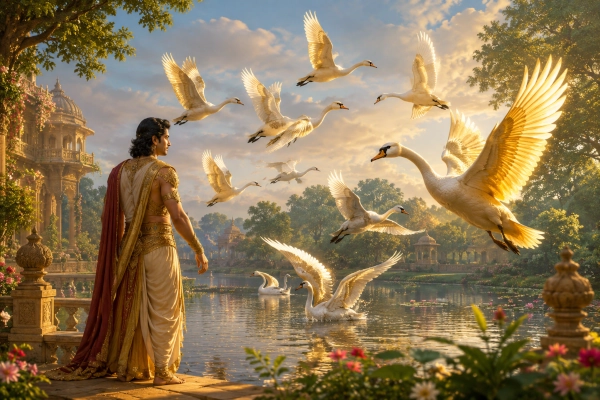
A flock of magnificent swans descended before Nala. Their wings gleamed with a golden radiance. Among them was one remarkable bird that would soon become the messenger through whom two distant hearts found one another. The episode appears in the Nalopakhyana, the celebrated story of Nala and Damayanti narrated in the Vana Parva of the Mahabharata.
The Story of Nala and Damayanti Begins
King Nala ruled the kingdom of Nishadha.
He was the son of Virasena and was renowned for his righteousness, courage, generosity and skill with horses. The Mahabharata presents him as a handsome and accomplished king, respected by his subjects and admired by other rulers.
Far away in Vidarbha, King Bhima had a daughter named Damayanti.
Her beauty became famous throughout the kingdoms of Bharata. Yet the descriptions of Damayanti in the Mahabharata go beyond physical beauty. She was presented as noble, graceful and worthy of the finest among kings.
As travellers moved between kingdoms, stories travelled with them.
Nala heard people speak of Damayanti.
Damayanti heard people speak of Nala.
Neither had exchanged a word. Neither had even looked upon the other’s face. Yet each began to imagine the person behind the stories.
Their love did not begin with a meeting.
It began with a name.
The Nalopakhyana describes this mutual attraction before the intervention of the swan. Sahapedia likewise notes that Nala and Damayanti had already become interested in each other through reports of one another before the golden-winged bird entered their story.
The Golden Wings in Nala’s Garden
One day, Nala was walking through a beautiful grove.
The air was calm beneath the trees. Flowers grew across the garden, and the waters nearby reflected the changing light.
Then movement flashed overhead.
A flock of swans descended into the grove.
These were no ordinary birds. The Mahabharata describes them as swans with golden wings. Their feathers shone as they moved through the garden, transforming the quiet grove into a scene of almost celestial beauty.
Nala watched them with fascination.
The birds wandered freely through the garden. Their golden wings caught the sunlight whenever they turned.
The king approached.
The flock stirred.
In a swift movement, Nala reached out and caught one of the swans in his hands.
For a moment, the king of Nishadha stood holding the extraordinary creature.
Then the bird spoke.
The Swan That Spoke Like a Man
Nala could hardly have expected what followed.
The swan addressed him in human speech.
Instead of struggling helplessly, the bird asked the king to spare its life. In return for its freedom, it offered Nala something far more valuable than any golden feather.
It promised to go to Damayanti.
The bird knew of the princess of Vidarbha. More remarkably, it seemed to know what lay hidden within Nala’s heart.
It offered to speak before Damayanti in such a way that her thoughts would turn toward the king of Nishadha.
The Mahabharata describes the swan making precisely this promise after Nala captured it. The king, pleased by its words, released the bird.
Nala opened his hands.
The golden-winged swan was free.
With powerful strokes of its wings, it rose into the sky and rejoined its companions.
The flock circled above the grove and then turned toward the distant kingdom of Vidarbha.
Nala watched until the golden wings disappeared into the brightness of the horizon.
He had released a bird.
He had unknowingly sent forth the messenger of his destiny.
Across the Skies to Vidarbha
The swans flew across the land.
Below them stretched forests, rivers, villages and kingdoms. The distance separating Nishadha from Vidarbha that had seemed so great to two young hearts meant little to creatures of the sky.
At last, the flock reached Vidarbha.
There lay the royal city of King Bhima, and within its palace grounds were gardens where Princess Damayanti spent time with her companions.
The swans descended.
Their golden wings immediately caught the attention of the young women.
Damayanti and her attendants had seen countless beautiful things within the royal palace, but these birds were extraordinary.
The golden swans moved across the garden while the princess and her companions watched in delight.
Soon the maidens decided to catch them.
The game began.
Damayanti Chases the Golden Swan
The garden suddenly came alive with laughter and movement.
The swans scattered in different directions.
Damayanti’s companions ran after them, each following a different bird. Silk garments moved among the flowering trees as the maidens hurried through the garden.
Damayanti herself followed one particular swan.
It was the very bird Nala had caught and released.
The swan remained just beyond her reach.
Whenever Damayanti drew closer, it moved a little farther away.
The princess followed.
Step by step, the bird led her away from her companions and deeper into a secluded part of the garden.
At last, when Damayanti was alone, the swan stopped fleeing.
The Mahabharata specifically describes the swans scattering so that the maidens pursued them individually. The bird followed by Damayanti then led her to a secluded place before addressing her in human speech.
The princess approached.
Then the golden swan turned toward her.
And it spoke.
“There Is a King Among the Nishadhas”
Damayanti must have been astonished.
Before her stood a bird shining with golden wings, yet from its beak came the language of human beings.
The swan had not come merely to display its beauty.
It had come with a message.
It began to speak of Nala.
There was, the bird told her, a king among the Nishadhas whose name was Nala.
The swan praised his appearance, nobility and virtues. It compared his beauty with that of the divine Ashvins and described him as a man without equal among mortals.
Then the bird turned its praise toward Damayanti.
She too was exceptional.
The message was simple in spirit: Nala was foremost among men, while Damayanti was a jewel among women. A union between such two people would be worthy and auspicious.
This comparison between Nala and Damayanti forms the heart of the swan’s message in the Mahabharata. The bird tells Damayanti that it has seen gods, Gandharvas, Nagas, Rakshasas and men, yet found none like Nala, while describing Damayanti herself as equally exceptional.
A Name Becomes a Living Presence
Damayanti had heard of Nala before.
But rumours and descriptions carried by travellers were different from this.
Now a mysterious golden-winged messenger had crossed the sky from Nishadha and stood before her speaking his name.
The distant king suddenly seemed close.
Nala was no longer merely a ruler whose virtues people praised in distant conversations.
Through the swan’s words, Damayanti could imagine his character, his nobility and his appearance.
The admiration already present within her heart deepened.
She listened as the bird spoke.
And when the swan had finished, Damayanti did not dismiss its message.
Instead, she gave the bird a message of her own.
Damayanti Sends Her Answer
Damayanti asked the swan to return to Nala.
Just as it had spoken of Nala before her, she wanted it to speak of her before him.
There was no elaborate declaration.
No royal embassy crossed the borders.
No minister carried sealed letters between palaces.
The first acknowledgment of their love travelled upon the wings of a bird.
The Mahabharata records Damayanti asking the swan to speak similarly to Nala. The bird accepted her request and returned to Nishadha, where it related everything that had happened.
The golden swan rose from the garden.
Damayanti watched it climb into the sky.
Soon it became only a distant shape against the clouds.
Then it vanished.
But something remained behind.
The princess who had entered the garden that day was not the same woman who returned to the palace.
Her heart now belonged to a man she had never seen.
The Swan Returns to Nala
Across the skies the messenger flew once more.
Forests rolled beneath its wings.
Rivers wound through the land like silver threads.
Eventually the familiar kingdom of Nishadha appeared.
The swan descended to Nala.
The king had waited without knowing what Damayanti would say.
Now the bird gave him his answer.
It told him about the garden in Vidarbha.
It told him how Damayanti had listened.
Most importantly, it told Nala that the princess had asked the bird to speak of her to him as well.
The message was enough.
The affection that had grown in silence was now shared.
The swan had accomplished what armies, ministers and royal envoys could not have done so delicately.
It had brought together two people before they had ever met.
Traditional retellings preserve the swan’s return to Nala after its conversation with Damayanti, while the Mahabharata text states that it returned to the country of the Nishadhas and related the entire encounter to him.
Damayanti Can No Longer Hide Her Love
The swan disappeared from Damayanti’s garden, but its words remained constantly in her mind.
Nala occupied her thoughts.
The Mahabharata describes Damayanti losing her peace after hearing the swan’s message. She sighed frequently, became distracted and showed little interest in ordinary comforts. Her companions began to realise that something had changed.
She would sit quietly, absorbed in thought.
The palace that had once provided every pleasure could not give her what she wanted.
Somewhere beyond Vidarbha lived Nala.
The distance between them now seemed unbearable.
Her companions eventually reported her condition.
Word reached her father, King Bhima.
The king understood that the time had come to arrange his daughter’s marriage.
Thus, from a golden swan’s simple mission began the chain of events that would lead to one of the Mahabharata’s most memorable Svayamvaras.
A Love Powerful Enough to Draw the Gods
The story was about to become far more complicated.
When Damayanti’s Svayamvara was announced, kings and princes prepared to travel to Vidarbha.
But Damayanti’s fame had reached beyond earthly kingdoms.
Even the gods heard of her.
Indra, Agni, Varuna and Yama would eventually set out for the ceremony. On their journey they encountered Nala himself.
Recognising his extraordinary qualities, the gods placed him in a cruelly difficult position.
They asked Nala to become their messenger to Damayanti.
The king who had once sent a swan to carry the message of his own love would now be forced by Dharma and honour to carry the proposals of the gods who wished to marry the same woman.
That later episode forms one of the great emotional tests in the Nala-Damayanti narrative. Despite Nala faithfully delivering the gods’ message, Damayanti remained firm in her choice of him.
The golden swan had planted something that even the splendour of the gods could not easily uproot.
The Hamsa as More Than a Messenger
The choice of a Hamsa, often rendered in English as a swan, gives the episode a special beauty.
The creature moves between different realms of nature.
It rests upon water.
It walks upon the earth.
It rises freely into the sky.
In this story, the bird similarly moves across boundaries that keep human beings apart.
Nala is in Nishadha.
Damayanti is in Vidarbha.
Royal customs separate them.
Distance separates them.
They have never spoken.
The Hamsa crosses every barrier.
Its wings transform physical distance into possibility.
It becomes the living bridge between two hearts.
Love Begins Before Sight
One of the most beautiful features of the episode is that Nala and Damayanti do not first fall in love through physical encounter.
They hear of one another.
Each becomes attracted to the other’s reputation, virtues and character.
The golden swan does not create their feelings from nothing. Instead, it gives shape and certainty to emotions already developing within them. Sahapedia notes this important feature of the narrative: the two are attracted through hearsay before the swan serves as Nala’s messenger.
The Mahabharata therefore begins their romance with something deeper than a chance glance.
Before Nala knows Damayanti’s touch, he knows her reputation.
Before Damayanti sees Nala’s face, she has heard of the man he is believed to be.
The swan connects those two images.
Freedom Creates the Messenger
There is another subtle beauty hidden at the beginning of the episode.
Nala first possesses the swan.
He has caught it.
He could have kept the magnificent golden-winged creature for himself.
Instead, he listens to it and releases it.
Only after receiving freedom does the swan become his messenger.
The moment is small, but its symbolism is powerful.
Nala’s hand opens.
The bird becomes free.
And through that act of release, the king receives something far greater than possession.
Had he kept the beautiful creature confined, its golden wings would have meant little.
Because he let it fly, those wings carried his destiny across kingdoms.
The First Thread in a Much Greater Story
The golden swan episode is only the beginning of Nala and Damayanti’s journey.
Their love would eventually survive forces far darker than geographical distance.
They would face divine rivalry, the anger of Kali, a disastrous game of dice, the loss of a kingdom, exile, hunger, separation and profound suffering.
Nala would lose almost everything.
Damayanti would search for him with extraordinary determination.
Their identities and fortunes would change.
Yet the bond first strengthened by the golden swan would endure through those trials.
The complete Nalopakhyana is narrated to Yudhishthira during the Pandavas’ forest exile. The sage Brihadashva tells him of Nala, another king who lost his realm through dice and eventually recovered both his kingdom and his life with Damayanti.
The little scene in the garden therefore becomes the first luminous chapter in a much larger story about love, Dharma, weakness, endurance and recovery.
What the Story Teaches
The episode of Nala and the golden swan carries several layers of meaning.
It reminds us first that character travels farther than physical appearance. Nala and Damayanti became known to one another because people spoke of their virtues.
It also shows the unexpected forms through which destiny can work.
The connection between two royal houses does not begin with a minister, priest or diplomatic envoy.
It begins with a bird.
The story also suggests that goodness can return through unexpected paths.
Nala responds to the captured swan by giving it freedom. The liberated creature then uses that freedom to bring joy to the very king who released it.
Most importantly, the episode gives the Nala-Damayanti story its distinctive tenderness.
Their later lives would be filled with hardship.
But their beginning is filled with sunlight, gardens, golden wings and the wonder of two people discovering that the love growing secretly in one heart has also begun to bloom in another.
The Golden Swan That Changed Two Destinies
A king stood in a grove and caught a golden-winged swan.
A princess walked through another garden many leagues away and followed the same bird among flowering trees.
Between those two moments, destiny opened its wings.
The swan spoke to Damayanti of Nala.
Damayanti entrusted the swan with her answer.
Then the bird crossed the sky once again and carried her words back to Nishadha.
No armies marched.
No royal decree was issued.
No elaborate ceremony had yet taken place.
Still, something greater had begun.
The golden swan had carried not merely words, but certainty.
Nala now knew that Damayanti’s heart inclined toward him.
Damayanti knew that the king she had heard praised throughout the land was worthy of the affection already awakening within her.
Soon kings would gather. Gods would descend. Dharma itself would test Nala’s honour.
But before all of that came a quieter miracle.
A golden-winged Hamsa flew from one kingdom to another and became the first messenger in one of the Mahabharata’s most enduring love stories.
Mahabharata Source
The episode belongs to the Nalopakhyana in the Vana Parva of the Mahabharata, particularly the section describing Nala’s capture and release of the golden-winged swan and the bird’s journey to Damayanti. In the traditional numbering used by the Kisari Mohan Ganguli translation, the central swan episode occurs in Vana Parva, Section LIII, followed by Damayanti’s lovesick state and the preparations for her Svayamvara in the succeeding sections.
The wider Nala-Damayanti narrative extends through Mahabharata, Vana Parva, Sections 52–79, where Brihadashva narrates Nala’s story to Yudhishthira during the Pandavas’ exile.
You may also like
-
Gnani AI Launches Nationwide Challenge Offering Up to 100 Paid AI Internships
-
NMMSS Scholarship Application Deadline Extended to October 31, 2026
-
DGCA Introduces Training Framework for Gyroplane Pilots in India
-
DRDO CASDIC Opens 30 Paid Internships for Engineering and Science Students
-
Duryodhana Wins Shalya Through Hospitality: Gifts, Obligation and Political Leverage Before the Kurukshetra War
