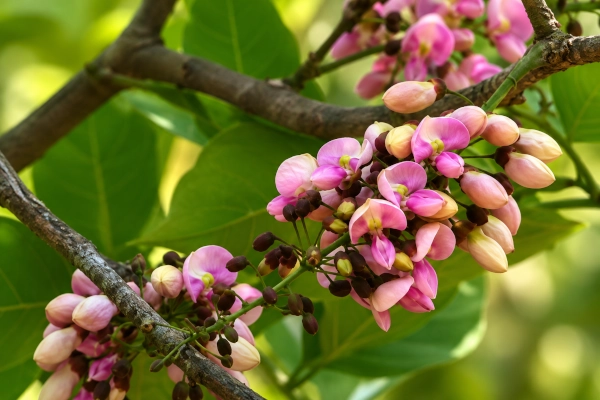
Botanical Name: Pongamia pinnata (L.) Pierre
Sanskrit Name: Karanja
Common Names: Indian Beech, Pongam Tree, Karanj
Family: Fabaceae
Synonym: Millettia pinnata (L.) Panigrahi
Hindi: Karanj
Malayalam: Ungu
Tamil: Pungai
Kannada: Honge
Telugu: Kanuga
Parts Traditionally Used: Seeds, seed oil, leaves, bark, roots and flowers
Karanja is one of Ayurveda’s important medicinal trees for conditions involving itching, skin disease, wounds, excessive Kapha and aggravated Vata.
Its bitter seeds yield the well-known Karanja oil, which has traditionally been used in external Ayurvedic preparations. The leaves, bark, roots and flowers also have distinct medicinal applications.
Botanically, Karanja is Pongamia pinnata (L.) Pierre, a member of the Fabaceae family. Royal Botanic Gardens, Kew currently accepts Pongamia pinnata as the botanical name and treats Millettia pinnata as a synonym. The tree is native across tropical and subtropical Asia and extends eastwards into the western Pacific.
Karanja deserves particular care in medicinal use. Unlike coconut or sesame oil, its ordinary crude seed oil should not be regarded as a culinary oil. Pongamia seeds contain biologically active and antinutritional compounds, while the oil has also attracted interest for agricultural and industrial applications.
Karanja in Classical Ayurveda
Karanja has a long history in the Ayurvedic tradition.
A recent medico-historical review tracing references across classical texts notes that Charaka included Karanja among Kandughna herbs, the group associated with relieving itching. Charaka also placed it within the Katu Skandha, while Sushruta included Karanja in groups such as Aragvadhadi, Varunadi and Arkadi. Vagbhata described its use in the cleansing of unhealthy wounds and in traditional dental care.
Classical synonyms include Naktamala, Prakirya, Udakirya, Chirabilva and Snigdhapatra.
This long textual history explains why Karanja remains closely associated with dermatology and wound care in Ayurvedic practice.
Ayurvedic Profile of Karanja
Karanja is a strong, penetrating medicinal plant rather than a mild everyday herb.
| Ayurvedic Property | Karanja |
|---|---|
| Rasa — Taste | Tikta, Katu, Kashaya — bitter, pungent and astringent |
| Guna — Qualities | Laghu, Tikshna — light and penetrating |
| Virya — Potency | Ushna — heating |
| Vipaka — Post-digestive effect | Katu — pungent |
| Dosha Action | Primarily Kapha-Vata Shamaka |
| Important Karma | Kandughna, Kushthaghna, Krimighna, Vranahara, Shothahara |
Ayurvedic teaching sources consistently describe Karanja as Tikta and Katu, Tikshna in quality, Ushna in potency and Katu in Vipaka. Its strong heating and penetrating nature helps explain its traditional usefulness where Kapha, itching, obstruction and certain Vata conditions predominate.
Because of its Ushna and Tikshna qualities, however, indiscriminate internal use may not suit people with pronounced Pitta or sensitive digestion.
Kandughna — The Herb Traditionally Associated With Itching
One of Karanja’s clearest classical identities is Kandughna.
Kandu means itching. Charaka grouped Karanja among herbs traditionally used to address this symptom.
This does not mean every itchy rash should be treated with Karanja oil.
Itching may arise from eczema, fungal infection, allergy, scabies, psoriasis, insect bites, liver disease or other causes. Ayurveda first considers the nature of the lesion and the Dosha pattern before selecting a preparation.
The traditional Kandughna reputation has nevertheless encouraged modern investigation into the antimicrobial and anti-inflammatory properties of Pongamia pinnata and its constituents. A major pharmacological review documents traditional use in skin diseases and summarises experimental antimicrobial, anti-inflammatory and wound-related research.
Kushthaghna — Karanja and Ayurvedic Skin Care
Karanja is strongly associated with Kushtha, the broad Ayurvedic category covering numerous skin disorders.
The term Kushtha should not be equated with one modern disease. Classical Ayurvedic dermatology uses it for a wide spectrum of chronic skin conditions.
Karanja’s Tikta, Katu, Kashaya, Ushna and Tikshna properties make it especially suited in traditional reasoning to disorders involving Kapha, itching, thickened secretions and obstruction.
Ayurvedic teaching material continues to describe Karanja as Kushthaghna and records the external use of its seed oil in skin disorders and ulcers.
Modern research has identified several biologically active compounds in the plant, including karanjin and pongamol. Experimental studies have investigated anti-inflammatory, antimicrobial, antioxidant and other activities associated with these compounds.
These findings help explain why Karanja remains scientifically interesting, but they do not establish crude Karanja oil as a cure for eczema, psoriasis or fungal infections.
Karanja Oil — The Best-Known Medicinal Preparation
The seeds of Karanja contain substantial quantities of oil.
Research on Pongamia seeds reports oil contents commonly in the range of roughly 27 to 39 percent, although composition varies with genetics, environment and processing.
In Ayurveda, Karanja oil is predominantly associated with external medicinal use.
It may be included in preparations used for itching, chronic skin lesions, selected wounds and certain Vata disorders. Ayurvedic teaching sources describe the oil as traditionally antipruritic, wound-supporting and useful for massage in appropriate Vata conditions.
The oil’s medicinal reputation should not lead to casual self-treatment.
Crude Pongamia seeds contain antinutritional and potentially toxic constituents. Ordinary Karanja oil therefore should not be consumed as though it were a normal edible cooking oil.
Specially processed products studied for potential food applications are a separate subject and should not be confused with traditional crude Karanja oil.
Karanja Oil and the Skin
Traditional practice often applies Karanja oil in formulations rather than using it indiscriminately at full strength.
Its strong Ushna and Tikshna character makes this sensible.
Some people may experience irritation from concentrated herbal oils. Broken skin can be especially sensitive.
A small patch test is advisable before applying any commercial Karanja-containing cosmetic product widely. Medicinal use on chronic lesions should be guided by a qualified Ayurvedic practitioner or dermatologist.
Serious infection, rapidly spreading redness, pus, fever or a non-healing wound requires medical assessment.
Vranahara — Traditional Use in Wounds
Karanja is also described as Vranahara or supportive in the management of Vrana.
Classical Ayurvedic sources contain references to Karanja in wound cleansing, while modern Ayurvedic teaching continues to associate its leaves, seeds and oil with wound care.
Modern pharmacological reviews likewise document traditional use of Pongamia pinnata in wounds.
The purpose of traditional external applications may include cleansing the lesion, reducing itching or supporting healing.
This does not mean crude plant material should be placed directly into an open wound.
Fresh wounds need proper cleaning. Deep wounds may require suturing, tetanus protection or antibiotics. Diabetic ulcers and wounds with impaired circulation require especially careful treatment.
Krimighna — Karanja and the Ayurvedic Concept of Krimi
Another important traditional action is Krimighna.
Krimi in Ayurveda includes worms and other disease-producing organisms within a broader classical framework.
The seeds, leaves and oil of Karanja have traditionally been used where Krimi is suspected, especially in relation to the skin. Ayurvedic sources specifically record Krimighna activity among the plant’s traditional actions.
Modern studies have investigated insecticidal, larvicidal and antimicrobial properties of Pongamia oil and its constituents.
These effects also explain why Karanja has applications beyond medicine.
However, agricultural insecticidal activity should not be confused with evidence that Karanja can safely replace clinically proven treatment for parasitic infection in humans.
Shothahara — Traditional Use in Swelling
Karanja leaves are traditionally described as Shothahara, referring to their use in swelling and inflammatory conditions.
Modern studies have provided experimental support for anti-inflammatory potential.
Karanjin, one of the important compounds isolated from Pongamia, has shown anti-inflammatory activity in experimental models. Researchers have also studied karanjin in animal models of arthritis.
Such findings are useful for pharmacological research.
They do not yet make Karanja a proven replacement for medicines used in rheumatoid arthritis, gout or other inflammatory conditions.
Karanja and Vata Disorders
Karanja’s Ushna Virya is one reason Ayurveda uses it in selected Vata conditions, particularly where coldness, stiffness and Kapha coexist.
Traditional descriptions mention the use of Karanja oil in massage for certain Vata disorders.
This does not mean every painful joint should be massaged with a heating oil.
Fresh injuries, marked inflammation and some Pitta-dominant conditions may require a different approach.
Ayurvedic treatment always considers the complete presentation rather than selecting a drug only because pain is present.
The Leaves of Karanja
Karanja leaves are compound, glossy and green. They form a dense crown that makes the tree useful for shade.
Medicinally, the leaves have been used in traditional external preparations for itching, swelling and wounds. Ayurvedic teaching sources describe them as Kapha-Vata balancing, Krimighna and Shothahara.
Modern scientists have also investigated Karanja leaf extracts.
One animal study reported glucose-lowering activity from leaf extracts in experimentally induced diabetic rats.
A more recent 2026 experimental study examined a Pongamia pinnata leaf extract through laboratory and animal models and included acute oral toxicity assessment.
These studies support further research. They do not establish ordinary Karanja leaf preparations as diabetes medicines for humans.
Karanja and Prameha
Ayurvedic literature also describes Karanja in connection with Prameha.
Prameha is a broad Ayurvedic metabolic and urinary disease category. Diabetes overlaps with some forms of Prameha but should not be regarded as an exact translation.
The traditional association has led researchers to explore glucose metabolism.
Animal experiments using Karanja leaf extracts and isolated compounds have reported hypoglycaemic or antidiabetic activity.
This is promising preclinical evidence.
People with diabetes should never replace insulin, metformin or other prescribed medicines with Karanja.
Combining potent herbal extracts with glucose-lowering medicines could also increase the risk of unpredictable blood-sugar changes.
Karanja and Arsha
Traditional Ayurvedic references also include Karanja in the management of Arsha, commonly associated with haemorrhoidal disorders.
Its Katu, Tikta and Ushna nature, together with its Kapha-Vata reducing action, explains this application within the Ayurvedic framework.
However, rectal bleeding should never automatically be assumed to be piles.
Bleeding may also occur with fissures, inflammatory bowel disease, polyps and colorectal cancer.
Persistent rectal bleeding therefore requires medical evaluation.
Dental Use in Classical Tradition
Karanja also appears in the Ayurvedic tradition of Dantadhavana, or cleansing the teeth with medicinal twigs.
The 2026 medico-historical review notes references to Karanja in Vagbhata’s discussion of traditional dental cleansing.
Using medicinal twigs reflects an older oral-care tradition in which texture and plant chemistry both contributed to cleaning.
This historical use should not be interpreted as evidence that Karanja can replace modern dental treatment.
Toothache, gum swelling, dental abscesses and persistent bleeding need professional dental assessment.
Karanja Flowers
The tree bears clusters of attractive flowers that may range from whitish pink to lavender tones.
Flowers are also mentioned among the medicinally used parts of the plant. Ayurvedic teaching sources record their traditional application in selected metabolic conditions, although the evidence is primarily traditional.
The flowers demonstrate an important feature of Ayurvedic pharmacology: different parts of the same tree are not assumed to be interchangeable.
A seed oil, leaf juice, bark decoction and flower preparation may have very different actions.
Karanjin — A Characteristic Compound
Karanjin is one of the best-known phytochemicals associated with Pongamia pinnata.
It belongs to a group of naturally occurring furanoflavonoid compounds and is abundant enough in the seed material to attract substantial scientific interest.
Experimental research has examined karanjin for anti-inflammatory and anti-arthritic activity.
Karanjin also contributes to the biological activity that has made Pongamia oil interesting as a natural agricultural pesticide.
The presence of a pharmacologically active compound is another reason not to assume that crude Karanja oil is simply an ordinary vegetable oil.
Pongamol — Another Important Phytochemical
Pongamol is another extensively studied compound from Pongamia pinnata.
A scientific review of pongamol describes experimental antioxidant, anti-inflammatory, antimicrobial and antidiabetic activities, among several other areas of investigation.
Most of these findings arise from laboratory or animal research.
The compound is therefore better viewed as a promising pharmacological lead than as an established human medicine.
This distinction is important because medicinal-plant research often produces exciting laboratory results long before effective clinical treatments emerge.
Skin Research and Modern Pharmacology
The long traditional association between Karanja and skin disease continues to influence modern research.
A 2013 review in the Journal of Ethnopharmacology examined the plant’s traditional uses, phytochemistry, pharmacological findings and toxicity. It recorded uses relating to piles, skin disease and wounds while also highlighting the need for further research.
A 2025 review further examined Pongamia pinnata and its phytochemicals in relation to experimental skin-tumour research.
Such research should be interpreted carefully.
Activity in cells or laboratory animals does not establish Karanja as a cancer treatment.
Suspected skin cancer requires diagnosis and treatment by qualified medical specialists.
Karanja Is Also an Important Oilseed Tree
Karanja has an unusual position between medicine, agriculture and energy research.
Its seeds are rich in oil, and researchers have extensively studied Pongamia as a source of non-food industrial oil and biodiesel feedstock. The species has also been investigated for cultivation on degraded land.
This industrial interest is separate from Ayurvedic medicine, but it demonstrates the chemical richness of the seed.
The same tree can provide compounds relevant to traditional dermatology, natural pest management and renewable fuels.
Few medicinal trees have such a broad technological profile.
An Ecologically Useful Legume
Karanja belongs to the Fabaceae family.
The tree is adapted to warm climates and can grow under a variety of tropical conditions. Kew records its native distribution across tropical and subtropical Asia into the western Pacific.
Pongamia has also attracted attention in agroforestry and land-restoration research because it can tolerate difficult growing environments better than many conventional crop trees.
Its broad crown provides shade, while its abundant seed production makes it useful as an oilseed species.
This ecological usefulness adds another dimension to a tree already important to Ayurveda.
Karanja Is Not Neem
Karanja and Neem are sometimes confused because both produce bitter medicinal oils used externally.
They are completely different botanical species.
Karanja is Pongamia pinnata and belongs to Fabaceae. Neem is Azadirachta indica and belongs to Meliaceae.
Both have traditions of use for skin conditions and pest management, but their phytochemistry and Ayurvedic properties are not identical.
Medicinal oils should therefore be correctly identified before use.
A Strong Herb Requires Correct Use
Karanja represents a category of Ayurvedic plants where potency is an advantage only when the medicine is correctly selected.
Its Tikta and Katu tastes, Tikshna quality and Ushna Virya create a powerful combination.
These properties may be useful where Kapha, itching, obstruction and certain Vata disturbances dominate. They can also make the drug unsuitable when used excessively or without regard to individual constitution.
The plant should therefore not be treated like an everyday herbal tea.
Internal use of Karanja seed, oil, bark or concentrated extracts should remain under professional supervision.
Safety and Precautions
Karanja deserves stronger precautions than many common kitchen herbs.
Scientific analysis of Pongamia seeds notes the presence of toxic and antinutritional compounds, even though researchers are also investigating methods of processing the oil for specialised uses.
For ordinary household purposes, crude Karanja oil should not be consumed as cooking oil.
External use may also irritate sensitive skin.
Pregnant or breastfeeding women, children, people with liver or kidney disease and those taking long-term medicines should avoid medicinal internal use unless supervised by a qualified practitioner.
People taking diabetes medicines require particular caution because experimental studies have reported glucose-lowering activity from Karanja extracts.
Karanja oil should not be put into the eyes or applied carelessly to deep wounds, severe burns or infected ulcers.
Karanja Through the Ayurvedic Lens
The medicinal personality of Karanja becomes clearer when its properties are considered together.
Its Tikta Rasa reflects bitterness.
Its Katu Rasa and Katu Vipaka add penetrating and Kapha-reducing action.
Its Tikshna Guna gives it intensity.
Its Ushna Virya counters cold and certain Vata-Kapha patterns.
These qualities help explain its classical identity as Kandughna, Kushthaghna, Krimighna and Vranahara.
Ayurveda developed this understanding through observation of the whole drug.
Modern science is now approaching the same plant through molecules such as karanjin and pongamol.
The languages are different, but both traditions recognise that Karanja is chemically and biologically active.
Karanja — A Medicinal Tree With Many Lives
Karanja is not a gentle ornamental tree that happened to enter medicine.
It is a powerful medicinal species whose bitter chemistry has shaped its role for centuries.
Ayurveda places it prominently in the management of itching, skin disorders, wounds, Krimi and selected Kapha-Vata conditions. Classical authorities referred to Karanja in several therapeutic groups, while later Ayurvedic practice developed extensive use of its seed oil.
Modern research has identified karanjin, pongamol and numerous other plant compounds. Scientists have studied their anti-inflammatory, antimicrobial, antidiabetic and other biological activities.
The seeds have also created an entirely different modern identity for the tree as a potential source of renewable industrial oil.
Yet its Ayurvedic lesson remains straightforward.
A medicinal substance can be valuable precisely because it is powerful.
That power requires proper identification, correct preparation and respect for dosage.
For generations, Ayurveda has known Karanja as a tree whose bitterness can become medicine when used wisely.
Modern science is now beginning to understand just how chemically complex that bitter medicine really is.
References
Royal Botanic Gardens, Kew accepts Pongamia pinnata (L.) Pierre within the Fabaceae family and treats Millettia pinnata as a botanical synonym.
A 2026 medico-historical review traces Karanja through Charaka, Sushruta, Vagbhata and other Ayurvedic sources, including its traditional Kandughna and wound-related applications.
A major peer-reviewed review in the Journal of Ethnopharmacology examines the traditional medicinal uses, phytochemistry, pharmacological research and toxicity of Pongamia pinnata.
Experimental research has investigated karanjin for anti-inflammatory and anti-arthritic activity and Karanja leaf extracts for effects on glucose metabolism.
Research into Pongamia seeds documents their high oil content as well as toxic and antinutritional constituents, supporting caution against treating crude Karanja oil as an ordinary edible oil.
Health Disclaimer
This article is intended for educational and informational purposes only. It is not medical advice and should not be used to diagnose, treat, cure or prevent any disease. Karanja is a potent medicinal plant. Its seeds and crude seed oil contain biologically active and antinutritional compounds and should not be consumed as ordinary food or cooking oil. Internal use of Karanja seed, oil, bark, leaves or concentrated extracts should take place only under qualified medical or Ayurvedic supervision. External Karanja oil may irritate sensitive skin. Pregnant or breastfeeding women, children, people with chronic illnesses and those taking prescription medicines should consult a qualified physician before medicinal use. Karanja must not replace prescribed treatment for diabetes, infections, chronic skin disease, wounds or other medical conditions.
You may also like
-
Bengaluru’s SugarStrings.ai Develops Cheek-Swab DNA Test Screening Thousands of Genetic Disorders
-
Green Pyramid Biotech Turns Sophorolipid Research Into a Natural Food-Safety Platform
-
Ashoka — Saraca asoca: Ayurveda’s Celebrated Tree for Rakta and Women’s Health
-
New Smart Technology can Make Diagnosis of Alzheimer’s disease (AD) More Accessible
-
Arjuna (Terminalia arjuna): Ayurveda’s Celebrated Hridya Tree for the Heart, Rakta and Tissue Strength
