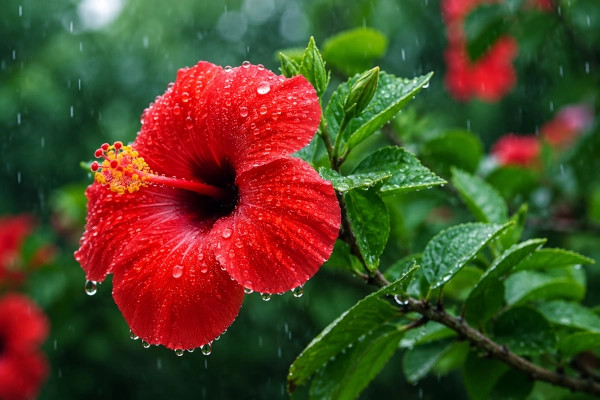
Botanical name: Hibiscus rosa-sinensis L.
Current botanical treatment: Hibiscus × rosa-sinensis L.
Family: Malvaceae
Sanskrit names: Japa, Japapushpa, Japakusuma
English names: Hibiscus, Chinese Hibiscus, China Rose, Shoe Flower
Hindi: Gudhal, Gurhal
Malayalam: Chembarathi
Tamil: Sembaruthi
Kannada: Dasavala
Telugu: Mandara
Parts used: Flowers, flower buds, leaves and, in some traditional practices, roots
Few flowers occupy the space between Ayurveda, household tradition and sacred culture as naturally as Japa. Its brilliant red flowers are familiar across India. They appear in temple gardens, home courtyards, traditional hair preparations and herbal remedies.
Known botanically as Hibiscus rosa-sinensis, Japa belongs to the Malvaceae family. Modern botanical databases such as Kew currently treat the cultivated plant as Hibiscus × rosa-sinensis. Indian medicinal-plant references continue to widely use the name Hibiscus rosa-sinensis.
Ayurveda values Japa especially for its cooling nature and its traditional association with hair, skin and Rakta-related conditions. Its flowers are the part most frequently encountered in traditional use. The Ministry of Ayush’s e-Charak medicinal-plant database also lists the flower of Hibiscus rosa-sinensis as the medicinally traded part.
The Plant
Japa is an evergreen or semi-evergreen woody shrub in warm climates. It develops glossy green leaves and large, striking flowers.
The familiar traditional form has deep-red flowers with a long central staminal column. However, centuries of cultivation have produced numerous varieties. Flowers may now be red, pink, orange, yellow, white or combinations of these colours.
The plant grows well in tropical and subtropical climates. It prefers good sunlight, moisture and well-drained fertile soil. It can also be propagated easily through stem cuttings.
India’s National Medicinal Plants Board includes Hibiscus rosa-sinensis in its medicinal-plant database. CCRAS publications have also documented Japa under the same botanical identification.
Japa in Ayurveda
Japa appears in later Ayurvedic literature and Nighantu traditions as a medicinal flower.
Traditional descriptions can vary slightly between texts and regional Dravyaguna traditions. A commonly cited Ayurvedic profile describes Japa as follows:
Rasa — Taste: Kashaya (astringent), Tikta (bitter)
Guna — Qualities: Laghu (light), Ruksha (dry)
Virya — Potency: Sheeta (cooling)
Vipaka — Post-digestive effect: Katu (pungent)
Traditional Karma attributed to Japa includes:
- Keshya — traditionally supportive of healthy hair
- Hridya — traditionally regarded as pleasing or supportive to the heart
- Sangrahi — possesses an absorbing or binding action
- Rasayana — used in certain traditions as a rejuvenative supportive drug
This profile is recorded by Ayurvedic teaching institutions in their Dravyaguna references.
Because Japa is considered Sheeta Virya, its traditional use is particularly associated with conditions in which excess heat or aggravated Pitta is considered important.
Effect on the Doshas
Japa is generally associated with the control of excessive Pitta, particularly where heat and Rakta are involved.
Its cooling nature explains many of its traditional applications. However, Ayurvedic treatment never depends on a herb’s Virya alone. The patient’s Prakriti, Vikriti, digestive strength, age, season and accompanying herbs must also be considered.
For this reason, Japa should not be described simply as a universal “Pitta medicine.”
Ayurveda treats the individual rather than the name of a disease.
Japa as a Keshya Dravya — The Traditional Hair Herb
Japa is perhaps best known today for its role in traditional Indian hair care.
Both its flowers and leaves are used in herbal hair preparations. Fresh hibiscus is commonly crushed into a paste or processed into coconut, sesame or other suitable oils.
The mucilaginous quality of the leaves and flowers gives freshly crushed hibiscus a naturally slippery texture. This makes it useful in traditional scalp applications and herbal hair washes.
Ayurvedic traditions classify Japa among herbs associated with Keshya, or the maintenance of healthy hair.
Traditional hibiscus preparations are used to:
- condition dry hair;
- support scalp health;
- maintain hair texture;
- reduce excessive dryness;
- support strong hair roots;
- maintain the natural appearance of hair.
These uses should be understood as traditional Ayurvedic and household applications. Evidence for treating clinical hair-loss disorders in humans remains limited.
Japa for the Scalp
The combination of flower, leaf and oil makes hibiscus particularly suited to external use.
Fresh leaves can be ground into a smooth paste. Flowers may be added to the preparation. The mixture can then be incorporated into an appropriate herbal hair oil.
Traditional processing with oil serves another purpose. Ayurveda often uses a Sneha, or lipid medium, to carry the qualities of herbs during external application.
Japa therefore became associated not only with individual remedies but also with classical and traditional medicated hair oils.
Among formulations linked with Japa in Ayurvedic teaching references are preparations such as Japakusumadi Taila.
Traditional Cooling Action
The deep-red colour of the flower may appear fiery, but Ayurveda traditionally describes Japa as cooling.
Its Sheeta Virya forms the basis of its traditional use when heat, burning or aggravated Pitta is considered dominant.
This illustrates an important Ayurvedic principle. The visual character of a plant does not automatically determine its pharmacological nature.
A brilliant red flower can still possess a cooling Virya.
Traditional Association With Rakta
Japa has long been associated with Rakta, or the Ayurvedic concept of the blood tissue and related physiological functions.
Traditional literature records preparations using Japa in conditions characterised by excessive bleeding. Ayurvedic literature has also described the use of Japa flower buds with milk in the management of Asrigdhara, a term associated with excessive uterine bleeding. A published Ayurvedic case report discusses this traditional application while referring to formulations mentioned in Chikitsa Manjari and Gada Nigraha.
Such historical uses are important for understanding Ayurvedic pharmacology. They should not be interpreted as a recommendation to self-treat abnormal bleeding.
Unexplained or excessive bleeding requires medical assessment.
Japa and Women’s Traditional Health Practices
Hibiscus appears in several traditional medical systems in relation to women’s health.
This area requires particular caution.
Some traditional sources describe Japa preparations for menstrual conditions. At the same time, laboratory and animal research has investigated extracts of Hibiscus rosa-sinensis for antifertility and reproductive effects.
These studies do not establish what ordinary household quantities of hibiscus will do in humans. However, they provide sufficient reason to avoid casual medicinal use during pregnancy or while attempting conception, unless a qualified physician advises otherwise.
Japa for Skin and External Applications
Hibiscus flowers and leaves contain naturally occurring mucilage and several phytochemical compounds.
Traditional systems have used preparations of the plant externally on the skin. Modern experimental research has also investigated Hibiscus rosa-sinensis in wound-healing models.
Animal studies found improved wound contraction and epithelialisation following treatment with specific hibiscus extracts.
This is scientifically interesting, but it does not mean homemade hibiscus paste should be applied to serious wounds.
Open, infected, deep or non-healing wounds require proper medical care.
Modern Research on Japa
Modern research has identified several groups of bioactive substances in Hibiscus rosa-sinensis. These include phenolic compounds, flavonoids, anthocyanins and other plant constituents.
A comprehensive scientific review published in 2024 examined studies reporting antioxidant, antimicrobial, anti-inflammatory, metabolic, wound-healing and hair-related effects. However, much of the existing evidence comes from laboratory studies, animal experiments or preliminary research rather than large human clinical trials.
This distinction is important.
Traditional use can provide valuable leads for scientific investigation. Experimental results can explain possible biological mechanisms. Neither automatically proves that a herb can treat a human disease.
Japa should therefore be appreciated both as an Ayurvedic medicinal plant and as a subject worthy of further clinical research.
Antioxidant Potential
The colourful flowers of hibiscus contain several phytochemicals capable of interacting with oxidative processes.
Experimental studies have therefore examined extracts for antioxidant activity. This may eventually help explain some traditional applications involving skin and tissue protection.
However, the antioxidant activity of an extract in a laboratory cannot be translated directly into a claim that hibiscus prevents or cures disease.
Different cultivars, extraction methods and plant parts can produce very different chemical profiles.
Japa Is Not the Same as Hibiscus Tea or Roselle
An important distinction is often missed in modern herbal discussions.
Japa is Hibiscus rosa-sinensis.
The tart red herbal beverage widely marketed internationally as “hibiscus tea” is usually prepared from the calyces of Hibiscus sabdariffa, commonly called roselle.
They belong to the same genus but are different plants.
Research findings about Hibiscus sabdariffa should therefore not automatically be attributed to Japa.
This distinction is especially important when discussing studies involving blood pressure, cholesterol or commercial hibiscus beverages.
Parts Used in Ayurveda and Traditional Medicine
Flowers
The flower is the best-known medicinal part of Japa.
It is traditionally used in hair preparations, cooling formulations and remedies associated with Pitta and Rakta.
Flower Buds
Flower buds have specific traditional applications. Ayurvedic literature records their use in certain preparations associated with excessive menstrual bleeding.
Leaves
Leaves contain abundant mucilage and are widely used externally.
They may be ground into herbal hair packs, incorporated into cleansing preparations or processed in oil.
Roots
Roots also appear in some traditional and experimental medicinal uses. However, they should not be treated as interchangeable with the flowers.
Research involving concentrated root extracts has also examined reproductive activity.
Traditional Hibiscus Hair Oil
One of the simplest household traditions is hibiscus-infused hair oil.
Fresh hibiscus flowers and leaves are cleaned thoroughly and allowed to dry so that excess surface water disappears. They are then crushed or ground.
The herbal material is traditionally processed gently with an appropriate base oil.
The finished preparation is used externally on the hair and scalp.
Care should be taken when preparing herbal oils at home. Moisture remaining in the finished product can encourage microbial spoilage. Small quantities are therefore preferable unless proper processing methods are followed.
Fresh Japa Hair Pack
Fresh hibiscus flowers and tender leaves can be washed and ground into a smooth paste.
Traditionally, this paste is used as a scalp and hair application before washing.
The natural mucilage gives the preparation a soft, conditioning texture.
A patch test is advisable before using any herbal preparation extensively on the skin or scalp.
Growing Japa at Home
Japa is one of the easier Ayurvedic plants to maintain in an Indian home garden.
It prefers:
Sunlight: Good sunlight, although some partial shade is tolerated.
Soil: Fertile and well-drained soil.
Water: Regular watering without prolonged waterlogging.
Climate: Warm tropical and subtropical conditions.
Propagation: Stem cuttings are commonly used.
Regular pruning encourages branching and can help maintain flowering.
The plant’s value goes beyond medicine. Its flowers also support pollinating insects and add considerable ornamental value to the home garden.
Japa in Indian Sacred Tradition
The hibiscus is more than a medicinal plant in India.
The brilliant red Japa flower has a strong place in Hindu worship. Its intense colour has long made it an important ritual flower, particularly in traditions where red symbolises Shakti, vitality and divine energy.
It is especially familiar in worship associated with forms of Devi and Lord Ganesha.
This sacred identity also helped preserve Japa around temples and households. Plants valued in worship were cultivated continuously, allowing medicinal knowledge associated with them to survive alongside ritual tradition.
Japa is therefore a good example of how India’s medicinal and sacred plant traditions often overlap.
Ayurveda’s Wider View of Japa
Modern herbal marketing often seeks a single headline benefit for every plant.
Ayurveda rarely thinks in such narrow terms.
Japa is not simply a “hair-growth flower.”
Its traditional identity combines Sheeta Virya, Keshya action, Pitta-related applications, Rakta associations and external usefulness.
Its flowers may be delicate and short-lived, but the plant itself became deeply established in Indian household medicine.
That combination explains Japa’s remarkable survival across generations.
Precautions
Japa should be used carefully when taken internally in medicinal quantities.
Particular caution is advisable in:
- pregnancy;
- women attempting conception;
- people undergoing fertility treatment;
- unexplained or excessive menstrual bleeding;
- people taking medicines for chronic medical conditions;
- children requiring medicinal doses;
- anyone with known allergy to hibiscus or related plants.
Experimental studies have reported reproductive and antifertility effects from certain concentrated hibiscus extracts in animals. These findings cannot be directly applied to ordinary human use, but they justify caution.
External application can also cause irritation in sensitive individuals. A small patch test should be performed before applying a new preparation widely.
Conclusion
Japa is one of India’s most recognisable examples of a plant in which beauty, medicine and sacred tradition meet.
Ayurveda remembers Hibiscus rosa-sinensis not merely as an ornamental flower but as a useful Dravya with cooling qualities and a strong association with hair and Rakta-related traditional practice.
Its flowers remain an important part of traditional hair care. Its leaves provide naturally mucilaginous preparations for external use. Its place in Indian worship has kept the plant close to households for generations.
Modern research is beginning to investigate many of these traditional observations. Studies have explored wound healing, antioxidant activity, inflammation, hair-related effects and other biological properties. Yet much of that evidence remains experimental.
Japa therefore deserves neither exaggerated medicinal claims nor dismissal as merely a decorative flower.
It is better understood in the way Ayurveda has long viewed medicinal plants: as a Dravya whose properties, preparation, dose and suitability must all be considered together.
The crimson flower growing beside an Indian home may appear ordinary because it is familiar. Behind that familiarity lies a long tradition of Ayurveda, household knowledge and sacred culture.
References
- Ministry of Ayush — e-Charak: Medicinal-plant listing identifying Hibiscus rosa-sinensis and its flower as a medicinal raw material.
- National Medicinal Plants Board, Government of India: Medicinal-plant database listing Hibiscus rosa-sinensis.
- CCRAS: Government research records identifying Japa as Hibiscus rosa-sinensis.
- Royal Botanic Gardens, Kew — Plants of the World Online: Current taxonomic treatment of Hibiscus × rosa-sinensis.
- Sri Jayendra Saraswathi Ayurveda College & Hospital: Dravyaguna profile, useful parts, Rasa Panchaka and traditional indications of Japa.
- Nayak BS et al., International Journal of Lower Extremity Wounds: Experimental investigation of wound-healing activity of Hibiscus rosa-sinensis.
- Amtaghri S et al.: Comprehensive scientific review of Hibiscus rosa-sinensis pharmacology and phytochemistry.
- Kerala Journal of Ayurveda: Published report discussing the traditional use of Japakusuma buds in Asrigdhara.
- PubMed-indexed reproductive studies: Experimental research examining antifertility activity of specific Hibiscus rosa-sinensis extracts.
Health Disclaimer
This article is intended only for educational and informational purposes. It describes traditional Ayurvedic knowledge, historical uses and findings from published research. It is not medical advice, diagnosis or a substitute for professional healthcare.
Do not use Japa or any herbal preparation to diagnose, prevent or treat a medical condition without appropriate professional guidance. Medicinal herbs can cause adverse effects and may interact with medicines.
Pregnant women, women trying to conceive, breastfeeding mothers, children and people receiving treatment for chronic illnesses should consult a qualified physician or Ayurvedic practitioner before medicinal use.
Do not stop, reduce or replace prescribed medication based on information in this article.
You may also like
-
Robotics, AI and Nanoscience Set to Transform Precision Medicine in India
-
Why Ayurveda Recommends Eating Only When Hungry
-
Ayurveda on Eating at the Right Time: How Food Timing Supports Balance and Health
-
Ayurveda and Late-Night Living: What Irregular Sleep Does to the Body
-
India’s Ayush Services Economy Reaches $36.92 Billion, RIS Study Projects Strong Growth to 2047
:%20Ayurveda’s%20Crimson%20Flower%20for%20Hair,%20Cooling%20and%20Traditional%20Healing)