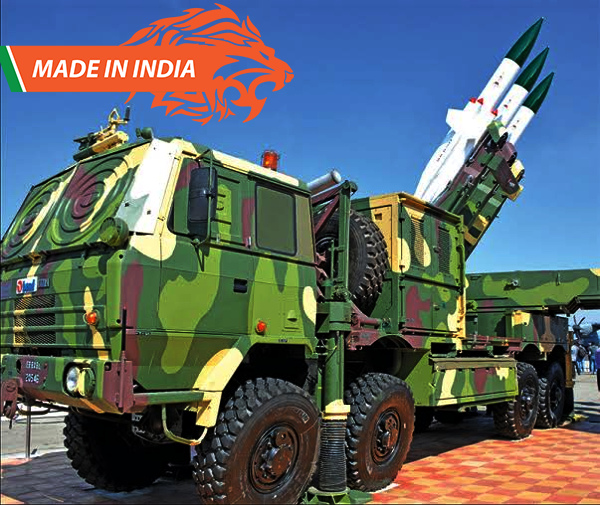
Armenia has brought India’s Akash-1S surface-to-air missile system into operational service, marking one of the most significant overseas deployments of an Indian-developed air-defence weapon.
The induction became publicly visible in August 2026, when footage released by the Armenian Ministry of Defence showed Armenian military personnel training with the Indian-origin system. Reports from Armenia identified the locally operated Akash as “Lusan,” meaning Lynx.
The development completes an important journey that began with Armenia’s decision to acquire the system, followed by the first physical deliveries from India in late 2024 and subsequent integration and training.
For India, the deployment represents something more than another defence export. Akash is a complex air-defence network involving missiles, radars, command systems and launchers. Its operational induction by a foreign military therefore demonstrates India’s growing ability to export complete weapon systems rather than only components and ammunition.
When Did Armenia Acquire the Akash System?
Armenia’s acquisition emerged publicly during 2022-24, when reports said Yerevan had selected the Indian Akash system as part of a broader programme to modernise its air defences.
Armenpress, Armenia’s state news agency, reported in August 2024 that Armenia had ordered 15 Akash systems in 2022, with the reported value of the programme at around $720 million. It also identified Armenia as the first foreign customer for the Indian system.
There is an important distinction, however. The governments of India and Armenia have not publicly released the full original Akash contract with its exact quantity and financial terms. The figures of 15 systems and roughly $720 million should therefore be described as reported contract details, rather than officially disclosed figures.
What is beyond doubt is the wider defence relationship. India’s Ministry of Defence has officially identified Armenia among the leading buyers of Indian defence equipment, alongside the United States and France during FY2023-24.
First Akash Battery Shipped in November 2024
The programme moved from procurement to delivery in November 2024.
On November 12, 2024, reports confirmed that India had shipped the first Akash weapon-system battery to Armenia. The event followed the flagging-off of the first export Akash battery by India’s Secretary of Defence Production.
The first exported battery was reported to include the missile launchers, radar and supporting command-and-control equipment required to operate the system as an integrated air-defence unit.
Armenpress had already reported in August 2024 that deliveries were expected to begin later that year.
Further deliveries subsequently followed. By August 2026, Armenian forces were publicly conducting training and field exercises with the system, demonstrating that the weapon had moved beyond the delivery stage into operational integration.
What Can Akash Do?
Akash is an indigenous mobile surface-to-air missile system developed by India’s Defence Research and Development Organisation, with Bharat Dynamics Limited and Bharat Electronics among the key production partners.
Bharat Dynamics officially lists the Akash weapon system with an engagement range between 4.5 km and 25 km and an operational altitude between approximately 100 metres and 20 km. It is designed to engage threats including fighter aircraft, helicopters and unmanned aerial vehicles.
The missile operates at supersonic speed, while the wider weapon system combines surveillance, target tracking, missile guidance, command-and-control and mobile launch capabilities.
India’s Cabinet noted when approving Akash exports in December 2020 that the system had more than 96 per cent indigenous content. The government also clarified that the export configuration would differ from the version deployed by India’s Armed Forces.
That 2020 decision was crucial. It opened the door for Indian manufacturers to offer a sophisticated indigenous air-defence system to friendly foreign countries.
Armenia has now become the most visible result of that policy.
Why Akash was Chosen by Armenia
Armenia has spent the past several years modernising and diversifying its military equipment.
Air defence has particular importance because recent conflicts in the South Caucasus demonstrated the destructive potential of unmanned aerial vehicles, loitering munitions, precision-guided weapons and modern combat aircraft.
A mobile system such as Akash provides Armenian forces with an additional layer of protection against aerial threats.
Its mobility is particularly useful because launchers, radars and command elements can relocate instead of depending entirely on fixed air-defence positions.
The system also gives Armenia an alternative supply chain outside its traditional dependence on Russian military equipment.
Akash therefore has both an operational and strategic significance for Yerevan.
Armenia Could Eventually Look Toward Akash-NG
The next question is whether Armenia will move from the Akash-1S to India’s much more advanced Akash-NG.
Reports of Armenian interest are not new. In June 2024, Armenpress reported that Armenia had shown interest in Akash-NG while evaluating future air-defence requirements. However, the report itself attributed the information to defence media sources rather than an announced Armenian procurement decision.
The situation has changed significantly since then.
On December 23, 2025, DRDO successfully completed the User Evaluation Trials of Akash-NG. The missile intercepted aerial targets under different range and altitude conditions. DRDO said completion of the trials had paved the way for the system’s induction into the Indian Armed Forces.
Akash-NG uses an indigenous RF seeker, a solid-propellant propulsion system and an entirely new weapon architecture involving a Multi-Function Radar and modern command-and-control elements.
This makes earlier reports of Armenian interest much more relevant today.
India-Armenia Defence Partnership Continues to Deepen
The timing of the Akash induction is also significant because bilateral defence engagement continues at senior levels.
India’s Defence Secretary Rajesh Kumar Singh arrived in Armenia on an official visit on August 17, 2026, according to the Armenian Defence Ministry.
Earlier, Armenian Chief of the General Staff Lieutenant General Edward Asryan met Singh in India in April 2026 to discuss bilateral defence cooperation.
From Indian Development Programme to Foreign Air-Defence Network
The Armenian induction represents a notable transformation for the Akash programme.
India’s Cabinet approved Akash for export only in December 2020.
Within a few years, Armenia emerged as its first reported foreign customer. The first battery was shipped in November 2024, and by August 2026, Armenian military personnel were publicly operating the system.
The development provides India with an important international reference customer for one of its most sophisticated indigenous weapon systems.
For Armenia, Akash adds a mobile and modern layer to its air-defence network.
For India’s defence industry, the significance is equally considerable. Akash demonstrates that Make in India defence exports are moving from smaller equipment and components towards complete, networked combat systems involving missiles, sophisticated radars, electronics and command infrastructure.
References
Press Information Bureau, Government of India: Cabinet approval for export of the Akash Missile System, December 30, 2020.
Bharat Dynamics Limited: Official Akash Weapon System specifications and capabilities.
Press Information Bureau / Ministry of Defence: India identifies Armenia among its leading defence export customers.
DRDO / Ministry of Defence: Completion of Akash-NG User Evaluation Trials, December 23, 2025.
Armenpress / Armenian Defence Ministry: India-Armenia defence engagements and current visit of India’s Defence Secretary.
You may also like
-
Project 75I Nears Final Clearance as India Prepares for Next Generation of Conventional Submarines
-
Kawa UAV’s Jet-Powered Divyastra Mk3 Completes Maiden Flight, Expanding India’s Loitering Munition Capabilities
-
TCS and Rolls-Royce Demonstrate 100% Hydrogen-Powered Aero Engine Across Full Flight Cycle
-
NIBE Secures ₹563-Crore Indian Army Contract for 300 Loitering Munitions
-
Sastra Robotics: Kerala-Built Robots That Test Electronic Devices Like Human Users
