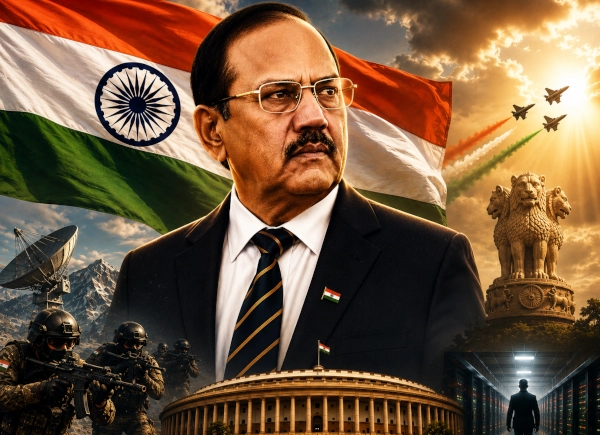
National Security Advisor Ajit Doval has offered one of the clearest accounts yet of the strategic thinking behind Operation Sindoor, saying India’s restraint and tolerance must never be interpreted as an inability to respond decisively to terrorism.
Speaking in the Discovery docuseries Declassified: Operation Sindoor, Doval said India had entered the operation with a clearly defined objective: to destroy terrorist infrastructure linked to the April 22, 2025 Pahalgam terror attack, which killed 26 civilians.
His remarks provide a rare insight into the decisions taken at the highest levels of government after the attack and the principles that shaped India’s military response.
Modi’s First Question: Who Was Responsible?
Doval recalled that Prime Minister Narendra Modi, who returned early from an overseas visit following the Pahalgam attack, immediately sought a clear assessment of responsibility.
According to the NSA, the Prime Minister first wanted the facts established and asked who had carried out the attack and who stood behind it. Modi wanted an immediate and unambiguous identification of the perpetrators before India decided on its response.
The emphasis on attribution was significant. It meant that the military response would be linked to identified terrorist infrastructure rather than launched as an open-ended retaliation.
Once responsibility and targets had been established, the objective of the operation became clear.
Terror Camps Were the Initial Objective
Doval said the mission was designed to destroy enemy camps, particularly those associated with the perpetrators of the Pahalgam attack.
India launched Operation Sindoor in the early hours of May 7, 2025, striking terrorist infrastructure in Pakistan and Pakistan-occupied Kashmir.
The initial phase was conceived as a punitive counter-terror operation. However, subsequent Pakistani military action expanded the confrontation, requiring India to respond across a wider spectrum.
The exchanges continued for nearly 88 hours before both sides reached an understanding on May 10.
Doval’s account suggests that New Delhi entered the operation with defined objectives while remaining prepared for escalation if Pakistan chose to widen the confrontation.
‘Tolerance Should Not Be Mistaken for Weakness’
The strongest message from Doval concerned the way India expects its strategic restraint to be interpreted.
He said India’s generosity and tolerance should not be mistaken for weakness, adding that the country possesses both the capacity and the political resolve to take risks and strike forcefully when its security requires it.
The statement reflects an increasingly visible element of India’s counter-terror doctrine: restraint does not automatically mean non-response.
For New Delhi, the intended message is that terrorist attacks carrying cross-border linkages can trigger military consequences, even when that response involves accepting a higher degree of strategic risk.
India Prepared to Go as Far as Necessary
Doval also addressed the possibility of escalation once military action begins.
He indicated that when India acts to defend its sovereignty, it must be prepared to continue as far as necessary to secure its national interests.
This is an important element of the thinking surrounding Operation Sindoor. India’s initial strikes were directed against terrorist infrastructure, but the armed forces remained prepared to counter subsequent military action.
The approach combines a limited initial objective with the ability to expand the response if the adversary escalates.
That distinction is important because it suggests that New Delhi did not view Operation Sindoor as a predetermined conventional war. Instead, the operation began with specific counter-terror objectives while leaving India prepared for a broader confrontation if required.
Message to Pakistan on Support for Terrorism
Doval said another purpose of the operation was to make Pakistan understand that support for terrorism, or failure to act effectively against terrorist groups operating from its territory, was unacceptable to India.
This places the military operation within a wider deterrence framework.
Rather than viewing terrorism exclusively as a law-enforcement or intelligence challenge, India demonstrated that a major terror attack could result in military action against infrastructure associated with those responsible.
Operation Sindoor therefore carried both an operational and a signalling objective: punish the perpetrators while raising the potential cost of enabling future attacks.
Operation Sindoor Remains a Continuing Doctrine
Doval also elaborated on Prime Minister Modi’s assertion that “Operation Sindoor is alive.”
According to the NSA, the statement means that India regards the struggle against terrorism as continuing rather than concluded with the May 2025 strikes.
The implication is that Operation Sindoor has significance beyond the specific 88-hour confrontation. It has become part of the broader framework through which India signals how it may respond to future acts of terrorism.
The doctrine places greater emphasis on deterrence through demonstrated capability and willingness to act.
Strategic Restraint Combined With Military Resolve
Doval’s comments reveal a security doctrine built around two complementary principles.
India does not seek escalation for its own sake, but it also does not want restraint to create an impression that serious attacks can be absorbed without consequences.
That balance was visible during Operation Sindoor. India selected specific targets after the Pahalgam attack, conducted precision strikes and remained prepared for a wider response after Pakistan entered the military confrontation.
The operation also demonstrated coordinated action involving the Army, Navy and Air Force, supported by intelligence, surveillance, target identification and extensive operational preparation.
A New Threshold in India’s Counter-Terror Response
Doval’s first detailed public comments on Operation Sindoor are significant because they explain the political thinking behind the military action rather than simply recounting battlefield events.
The central message is that India intends to retain strategic flexibility.
It can exercise restraint when circumstances demand it, but it is also willing to employ military power when terrorist attacks cross a threshold that New Delhi considers unacceptable.
Operation Sindoor therefore appears to have established a broader principle in India’s national security posture: terrorism may invite a calibrated military response, and any subsequent escalation will not necessarily deter India from pursuing its stated objectives.
For Doval, the message is ultimately about perception and deterrence. India may remain tolerant and measured, but those qualities, he argues, should never be confused with an unwillingness to defend the country or impose costs on those responsible for attacks against it.
You may also like
-
Sigma Advanced Systems Secures ₹174 Crore Export Order for 155mm Artillery Ammunition Subsystems
-
Bharat Electronics Secures ₹1,011 Crore in New Defence Orders for Radar, Communication and Sonar Systems
-
India’s 300 kW Laser Weapon Ambitions Could Strengthen Future Defence Against Cruise Missiles
-
Indian Army Seeks 360-Degree Laser Warning System with Automatic Smoke Protection for Tanks
-
DRDO Seeks Indian Industry Partners for Development and Production of R-59 Air-Launched Weapon System
