India’s defence sector is entering a new phase in which military modernisation increasingly rests on domestic manufacturing, indigenous research and a wider industrial ecosystem. A new government assessment released ahead of Independence Day 2026 shows substantial growth across defence spending, production, exports, research and private-sector participation.
The transformation reflects a broader effort to reduce external dependence while building the industrial and technological capacity required for future warfare. India’s defence budget has risen from ₹2.53 lakh crore in 2013–14 to ₹7.85 lakh crore in 2026–27, representing more than a threefold increase. Capital expenditure has simultaneously grown from ₹94,587.95 crore in 2014–15 to ₹2.19 lakh crore in 2026–27, providing greater financial space for military modernisation.
Defence Production Reaches Record ₹1.78 Lakh Crore
The growth of India’s domestic defence industry is perhaps the clearest indication of this transition. Defence production reached a record ₹1.78 lakh crore in FY2025–26. Public-sector entities accounted for around 76 per cent of output, while private companies contributed the remaining 24 per cent.
India is also converting rising domestic production into a growing export presence. Defence exports increased from just ₹686 crore in FY2013–14 to ₹38,424 crore in FY2025–26, a 56-fold expansion. Indian defence products now reach more than 80 countries.
Private companies contributed ₹17,353 crore, or 45.16 per cent, of defence exports during FY2025–26. Defence Public Sector Undertakings accounted for ₹21,071 crore. The government has now set targets of ₹3 lakh crore in annual defence production and ₹50,000 crore in exports by 2029.
Major Indigenous Procurement Pipeline Takes Shape
Government procurement policy has increasingly shifted towards systems designed and manufactured within India. The Defence Acquisition Council has granted Acceptance of Necessity for more than ₹6 lakh crore worth of DRDO-designed systems intended for production by Indian industry.
Among the prominent programmes cited are 97 additional Tejas Mk-1A fighter aircraft valued at around ₹62,000 crore and 156 LCH Prachand combat helicopters worth about ₹62,700 crore. These large orders can provide Indian aerospace companies with longer production runs and strengthen domestic supplier networks.
The government is also preparing Defence Acquisition Procedure 2026. The draft proposes simplified procurement categories, stronger support for indigenous design and development, and indigenous-content requirements reaching as high as 60 per cent in applicable categories.
Defence R&D Spending More Than Doubles
India’s effort to build sovereign military technologies is being supported by higher research expenditure. The defence R&D allocation has increased from ₹13,716.14 crore in 2014–15 to ₹29,100.25 crore in 2026–27, an increase exceeding 112 per cent. Since 2022–23, one-fourth of the defence R&D budget has also been opened to industry, start-ups and academic institutions.
Programmes such as Innovations for Defence Excellence (iDEX), ADITI and the Technology Development Fund are creating another pathway for emerging Indian companies to enter defence technology development.
As of March 2026, iDEX had engaged 676 start-ups, MSMEs and innovators and generated 551 design and development contracts. The Technology Development Fund can provide grants of up to ₹50 crore for critical technologies. By June 2026, 80 TDF projects worth ₹334 crore were under implementation, while another ₹500 crore corpus had been sanctioned for deep and emerging technologies.
Indigenisation Moves Deeper into the Supply Chain
India’s defence self-reliance programme is increasingly moving beyond final platforms toward components, ammunition, electronics, subsystems and materials.
By May 2026, the government had issued 10 Positive Indigenisation Lists covering 5,521 items. The Srijan Defence Equipment Empowerment Platform had meanwhile grown to include more than 41,000 vendors and 2.7 lakh products.
DRDO has transferred technologies through its Development-cum-Production Partner framework to 134 companies. The organisation has also signed 2,180 technology-transfer agreements and opened more than 2,780 intellectual property rights for industry use as of March 2026.
Defence manufacturing corridors are adding another layer to this industrial expansion. By April 2026, the Uttar Pradesh Defence Industrial Corridor had received investment commitments worth ₹42,057 crore, while the Tamil Nadu Defence Industrial Corridor had attracted ₹32,699 crore. The BrahMos Integration and Testing Facility at Lucknow has also begun missile manufacturing.
Indigenous Weapons Move Toward Operational Maturity
The transformation is also visible within the armed forces. According to the government assessment, the Indian Army has achieved roughly 91 per cent self-sufficiency in ammunition, with 159 of 175 ammunition variants in its inventory indigenised.
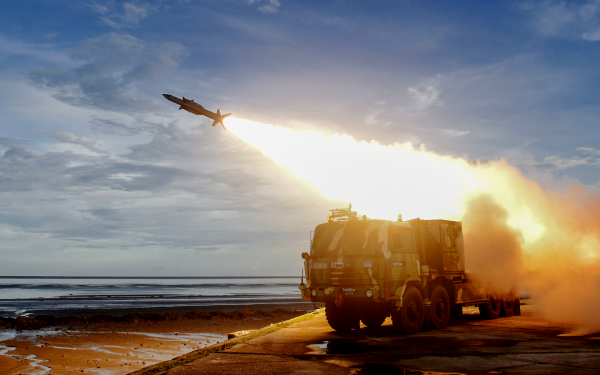
India has continued testing major indigenous strategic and tactical systems, including the Agni-4 and Agni-5 ballistic missiles, RudraM-II air-to-surface missile, TARA glide weapon, Kusha long-range air-defence system and VSHORADS. DRDO has also completed a 12-minute ground test of an actively cooled scramjet combustor, advancing technologies relevant to future hypersonic weapons.
These programmes indicate that indigenisation is gradually extending from conventional weapons and platforms into propulsion, precision strike, air defence and advanced missile technologies.
Naval Shipbuilding Emerges as a Major Strength
India’s naval shipbuilding programme provides another strong example of indigenous industrial growth. The Navy commissioned 12 warships and submarines, with vessels including INS Surat, INS Nilgiri and INS Vaghsheer highlighted in the government review.
The expanding naval programme demonstrates how Indian shipyards and domestic suppliers are increasingly capable of delivering complex surface combatants, submarines, survey vessels and offshore patrol ships.
DRDO has simultaneously advanced indigenous maritime weapons, including the Naval Anti-Ship Missile–Medium Range, while work on layered ballistic missile defence continues.
Building a Defence Industrial Power for 2047
India’s defence transformation is therefore moving beyond the earlier objective of simply substituting imported equipment. The emerging strategy connects military procurement with industrial development, indigenous intellectual property, start-ups, private companies, research institutions and export markets.
Rising production and exports show that the domestic defence ecosystem has expanded considerably. Large indigenous orders can provide the scale required for suppliers to invest in new manufacturing capacity and technology. At the same time, programmes in missiles, air defence, aerospace, naval systems and advanced propulsion are pushing Indian defence research into increasingly complex technological domains.
The next challenge will be to convert this industrial expansion into sustained production rates, faster development cycles and increasingly sophisticated indigenous systems. If these trends continue, India could enter the next decade with a defence industry that serves both national military requirements and an expanding international market.
Official Source: Press Information Bureau, Government of India, “India’s Defence Strength — Powering National Security through Self-Reliance,” published 14 August 2026. (Press Information Bureau)
You may also like
-
Indian Army to Get Indigenous Loitering Munitions Under ₹1,577 Crore Tata-NIBE Contracts
-
Indian Bulletproof Jackets and Ballistic Body Armour: Make in India Protection for the Modern Soldier
-
IOL launches indigenous ‘GARUD’ High Resolution Binoculars for civil market
-
India Moves Ahead With 60-Aircraft Medium Transport Programme as ₹1 Lakh Crore Tender Is Reported
-
Sheshnaag-150: India’s 1,000-km Swarming Deep-Strike Drone Takes Shape
