India’s manufacturing sector is entering a stage in which automation is no longer limited to large, isolated industrial machines performing one repetitive operation. The next generation of robots is expected to work beside people, adapt to changing tasks, understand objects through machine vision and learn new physical skills through artificial intelligence.
Hyderabad-based Svaya Robotics is attempting to build this new generation of intelligent machines within India. The company develops collaborative robotic arms, dual-arm humanoid systems, industrial-control software and embodied artificial-intelligence capabilities as an integrated robotics platform.
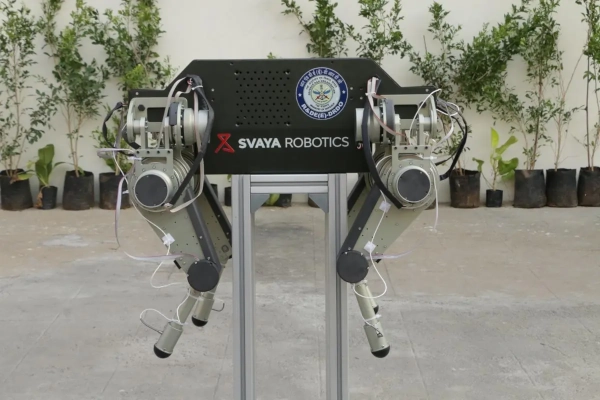
Svaya has also been associated with the development of an indigenous four-legged robotic demonstrator for defence and hazardous-environment applications. Together, these programmes place the company within a small but strategically important group of Indian enterprises working across mechanical engineering, precision manufacturing, actuators, embedded electronics, machine vision, motion control and artificial intelligence.
Moving Beyond Conventional Factory Automation
Traditional industrial robots usually operate inside fenced-off cells. They are programmed to perform a narrowly defined sequence such as welding the same joint, lifting the same component or repeating the same assembly movement.
Such systems are highly productive when a factory manufactures the same product in large quantities. They become less economical when production volumes are lower, product designs change frequently or workers need to enter the robot’s workspace.
Collaborative robots, commonly known as cobots, are designed to address this limitation. They incorporate force sensing, speed control, collision detection and other safety mechanisms that allow them to operate more closely with human workers.
Svaya describes its objective as developing human-centred robots that can be integrated into existing factories without requiring extensive reconstruction of the production environment. The company designs robotic hardware, writes its control software and develops the associated artificial-intelligence stack through a vertically integrated approach.
This integration is significant because a modern robot is not merely a mechanical arm. Its performance depends on the interaction between:
- Mechanical links and joints
- Electric motors and actuators
- Gearboxes and encoders
- Force and torque sensors
- Embedded control electronics
- Real-time operating software
- Motion-planning algorithms
- Machine-vision systems
- Digital twins
- Artificial-intelligence models
A company that controls more of these layers can optimise the complete machine instead of assembling a robot entirely from unrelated imported subsystems.
Svaya’s Six-Axis Collaborative Robots
Svaya’s principal industrial products include six-axis collaborative robotic arms intended for flexible factory automation.
A six-axis robot can move its arm through multiple directions and orientations, allowing it to approach a component from different angles. This makes the machine suitable for jobs such as loading machine tools, handling materials, applying adhesives, inspecting components and completing assembly operations.
Svaya states that its collaborative robots use torque sensors at every joint. These sensors measure the twisting force acting through the robot and allow the controller to detect physical contact, changes in load and resistance during an operation.
Joint-level torque sensing enables adaptive force control. Instead of only moving to a programmed coordinate, the robot can regulate how strongly it presses, pushes, inserts or polishes a component.
This capability is particularly valuable for operations such as:
- Precision assembly
- Connector insertion
- Surface polishing
- Grinding and deburring
- Component inspection
- Machine tending
- Welding
- Gluing and sealing
- Pick-and-place operations
- Wire-harness handling
The company says its collaborative robots have been engineered toward Category 4 and Performance Level d safety requirements under relevant international industrial-robot standards. It also describes the machines as having IP67 protection against dust and fluid exposure, making them suitable for demanding factory environments.
Compliance claims ultimately depend on the exact model, configuration and applicable independent certification. Nevertheless, designing around recognised functional-safety standards is essential when robots are expected to operate near people.
Robots That Workers Can Teach Physically
One of the barriers to robotic adoption among smaller manufacturers is the need for specialised programmers.
Svaya’s robots are designed to support physical teaching. An operator can guide the arm through a desired movement by pushing or pulling it into position. The robot records the movement and uses it as the basis for an automated task.
This approach can make robotic programming more accessible to production workers who understand the manufacturing process but may not possess advanced software skills.
Svaya also provides a web-based interface through which users can create workflows, control robots, connect external sensors and monitor operations. The interface is intended to work across the company’s robot platforms rather than requiring separate software for each machine.
Such accessibility is important for India’s manufacturing environment, where thousands of small and medium enterprises operate high-mix production lines. These factories may manufacture several different components in relatively small batches and therefore require robots that can be reassigned quickly.
Software-Defined Robotics
Svaya describes its machines as software-defined robots.
The term means that much of the robot’s behaviour can be altered through software rather than by rebuilding the physical machine. A robotic arm fitted with one tool may undertake material handling, while the same arm fitted with another tool and a different software workflow may perform inspection, welding or surface finishing.
Svaya’s open hardware interfaces allow industrial end-effectors to be attached to its robots. These end-effectors can include grippers, welding torches, cameras, polishing tools, screwdrivers, inspection probes or adhesive-dispensing systems.
The company’s software platform connects the robot with factory sensors, programmable logic controllers and external manufacturing equipment through standard communication interfaces.
This architecture can reduce dependence on one permanently configured robotic cell. It also allows manufacturers to change tasks as orders, products and production volumes evolve.
Using Digital Twins Before Deployment
Svaya incorporates digital-twin technology into its automation platform.
A digital twin is a virtual representation of a physical robot and its operating environment. Engineers can use it to simulate movements, test reach, identify collisions and validate a production workflow before deploying the actual machine.
Virtual validation can help answer practical questions:
- Can the robot reach every required component?
- Will its arm collide with a machine enclosure?
- Is the proposed movement unnecessarily long?
- Can two robots work in the same area safely?
- Will cables or tools interfere with the motion?
- How quickly can the robot complete the operation?
By identifying such problems virtually, manufacturers can reduce installation delays and physical trial-and-error.
Svaya’s platform also provides remote monitoring, operational analytics and application-programming interfaces through which developers can create additional functions.
Precision as an Indigenous Engineering Challenge
Building a robot arm is comparatively easy. Building one that repeatedly returns to the same point with industrial accuracy is considerably more difficult.
Small errors can arise from mechanical backlash, gearbox imperfections, structural deflection, sensor noise, thermal expansion and delays within the control system. These errors accumulate across every joint of the robot.
Svaya states that it co-designs mechanical structures, actuators, sensing and control systems to reduce such cumulative errors. Its control loop continuously recalculates position, velocity and torque commands at frequencies around 1,000 hertz.
According to the company’s technical testing, the control system of its SR-L6 collaborative robot maintains repeatability within a range of approximately ±20 microns under the tested conditions.
A micron is one-thousandth of a millimetre. Achieving reliable movement at this scale requires high-resolution absolute encoders, precise machining, rigid mechanical construction and tightly integrated control electronics.
Such capabilities have value beyond robotics. They contribute to India’s broader expertise in precision gearboxes, servo motors, industrial electronics, aerospace manufacturing, machine tools and advanced mechatronics.
The Bimanual Humanoid Robot
Svaya is also developing a bimanual humanoid robot.
Unlike a conventional single robotic arm, a bimanual machine has two coordinated arms mounted on a human-inspired upper-body structure. This configuration allows it to undertake tasks that require one arm to hold an object while the other manipulates it.
The robot has 17 actuators, including two seven-degree-of-freedom arms. Seven degrees of freedom allow each arm to reproduce a wide range of human-like movements and operate inside constrained workspaces.
The machine also incorporates:
- Full-body rotation
- Modular wrists
- Replaceable end-effectors
- Joint-level force sensing
- Stereo machine vision
- Coordinated head movement
- Object-detection capability
- Grasp planning
- Visual inspection
The modular wrist allows the robot to change tools according to the operation. It could use a gripper for handling, a specialised tool for assembly or a probe for inspection.
Svaya states that the platform has been engineered for sub-millimetre precision and includes stereo vision mounted on a movable head. This provides three-dimensional information about objects and the surrounding workspace.
Why Two Arms Matter
Many factory operations were originally designed around the human body.
Components are positioned at human working height. Tools are placed within arm’s reach. A worker may steady a part with one hand while using a tool with the other. Wiring, cloth, cables and flexible materials may require continuous repositioning.
A humanoid or bimanual robot can potentially enter these existing environments more easily than a completely redesigned automation system.
Possible applications include:
- Two-handed component assembly
- Cable and wire-harness installation
- Sorting irregular objects
- Packaging
- Operating human-designed tools
- Laboratory handling
- Electronic assembly
- Visual inspection
- Machine loading
- Handling flexible materials
The objective is not simply to make a robot resemble a person. The human-like form is useful because much of the world’s infrastructure, equipment and industrial workflow was created for human reach and movement.
Building Embodied Artificial Intelligence
A conventional artificial-intelligence model produces text, images, predictions or digital instructions. An embodied AI system must convert information into physical action.
It must understand the three-dimensional world, decide what movement is required and execute that movement without damaging the object, colliding with a person or losing balance.
Svaya is developing an embodied-AI framework that combines demonstrations, sensor data and physics-based simulations. The company says its training architecture employs vision-language models and large language models to interpret instructions and sequence tasks. Its motion planner then generates collision-free trajectories for the robot.
Reinforcement learning and digital-twin simulation are used to train reusable physical skills. These may include grasping, assembly, handling, welding and surface finishing.
The important concept is generalisation. Instead of programming one exact movement for one exact object, the robot should eventually adapt when the object’s position, orientation or appearance changes.
Reliable generalisation remains one of the central challenges facing humanoid robotics worldwide. Factory deployment requires considerably greater consistency and safety than a laboratory demonstration.
Svaya’s Indigenous Quadruped Programme
In 2023, Svaya Robotics presented an indigenously developed four-legged robot created with design inputs from two Defence Research and Development Organisation laboratories: the Research and Development Establishment in Pune and the Defence Bioengineering and Electromedical Laboratory in Bengaluru.
The system was described as a technology demonstrator intended to navigate rough and unstructured terrain, conduct remote reconnaissance and inspect locations considered unsafe for human personnel. Contemporary reports stated that the robot was designed to carry a payload of approximately 25 kilograms.
Four-legged robots offer several advantages over conventional wheeled unmanned ground vehicles.
A wheeled machine performs efficiently on roads and level surfaces but can be obstructed by stairs, rocks, trenches, debris or steep changes in terrain. A quadruped can place each foot independently, alter its body height and distribute its weight across changing contact points.
Potential missions include:
- Reconnaissance in difficult terrain
- Inspection of hazardous industrial sites
- Surveillance around sensitive installations
- Carrying equipment with soldiers
- Entering chemically contaminated areas
- Examining damaged buildings
- Tunnel and cave inspection
- Nuclear-facility monitoring
- Search-and-rescue support
However, the quadruped should be described carefully. Svaya’s present public product pages prominently list collaborative robots and the bimanual humanoid platform but do not list the four-legged machine as a regular commercial product. The available evidence therefore supports describing it as a defence-linked technology demonstrator, rather than as a mass-produced or operationally inducted system.
Robotics for Defence and Hazardous Environments
The foundational technologies developed for factory robots can be transferred to defence systems.
Torque-sensitive actuators, autonomous perception, terrain mapping, remote control and motion planning are relevant to military logistics, reconnaissance, explosive-ordnance handling and combat engineering.
A quadruped fitted with cameras, thermal sensors or chemical detectors could inspect an area before soldiers enter it. A dual-arm robot could manipulate hazardous materials, open doors, operate tools or handle suspicious objects.
The same technology could also be used in civilian emergencies involving fires, industrial accidents, collapsed buildings or toxic leaks.
DRDO’s current technology priorities include load-carrying four-legged robots, collaborative robotic manipulation, human–robot teaming and autonomous ground systems. This demonstrates the wider strategic demand for the type of technologies being explored by companies such as Svaya.
Powered Exoskeleton Development
Svaya has additionally worked on powered exoskeleton systems.
An exoskeleton is a wearable mechanical structure that follows the movement of the user. Motors, sensors and control systems can assist the wearer while walking, lifting or carrying loads.
Reports concerning Svaya’s DRDO-linked programme stated that the exoskeleton was being adapted to Indian soldiers’ body dimensions and intended to reduce fatigue while carrying equipment over long distances.
Possible applications extend beyond defence to:
- Industrial load handling
- Rehabilitation
- Mobility assistance
- Disaster response
- Warehousing
- Construction
- Occupational support
DRDO has identified exoskeletons, human–machine force interfaces, gait analysis, lightweight batteries and military load-carriage systems as important areas of soldier-support research.
As with the quadruped, publicly available information does not establish large-scale military induction. The programme is better understood as an advanced indigenous development effort.
Manufacturing in Hyderabad
Svaya’s importance to Make in India lies in its vertically integrated development model.
The company states that it designs its robots, develops the software and algorithmic stack, manufactures components and assembles the final systems through its own engineering and production structure. It also employs modular robot architecture intended to simplify manufacturing, repairs and the development of additional robot forms.
Its recruitment activities show continuing work in areas such as:
- Embedded systems
- Robot-control electronics
- Motion planning
- Mechanical design
- Wire-harness engineering
- Precision CNC manufacturing
- Automation integration
- Full-stack software
- Machine vision
- Manufacturing management
These are precisely the capabilities India must strengthen to reduce dependence on imported industrial robots.
Why Indigenous Industrial Robots Matter
Industrial robotics has strategic importance because robots manufacture other advanced products.
They are used to build automobiles, aircraft, electronics, medical devices, batteries, weapons, satellites and precision machinery. Dependence on imported robotic systems can create vulnerabilities involving cost, maintenance, software access, spare parts and export restrictions.
An indigenous robotics ecosystem can provide:
- Locally controlled software
- Faster technical support
- Customisation for Indian factories
- Reduced foreign-exchange expenditure
- Domestic spare-parts availability
- Protection of production data
- Integration with Indian machinery
- Employment in advanced engineering
- Defence and dual-use applications
- Export opportunities
The value therefore lies not only in the number of robots sold. It lies in developing the national capacity to design actuators, safety electronics, control systems, perception software and intelligent machines.
Challenges Ahead
Building a successful robotics company requires more than demonstrating an impressive prototype.
Industrial customers expect machines to operate reliably for thousands of hours. Robots must maintain accuracy under changing loads, temperatures and production conditions. Safety systems must respond correctly every time.
Svaya and other Indian robotics companies must compete with established international manufacturers possessing decades of production experience, global service networks and extensive component supply chains.
Major challenges include:
- Scaling precision manufacturing
- Obtaining internationally recognised certifications
- Establishing long-term reliability
- Reducing actuator and gearbox costs
- Developing domestic semiconductor and sensor supply chains
- Training robot integrators
- Creating after-sales support networks
- Protecting industrial data
- Financing long product-development cycles
- Converting humanoid demonstrations into economically useful machines
Humanoid robotics presents an especially difficult commercial challenge. A humanoid must offer sufficient flexibility to justify its greater complexity and cost compared with a conventional robot arm.
A Platform Rather Than a Single Robot
Svaya’s wider ambition appears to be the creation of a common Indian robotics platform.
Collaborative arms, dual-arm humanoids, exoskeletons and quadrupeds may appear to be different machines, but they share several foundational technologies:
- High-performance actuators
- Real-time motion control
- Force and torque sensing
- Embedded electronics
- Machine vision
- Digital simulation
- Human–robot interaction
- Artificial intelligence
- Safety engineering
Developing these layers as reusable building blocks can shorten the time needed to create new robotic forms.
A control system developed for a collaborative arm can contribute to the arm of a humanoid. Perception software developed for factory inspection can assist a quadruped operating in a hazardous site. Actuator technology can be adapted for an exoskeleton.
This platform approach is what makes Svaya particularly relevant to India’s high-technology manufacturing ambitions.
Conclusion
Svaya Robotics represents an important stage in the evolution of India’s robotics industry.
The company is not merely importing robot arms and integrating them into Indian factories. It is attempting to develop the mechanical systems, actuators, electronics, control software, digital twins and embodied-AI capabilities required to create intelligent machines within the country.
Its collaborative robots address immediate industrial requirements such as machine tending, assembly, inspection and material handling. Its bimanual humanoid platform explores the more difficult challenge of performing human-scale physical work with two coordinated arms and machine vision.
The DRDO-linked quadruped and exoskeleton projects extend these capabilities into defence, reconnaissance, hazardous inspection and soldier-support applications. These systems remain developmental rather than publicly confirmed mass-produced products, but they illustrate the wider technological foundation being created.
Svaya’s greatest contribution may therefore extend beyond any single robot. By building expertise across precision mechanics, software, sensing, artificial intelligence and manufacturing, the company is helping India develop the capacity to create the intelligent physical machines that will define future factories, logistics systems and defence operations.
Reference
- Svaya Robotics — official company overview and indigenous robotics-development approach.
- Svaya Robotics — collaborative and bimanual robot product specifications.
- Svaya Robotics — software platform, digital twins and embodied-AI architecture.
- Svaya Robotics — technical paper on robot accuracy, sensing and control.
- Telangana Today — Svaya–DRDO quadruped and exoskeleton development.
- The New Indian Express — indigenous quadruped technology demonstrator and reported payload.
- Defence Research and Development Organisation — autonomous-systems and robotics technology priorities.
- Defence Research and Development Organisation — soldier-support and exoskeleton research priorities.
You may also like
-
Bihar’s GI-Tagged Mithila Makhana Expands Global Reach as India Exports 7,265 Tonnes in FY26
-
Sigma Advanced Systems Secures ₹174 Crore Export Order for 155mm Artillery Ammunition Subsystems
-
Bharat Electronics Secures ₹1,011 Crore in New Defence Orders for Radar, Communication and Sonar Systems
-
NHPC Announces Commercial Operation of Fifth 250 MW Unit at Subansiri Lower Hydroelectric Project
-
India’s 300 kW Laser Weapon Ambitions Could Strengthen Future Defence Against Cruise Missiles
