In the earliest age, when mountains still seemed close to heaven and the rivers carried the memory of creation, the great sage Kashyapa lived in a hermitage surrounded by forests, lakes and flowering groves.
Kashyapa was a son of the ancient seer Marichi and one of the great progenitors through whom the many races of the world came into being. Among his wives were two sisters, Kadru and Vinata, daughters of Daksha Prajapati.
Though born of the same house, the sisters were very different.
Vinata possessed the brightness of the open sky. She was proud, impatient and drawn towards greatness. Kadru was quieter and more mysterious. Her thoughts moved like shadows beneath deep water, and her gaze often seemed fixed upon things hidden from ordinary sight.
For many years, both women longed for children.
One evening, when the forest was washed in the copper light of sunset, Kashyapa called them before him.
“My austerities have pleased the gods,” he said. “Ask me for the children your hearts desire.”
Kadru stepped forward first.
“Lord,” she said, “grant me a thousand sons—powerful, radiant and equal in splendour.”
Kashyapa blessed her.
“So shall it be.”
Vinata then spoke.
“I do not ask for a thousand. Grant me only two sons, but let each of them surpass Kadru’s thousand in strength, courage and glory.”
Kashyapa looked upon her thoughtfully.
“You shall have two sons of immeasurable power.”
Having granted their wishes, the sage returned to his austerities.
In time, Kadru brought forth one thousand eggs, while Vinata laid two. The eggs were placed in warm vessels and guarded with great care. Days became months, and months became years. Still the shells remained unbroken.
The sisters waited.
Seasons passed over the hermitage. Forests flowered and withered. Rivers rose during the rains and shrank beneath the summer sun. Generations of deer were born beneath the trees, while the eggs remained silent.
Kadru never lost faith. Each morning she visited the vessels and laid her hand upon them.
“My sons are gathering strength,” she would say. “The earth itself must prepare before they emerge.”
Five hundred years passed.
Then, one dawn, the stillness was broken.
A faint crack appeared upon the surface of one egg. Then another split. Soon the entire chamber filled with the dry music of shells opening.
From them emerged serpents—hundreds upon hundreds—shining, coiling and hissing as they entered the world.
Some gleamed like polished gold. Some were white as moonlight. Some were green as forest leaves after rain, while others were dark as storm clouds. Their eyes burned like embers, and their hoods bore strange and beautiful markings.
Kadru stood among them in wonder.
Her wish had been fulfilled.
From her thousand eggs had arisen the Nagas, the mighty serpent race.
Among them was Shesha, vast in strength and calm in spirit. Unlike many of his brothers, he had little desire for conflict, rivalry or worldly power. He turned away from quarrels and devoted himself to severe austerities.
So great was his discipline that Brahma appeared before him.
“Ask for a boon,” said the Creator.
Shesha bowed.
“Grant me the strength to remain steadfast in righteousness. I wish to be free from anger and from the destructive impulses that trouble my brothers.”
Brahma was pleased.
“You shall become a foundation of the worlds. Beneath the earth you will bear its weight and keep it steady.”
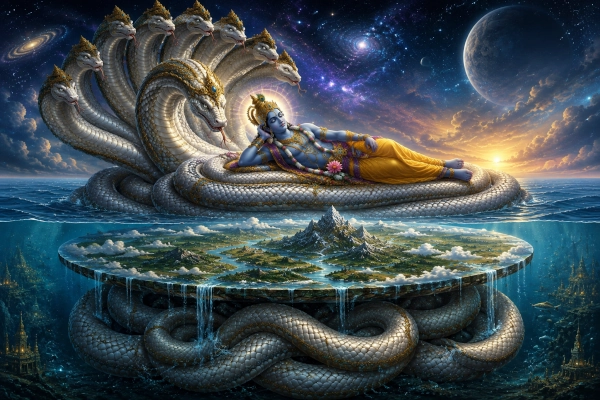
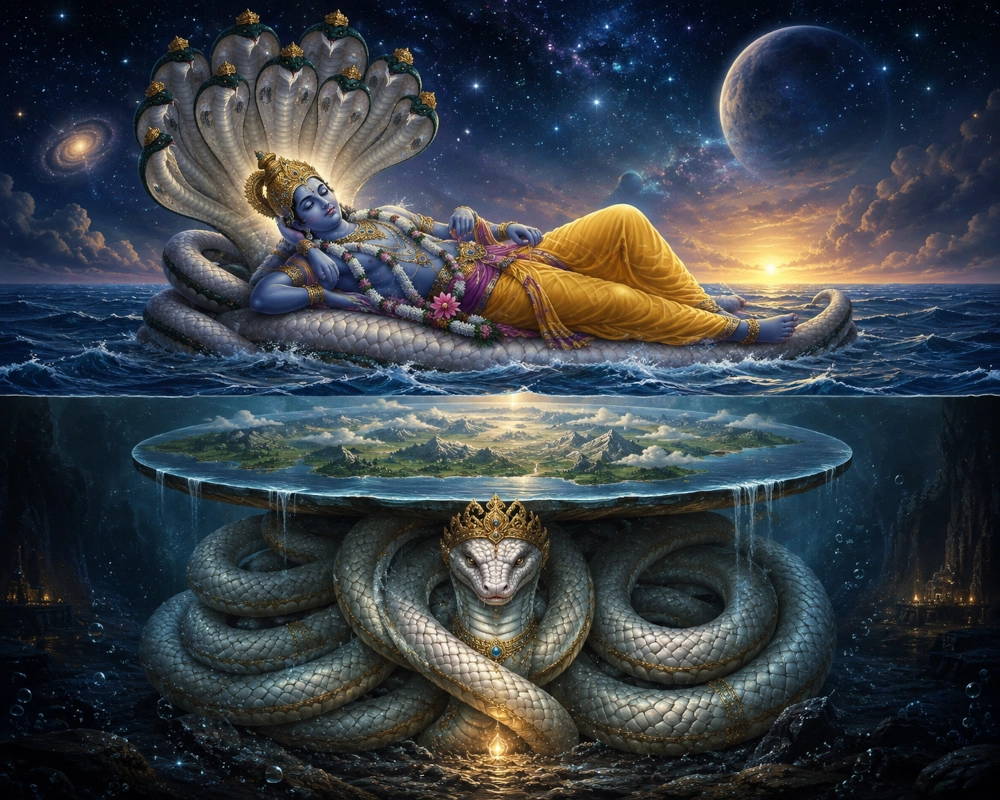
Thus Shesha descended below the world and supported it upon his immeasurable coils. In later ages he would also become the divine couch upon which Lord Vishnu rested upon the cosmic ocean.
Another of Kadru’s sons was Vasuki, splendid and powerful, who became king among the Nagas. Jewels shone upon his hood, and his authority was recognised throughout the serpent realms.
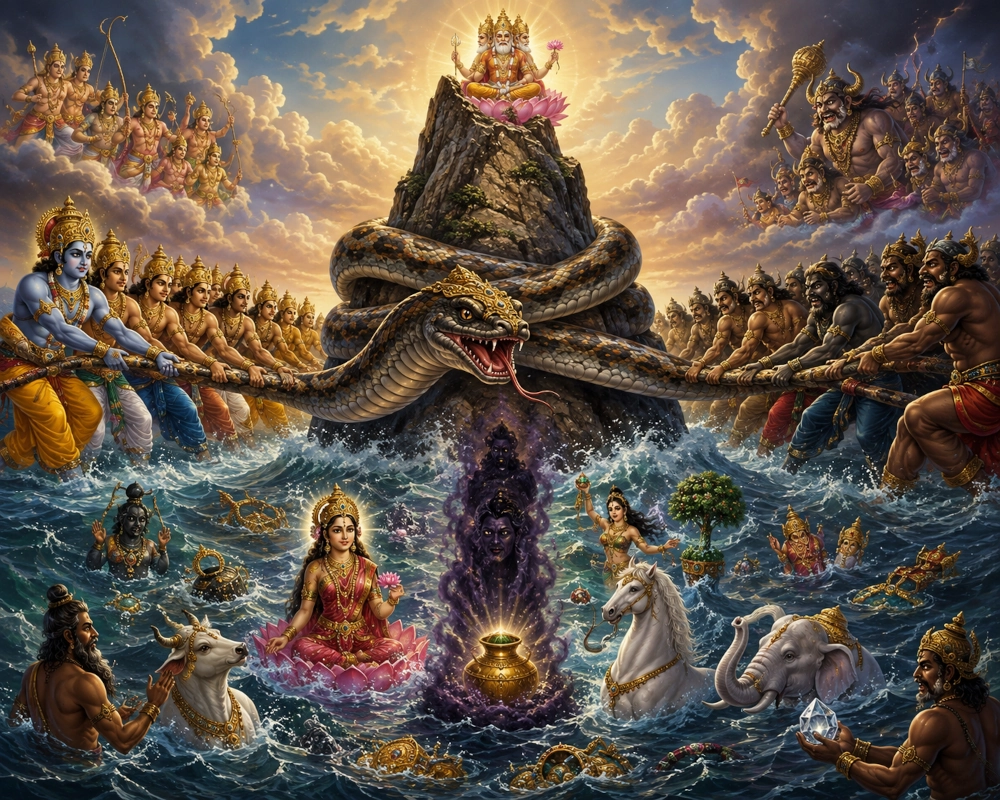
In a later age, when the gods and Asuras sought the nectar of immortality, Vasuki would allow himself to be used as the great churning rope wound around Mount Mandara. Pulled from both ends, he would endure terrible strain as the ocean yielded poison, treasures and finally Amrita.
There was also Takshaka, fierce, proud and swift as lightning. He would become lord of a powerful serpent kingdom and a central figure in the destiny of the Kuru line. His name would one day be linked with the death of King Parikshit and the terrible serpent sacrifice begun by Janamejaya.
Among Kadru’s other sons were renowned Nagas such as Karkotaka, Airavata, Kaliya and many more. Some lived beneath the earth in magnificent palaces filled with gems. Some guarded rivers, lakes, forests and sacred places. Some became protectors, while others became feared for their venom and wrath.
The realm of the Nagas was said to be a place of dazzling beauty. Its halls were illuminated by jewels set upon serpent hoods. Its pillars glittered like crystal, and its gardens were filled with strange flowers untouched by the seasons.
Yet greatness carried danger within it.
Many of Kadru’s sons possessed immense strength, but they were also proud and difficult to govern. They quarrelled among themselves and sometimes acted with cruelty. Their mother loved them, yet she understood that their power could become destructive.
Meanwhile, Vinata continued to wait beside her two eggs.
When Kadru’s thousand sons surrounded their mother, Vinata’s heart grew heavy. She had asked for only two sons, trusting that their greatness would surpass number. But after five hundred years, her eggs had still not opened.
Impatience overcame her.
She broke one shell before its time.
From it emerged Aruna, radiant from the waist upward but incompletely formed below. His face shone with divine fire, yet sorrow filled his eyes.
“Mother,” he said, “your impatience has left me unfinished. Because you could not wait, you will one day become the servant of Kadru. But your bondage will not last forever. Leave the second egg untouched. In time, the son born from it will free you.”
Aruna then rose into the heavens and became the charioteer of Surya, the Sun God. Each dawn, his crimson radiance would soften the sun’s fierce brilliance before it reached the world.
Vinata, grieved by her mistake, guarded the remaining egg with patience.
From that egg would later emerge Garuda, the mighty king of birds.
Thus, within the same household, the future of two great races was prepared: the Nagas, born from Kadru, and Garuda, born from Vinata.
They were related by blood, yet destiny would make them enemies.
The cause would arise from a wager concerning the celestial horse Uchchaihshravas. Kadru would ask her serpent sons to deceive Vinata by clinging to the horse’s tail and making it appear black. Some Nagas would refuse to participate in the fraud.
Angered by their disobedience, Kadru would curse them to perish in a future serpent sacrifice.
That terrible curse would cast its shadow over generations. It would eventually lead to King Janamejaya’s Sarpa Satra, where countless serpents were summoned into a sacrificial fire. Vasuki and the Nagas would then depend upon the wisdom of the young sage Astika to save their race from destruction.
Yet all those events still lay far in the future.
For now, Kadru stood beneath the ancient trees, surrounded by her thousand sons.
Their bodies coiled around branches, stones and one another. Their hoods rose like living crowns. Their scales caught the morning light, flashing gold, silver, green and black.
Some would become guardians of treasure. Some would dwell in rivers and forests. Some would uphold the earth, while others would challenge kings and heroes. They would inspire fear, reverence and wonder in equal measure.
Kadru looked upon them and understood that she had not merely become the mother of many children.
She had become the mother of a race whose destiny would wind through the Mahabharata like a serpent through tall grass—sometimes concealed, sometimes deadly, and always close to the hidden foundations of the world.
You may also like
-
Gnani AI Launches Nationwide Challenge Offering Up to 100 Paid AI Internships
-
NMMSS Scholarship Application Deadline Extended to October 31, 2026
-
DGCA Introduces Training Framework for Gyroplane Pilots in India
-
DRDO CASDIC Opens 30 Paid Internships for Engineering and Science Students
-
Duryodhana Wins Shalya Through Hospitality: Gifts, Obligation and Political Leverage Before the Kurukshetra War
