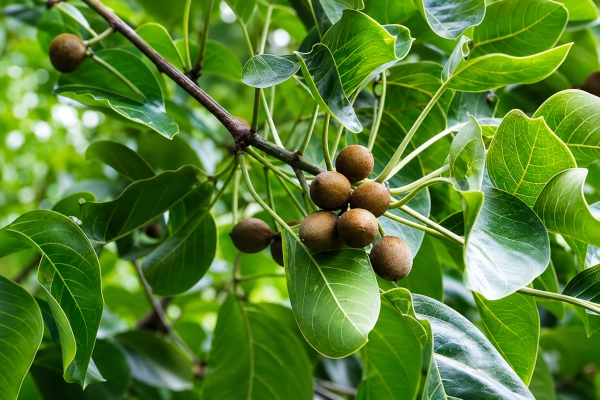
Vibhitaki: The Ayurvedic Belleric Myrobalan
Vibhitaki, also written as Bibhitaki or Bhibitaka, is one of the most important fruits used in Ayurveda. It is obtained from the large deciduous tree Terminalia bellirica (Gaertn.) Roxb., belonging to the family Combretaceae. The dried fruit pericarp is the principal medicinal part used in Ayurvedic formulations.
Vibhitaki is best known as one of the three ingredients of Triphala, together with Haritaki and Amalaki. Its traditional reputation, however, extends well beyond Triphala. Ayurvedic texts associate it particularly with Kapha disorders, sluggish digestion, cough, excessive mucus, bowel irregularity and disturbances involving Meda, or adipose tissue.
The accepted botanical name is Terminalia bellirica (Gaertn.) Roxb. The species is native across the Indian subcontinent and extends through parts of China and Southeast Asia. It commonly grows as a large tree in tropical and mixed deciduous forests.
Names of Vibhitaki
Sanskrit: Vibhitaki, Bibhitaka, Aksha, Kalidruma
Hindi: Baheda, Bahera
English: Belleric myrobalan
Malayalam: Thanni, Thannikka
Tamil: Thandri, Tani
Telugu: Tandra
Botanical name: Terminalia bellirica
Family: Combretaceae
Part used: Dried fruit pericarp
The Ayurvedic Pharmacopoeia of India identifies the medicinal drug as the dried fruit pericarp. Kew’s medicinal-plant database also records Vibhitaki, Baheda and belleric myrobalan as names associated with Terminalia bellirica.
Description of the Tree and Fruit
Vibhitaki is a tall, spreading tree that may develop a broad crown and a strong trunk. Its leaves are generally large, leathery and clustered near the ends of branches. The flowers are small and greenish-white, while the fruits are round to oval drupes that become greyish or brown when mature and dried.
The dried fruit commonly measures a few centimetres across and has a firm outer surface. Its medicinal portion is the pericarp surrounding the hard seed. Traditional pharmacies remove or exclude the seed and use the dried fruit covering in powders, decoctions, confections and compound preparations.
Ayurvedic Properties of Vibhitaki
Classical descriptions of Vibhitaki are commonly summarised through the following attributes:
Rasa — taste: Predominantly Kashaya, or astringent
Guna — qualities: Laghu and Ruksha, or relatively light and drying
Virya — potency: Ushna, or heating, according to many traditional authorities
Vipaka — post-digestive effect: Madhura
Dosha action: Especially reduces Kapha and helps regulate Pitta; its drying nature requires care where Vata is already aggravated
Principal actions: Kaphahara, Kasahara, Shwasahara, Deepana, Pachana, Krimighna, Medohara and Chakshushya
The name Vibhitaki is traditionally interpreted as “that which removes fear of disease.” This interpretation reflects the fruit’s wide place in Ayurvedic medicine rather than a literal claim that it prevents every illness.
Vibhitaki and Kapha Balance
Vibhitaki is strongly associated with the management of excess Kapha. Kapha imbalance may be expressed through heaviness, sluggish digestion, excessive mucus, congestion, lethargy and slow metabolic activity.
The fruit’s astringent, drying and penetrating qualities are traditionally used to counter excessive moisture and mucus. It therefore appears in formulations for productive cough, throat congestion, respiratory heaviness and Kapha-related digestive disturbances.
Vibhitaki should not be reduced to a single “anti-mucus” herb. Its action depends upon the accompanying ingredients, the preparation method, the individual’s constitution and the condition being treated.
Role in Digestion
Although Vibhitaki is markedly astringent, Ayurveda also employs it in formulations intended to improve digestive efficiency. It may be combined with warming substances such as dry ginger, long pepper, black pepper, ajwain, asafoetida and rock salt.
Such combinations are designed to:
- kindle Jatharagni, or digestive fire;
- reduce heaviness after eating;
- support the digestion of poorly processed food;
- relieve Kapha–Vata obstruction;
- encourage proper movement within the gastrointestinal tract.
The recipe described later in this article is a clear example of this approach. Vibhitaki is combined with Triphala ingredients, pungent spices, asafoetida, rock salt and jaggery to produce a digestive Modaka.
Vibhitaki in Triphala
Vibhitaki forms one-third of Triphala, the classical combination of:
- Haritaki — Terminalia chebula;
- Vibhitaki — Terminalia bellirica;
- Amalaki — Phyllanthus emblica.
The three fruits are traditionally regarded as complementary. Haritaki is closely associated with Vata regulation, Vibhitaki with Kapha balance and Amalaki with Pitta support.
The fruit pericarps of these three plants constitute the classical Triphala combination. Modern analyses have identified polyphenols and tannin-related compounds such as gallic acid, ellagic acid, chebulagic acid, chebulinic acid and corilagin in Triphala and its constituent fruits.
Traditional Applications of Vibhitaki
Kasa and respiratory congestion
Vibhitaki is traditionally used in formulations for Kasa, particularly where cough is accompanied by Kapha, mucus and chest heaviness. Its drying and astringent nature is balanced with honey, Pippali, ginger or other warming ingredients depending on the condition.
Persistent cough, breathing difficulty, fever, blood in sputum or chest pain requires medical assessment.
Agnimandya
Agnimandya refers to impaired or weakened digestive activity. It may present as poor appetite, heaviness, belching, bloating, sluggish digestion and discomfort after meals.
Vibhitaki is rarely used alone for pronounced Agnimandya. It is generally combined with Deepana herbs because its own astringency may be too drying when administered without appropriate balancing ingredients.
Krimi
Vibhitaki is described as Krimighna in traditional practice and appears in preparations intended for intestinal imbalance or worm-related conditions. Such use belongs to Ayurvedic clinical practice and should not replace modern diagnosis and prescribed antiparasitic treatment.
Meda and metabolic heaviness
Its drying and Kapha-reducing qualities have led to its inclusion in formulations for excessive Meda, heaviness and sluggish metabolism. These traditional applications should not be presented as evidence that Vibhitaki alone produces medically significant weight loss.
Eyes and hair
Vibhitaki is also described as Chakshushya in several Ayurvedic traditions and appears in formulations relating to eye health. Traditional uses involving the eyes require particular caution because homemade powders, washes or drops may cause infection or injury.
The fruit is also used in some oils and hair preparations, although current evidence does not establish it as a treatment for clinically diagnosed hair-loss disorders.
The Chakradatta Manuscript
The recipe supplied with this article is attributed to Chakradatta, Chapter 6, verse 13. Chakradatta, also known as Chikitsa Sangraha, is a major Ayurvedic therapeutic compendium associated with the physician-scholar Chakrapanidatta. The work is valued for arranging formulations according to diseases and presenting practical combinations drawn from earlier Ayurvedic traditions.
Unlike texts centred primarily on theory, Chakradatta is strongly treatment-oriented. It contains decoctions, powders, pills, medicated oils, ghee preparations and dietary formulations intended for clinical use. Its influence can be seen in later Ayurvedic formularies and regional medical traditions.
The formulation shown in the supplied source is officially reproduced in the Food Safety and Standards Authority of India’s notified compilation of Ayurveda Aahara recipes under the name Sindhutthadi Modaka. The official compilation cites Chakradatta 6/13 and classifies it as an Ashita, or eatable preparation.
Sindhutthadi Modaka
Sweet and Spicy Digestive Balls
Classical reference: Chakradatta, 6/13
Category: Ashita — eatable preparation
Traditional property: Jatharagni Deepaka
Traditional benefit: Agnimandya, or low digestive fire
Ingredients
| Ingredient | Common or botanical identity | Part used | Ratio |
|---|---|---|---|
| Guda | Jaggery | — | 9 parts |
| Saindhava Lavana | Rock salt | — | 1 part |
| Hingu | Asafoetida, Ferula species oleo-gum-resin | Oleo-gum-resin | 1 part |
| Haritaki | Chebulic myrobalan, Terminalia chebula | Fruit pericarp | 1 part |
| Vibhitaki | Belleric myrobalan, Terminalia bellirica | Fruit pericarp | 1 part |
| Amalaki | Indian gooseberry, Phyllanthus emblica | Fruit pericarp | 1 part |
| Yavani | Ajwain or carom, Trachyspermum ammi | Fruit | 1 part |
| Shunthi | Dry ginger, Zingiber officinale | Rhizome | 1 part |
| Pippali | Long pepper, Piper longum | Fruit | 1 part |
| Maricha | Black pepper, Piper nigrum | Fruit | 1 part |
The official recipe table uses the older botanical designation Emblica officinalis for Amalaki. The currently accepted name is commonly given as Phyllanthus emblica.
Method of preparation
- Clean and dry all the herbal ingredients properly.
- Powder Saindhava, Hingu, Haritaki, Vibhitaki, Amalaki, Yavani, Shunthi, Pippali and Maricha separately.
- Sieve the powders to obtain a uniform texture.
- Combine all the powdered ingredients in the prescribed proportions.
- Add the required quantity of softened or powdered jaggery.
- Mix thoroughly to form a uniform mass.
- Shape the mixture into small Modakas or balls.
The notified Ayurveda Aahara compilation instructs that all ingredients be powdered, mixed thoroughly and formed into small balls. It describes the preparation as Jatharagni Deepaka and states that it may be beneficial in Agnimandhya.
How the Formula Is Structured
Sindhutthadi Modaka is more than a sweetened herbal ball. Its formulation follows a deliberate Ayurvedic logic.
Triphala base
Haritaki, Vibhitaki and Amalaki together form Triphala. Within this recipe, they provide a balanced fruit-based foundation and support gastrointestinal regulation.
Trikatu component
Shunthi, Pippali and Maricha together resemble the classical Trikatu combination. These pungent ingredients are strongly associated with Deepana and Pachana actions.
Hingu and Yavani
Asafoetida and ajwain are traditionally used for abdominal gas, Vata obstruction, poor digestion and discomfort after meals.
Saindhava Lavana
Rock salt is traditionally regarded as more agreeable and digestive than many other salts. In small quantities, it helps improve palatability and supports digestive activity.
Guda
Jaggery binds the powders and allows the preparation to be shaped into Modakas. Its sweetness balances the sharp, salty and astringent ingredients.
Vibhitaki’s Role in the Recipe
Vibhitaki contributes astringency and Kapha-reducing qualities. Used alone, such astringency might not be ideal for a person with weak digestion. In Sindhutthadi Modaka, however, it is surrounded by warming and pungent ingredients.
Dry ginger, long pepper, black pepper, ajwain and asafoetida help prevent the formulation from becoming excessively cold or constricting. Jaggery provides the base, while rock salt supports taste and digestion. The result is a balanced classical combination rather than a collection of unrelated ingredients.
Modern Scientific Perspective
The fruits of Terminalia bellirica contain tannins, polyphenols and related compounds. Reported constituents include gallic acid, ellagic acid, corilagin, chebulagic acid and chebulinic acid. Modern research has explored antioxidant, antimicrobial, anti-inflammatory, gastrointestinal and metabolic effects.
Most of this research consists of laboratory studies, animal experiments or chemical analyses. It does not prove that Vibhitaki cures human diseases. Reviews of Terminalia species repeatedly note the need for stronger clinical trials, standardised preparations and clearer dose–response data.
A 2025 experimental study reported activity of Terminalia bellirica extracts against Helicobacter pylori in laboratory and animal models. The authors also stated that further work and clinical validation were required.
Precautions
Vibhitaki and Sindhutthadi Modaka should be used carefully because the formula contains several potent digestive substances.
The formulation may be unsuitable in cases involving:
- active gastritis or peptic ulcer;
- severe acid reflux or burning sensation;
- inflammatory bowel symptoms;
- dehydration or marked dryness;
- pregnancy without professional supervision;
- very young children;
- unexplained weight loss or prolonged loss of appetite;
- severe diarrhoea or persistent constipation.
Hingu, Pippali, Maricha, Shunthi and Yavani are heating and pungent. Excessive intake may cause burning, abdominal irritation or worsening of Pitta-related symptoms. Jaggery also contributes a considerable sugar load and may require restriction in diabetes or other conditions requiring controlled carbohydrate intake.
People taking anticoagulants, antidiabetic medicines, gastrointestinal medicines or multiple prescription drugs should consult a qualified clinician before using concentrated herbal formulations.
No dosage is specified in the supplied table. A dose should therefore not be inferred merely by converting the classical ratios into household quantities. Preparation and use are best guided by a qualified Ayurvedic physician.
Conclusion
Vibhitaki is a central Ayurvedic fruit known for its place in Triphala and its traditional relationship with Kapha balance, digestion, respiratory congestion and metabolic heaviness. Its dried fruit pericarp is used in powders, decoctions, confections and compound formulations.
The Sindhutthadi Modaka of Chakradatta demonstrates how Vibhitaki can be incorporated into a carefully balanced digestive preparation. Triphala is combined with Trikatu-like spices, ajwain, asafoetida, rock salt and jaggery to create a sweet, salty, pungent and astringent Modaka intended to stimulate Jatharagni.
Its historical and dietary importance is substantial, but its medicinal ingredients also demand restraint. The recipe should be understood as a classical Ayurvedic formulation rather than an unrestricted digestive sweet.
Copy-Pastable Reference Block
References
- Chakrapanidatta. Chakradatta or Chikitsa Sangraha, Chapter 6, verse 13: Sindhutthadi Modaka.
- Food Safety and Standards Authority of India. Ayurveda Aahara: Category-wise List of Recipes, Sindhutthadi Modaka, Recipe 20.5.
- Royal Botanic Gardens, Kew. Plants of the World Online: Terminalia bellirica (Gaertn.) Roxb.
- Royal Botanic Gardens, Kew. Medicinal Plant Names Services: Terminalia bellirica, Vibhitaki and belleric myrobalan records.
- Cock IE. The medicinal properties and phytochemistry of plants of the genus Terminalia. Inflammopharmacology. 2015;23(5):203–229.
- Zhang XR, Kaunda JS, Zhu HT, et al. The genus Terminalia: an ethnopharmacological, phytochemical and pharmacological review. Natural Products and Bioprospecting. 2019;9:357–392.
- Peterson CT, Denniston K, Chopra D. Therapeutic uses of Triphala in Ayurvedic medicine. Journal of Alternative and Complementary Medicine. 2017;23(8):607–614.
- Ayurvedic Pharmacopoeia of India. Monograph on Vibhitaki or Baheda, dried fruit pericarp of Terminalia bellirica.
Health disclaimer: This article presents traditional Ayurvedic information for education and documentation. It is not medical advice, a prescription or proof of efficacy for any disease. Classical formulations should be prepared and used under the guidance of a qualified Ayurvedic physician.
You may also like
-
Ritucharya: How Ayurveda Adapts Lifestyle to the Six Seasons
-
India Backs Ceramat to Commercialise 3D-Printed Patient-Specific Bone Grafts
-
Dinacharya in Ayurveda: Building a Daily Routine for Better Health
-
Abhyanga: The Ayurvedic Practice of Daily Oil Massage
-
Dr. Reddy’s Launches Made-in-India Nivolumab Biosimilar NIVORZ Across 12 Cancer Indications
