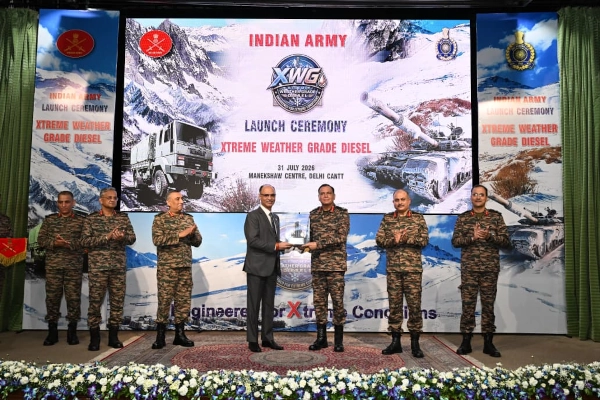
The Indian Army has introduced an indigenously developed specialised diesel capable of functioning in temperatures as low as minus 42 degrees Celsius, strengthening the reliability of military vehicles deployed in high-altitude and severe winter conditions.
Chief of the Army Staff General Dhiraj Seth launched the Xtreme Weather Grade Diesel in New Delhi on July 31, 2026. The fuel was jointly developed by the Indian Army and public-sector Oil Marketing Companies to improve the mobility, safety and operational availability of combat and logistics vehicles operating in extreme climates.
Designed for High-Altitude Military Operations
Conventional diesel tends to thicken when exposed to very low temperatures. This can block fuel filters, restrict fuel flow and prevent engines from starting or operating efficiently. Such problems can seriously affect troop movement, logistics and equipment availability in snow-bound and high-altitude regions.
Xtreme Weather Grade Diesel has been formulated to overcome these limitations. It remains usable at temperatures down to minus 42 degrees Celsius, allowing military vehicles and equipment to function more reliably during severe winters.
The fuel can be used across the Indian Army’s existing vehicle fleet without requiring engine modifications or fresh homologation. This enables faster deployment while avoiding the cost and operational disruption associated with redesigning or replacing vehicle systems.
The specialised diesel complies with Bharat Stage VI emission standards and conforms to IS 1460:2025 specifications.
Improved Mobility and Mission Reliability
Speaking at the launch, General Dhiraj Seth described the new fuel as a game-changing indigenous innovation that would improve operational preparedness and mission reliability in extreme climatic conditions.
Military vehicles deployed in mountain regions must remain ready for immediate movement, regardless of temperature. Fuel-related problems can delay troop transport, ammunition supply, casualty evacuation and the movement of essential equipment.
By reducing cold-weather fuel failures, Xtreme Weather Grade Diesel is expected to improve the availability of both combat and logistics vehicles. It will also support safer and more dependable operations in strategically important high-altitude areas.
Ending Hazardous Winter Practices
Until now, personnel in extremely cold regions often had to adopt additional measures to prevent diesel from thickening or freezing inside fuel systems. Such practices could involve continuous engine operation, heating arrangements and other temporary interventions to keep vehicles functional.
The new diesel is expected to reduce the need for these measures. This will conserve fuel, simplify winter maintenance and lower the risks faced by personnel while preparing vehicles for operations in freezing conditions.
General Seth said the innovation would improve the safety and morale of soldiers deployed in severe winter environments by providing them with more dependable transport and equipment.
Developed Within One Year
The specialised fuel was developed within a year through cooperation between the Indian Army and Oil Marketing Companies. The relatively short development period demonstrates the potential of coordinated defence-industry research focused on clearly defined operational challenges.
The Army Chief commended the teams involved and expressed confidence that the collaboration could lead to the development of additional specialised fuels for different terrains, climatic zones and military requirements.
Future formulations could potentially be tailored for deserts, high-altitude operations, extended storage, specialised engines and other demanding defence applications.
Civilian Applications in Cold Regions
Although developed primarily for the armed forces, Xtreme Weather Grade Diesel also has significant civilian potential.
Residents, transport operators, emergency agencies and infrastructure organisations in Himalayan and other severe winter regions frequently face similar fuel-related challenges. The new diesel could improve the reliability of buses, trucks, construction machinery, ambulances, generators and other equipment operating in freezing temperatures.
More dependable fuel could also support tourism, road construction, disaster response and essential supply services in remote mountain areas where vehicle failure can have serious consequences.
Strengthening Indigenous Defence Capability
The development of Xtreme Weather Grade Diesel represents a practical example of the Atmanirbhar Bharat initiative. Instead of depending on imported specialised fuels or costly technological modifications, Indian institutions have developed a solution suited to the country’s own operational environment.
The innovation also underlines the growing emphasis on indigenous technologies that improve not only major weapons platforms but also the logistical systems required to sustain military operations.
By ensuring that vehicles remain functional in temperatures reaching minus 42 degrees Celsius, the new fuel can strengthen mobility, reduce maintenance difficulties and improve the Indian Army’s readiness in some of the country’s most demanding operational regions
Source: PIB
You may also like
-
EON Space Labs and Dhruva Space Advance Indian Space Hardware on Transporter-18 Mission
-
SatLeo Labs’ TAPAS-1 Reaches Orbit, Advancing India’s Private Thermal-Imaging Capability
-
TakeMe2Space’s MOI-1A Reaches Space on Falcon 9 Transporter-18 Mission
-
PRAHAAR: India’s First National Counter-Terrorism Policy and Strategy
-
SCI and India’s Push for a Larger Indigenous Maritime Fleet
