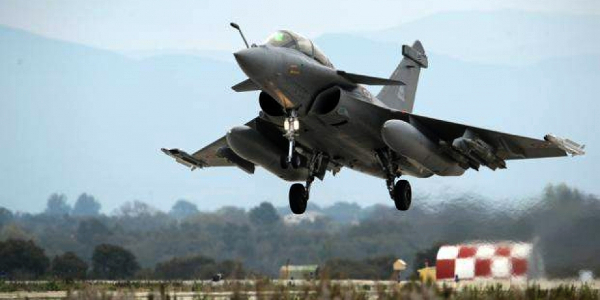
India has moved closer to one of the largest combat-aircraft acquisitions in its history, with the proposed purchase of 114 Rafale multirole fighters for the Indian Air Force entering the government-to-government negotiation stage. The programme is intended to rebuild the IAF’s declining fighter strength, expand its long-range strike capability and establish a substantial Rafale manufacturing ecosystem in India.
The Defence Acquisition Council, chaired by Defence Minister Rajnath Singh, granted Acceptance of Necessity for the Multi-Role Fighter Aircraft programme in February 2026. The Rafale proposal formed part of capital-acquisition approvals estimated at approximately ₹3.60 lakh crore. The Ministry of Defence stated that the aircraft would strengthen India’s ability to conduct air-dominance missions and long-range precision strikes across the spectrum of conflict. It also confirmed that the majority of the fighters would be manufactured in India.
India subsequently sent a formal Letter of Request to the French government, outlining the IAF’s operational requirements and the proposed procurement framework. France is expected to respond with technical, commercial and industrial details, after which formal negotiations can determine the aircraft configuration, weapons package, delivery schedule, indigenous-content commitments, technology transfer, maintenance arrangements and final price. France was reported in late July to be preparing its response by around mid-August 2026.
Why the Indian Air Force Needs More Fighters
The proposed acquisition comes amid concern over the IAF’s shrinking number of fighter squadrons. India has an authorised strength of 42 fighter squadrons, while the operational figure has fallen to around 29 as older MiG-series aircraft are progressively retired. At the same time, China is expanding and modernising the People’s Liberation Army Air Force, while Pakistan continues to induct and upgrade aircraft such as the JF-17 and J-10CE.
The IAF is inducting the indigenous Tejas Mk1A and developing the more capable Tejas Mk2 and Advanced Medium Combat Aircraft. These programmes, however, require time to reach their intended production rates and fleet strength. The Rafale acquisition is therefore intended to provide a proven, high-end platform alongside India’s indigenous fighter programmes rather than replace them.
A fleet of 114 additional aircraft would theoretically support six new fighter squadrons, depending on the final aircraft allocation, training establishment and reserve strength. Combined with the 36 Rafales already operated by the IAF, India could eventually possess a land-based Rafale fleet of 150 aircraft.
The Indian Navy is separately acquiring 26 Rafale Marine fighters for aircraft-carrier operations. Although the naval and air-force versions have important structural and operational differences, the enlarged Rafale ecosystem could create benefits in training, weapons procurement, maintenance infrastructure, simulators and lifecycle support.
Most Aircraft to Be Manufactured in India
Local production is expected to be one of the defining elements of the programme. The government has officially stated that the majority of the 114 aircraft will be manufactured domestically. Reports have suggested that roughly 90 to 96 fighters could be assembled or manufactured in India, while an initial batch of approximately 18 to 24 aircraft could arrive from France in fly-away condition. These figures remain subject to negotiation and have not all been formally confirmed by the Ministry of Defence.
The Indian production line would require extensive domestic participation in airframe manufacturing, systems integration, testing, certification, maintenance and component supply. India is expected to seek substantial indigenous content along with the transfer of manufacturing knowledge and selected technologies.
The programme’s long-term value will depend on the depth of local production. Simple final assembly would provide fewer strategic gains than domestic manufacture of major structural sections, avionics components, wiring systems, electronic equipment, landing-gear elements and mission-system subassemblies.
A properly structured programme could create a network of Indian suppliers capable of supporting both domestic Rafale operations and Dassault Aviation’s international production requirements. This would help India move from licensed assembly toward higher-value aerospace engineering, quality assurance and systems integration.
Possible Industrial Structure
Dassault Aviation is expected to work with one or more Indian industrial partners, although the final production arrangement has yet to be publicly announced. Reports indicate that the French manufacturer may assume direct responsibility for integration, production quality and validation of aircraft built in India.
Such an arrangement would seek to avoid the difficulties encountered during the earlier Medium Multi-Role Combat Aircraft negotiations, where disagreement over responsibility for aircraft manufactured domestically became one of the major obstacles to concluding the programme.
The new structure could give Dassault tighter control over production standards while allowing Indian companies to gradually absorb more manufacturing work. The precise responsibilities of Dassault, its Indian partners and government-owned aerospace companies will become clearer only after commercial and industrial negotiations are completed.
Expected Rafale Configuration
India is likely to seek an advanced Rafale standard incorporating improvements in sensors, electronic warfare, connectivity, weapons integration and survivability. France is developing the Rafale F4 standard, while further upgrades under the future F5 programme are planned for the next decade.
The final Indian configuration could draw on the capabilities of the F4 standard while retaining India-specific enhancements already integrated into the existing IAF fleet. The 36 aircraft currently in service were modified with specialised features intended for Indian operating conditions and mission requirements.
These enhancements reportedly include helmet-mounted displays, improved electronic-warfare capabilities, cold-weather starting equipment, advanced identification systems and modifications for Indian weapons and communications requirements. The precise configuration of the new aircraft will remain classified or commercially sensitive.
Weapons and Combat Capabilities
The Rafale is designed for air defence, air superiority, deep strike, reconnaissance, maritime operations and nuclear-deterrence missions. It can undertake several mission types during a single sortie, giving it the “omnirole” description used by Dassault Aviation.
India’s existing Rafales employ the Meteor beyond-visual-range air-to-air missile, the MICA air-to-air missile and the SCALP long-range cruise missile. The Hammer precision-guided weapon has also been integrated for attacks against hardened and fixed targets.
The Meteor is particularly important because its ramjet propulsion provides a large engagement envelope and a substantial no-escape zone against hostile aircraft. The SCALP allows the Rafale to strike high-value targets from stand-off distances, reducing its exposure to hostile air-defence systems.
The new package could include additional missiles, precision-guided weapons, electronic-warfare systems, simulators, training equipment and performance-based logistics. The final contract value will depend heavily on the number and type of weapons, spares and support systems included.
Sensors and Electronic Warfare
The Rafale is equipped with the RBE2 active electronically scanned array radar, which can track multiple targets and support simultaneous air-to-air and air-to-ground operations.
Its Front Sector Optronics system provides passive infrared and electro-optical detection, allowing the aircraft to locate and identify targets without continuously emitting radar energy.
A central element of the aircraft’s survivability is the SPECTRA electronic-warfare suite. It detects and analyses hostile radar, missile and laser threats and can activate jamming, decoys and evasive responses. The combination of radar warning, electronic support measures and defensive countermeasures gives the aircraft a strong ability to operate in contested airspace.
Future enhancements are expected to improve sensor fusion, cooperative engagement and secure connectivity between Rafales, airborne warning aircraft, ground stations and other combat platforms.
Strategic Importance for India
The acquisition would significantly increase India’s capacity to conduct precision operations over long distances. Rafales can operate from dispersed bases, carry heavy weapon loads and combine air-to-air and strike weapons during the same mission.
On India’s northern frontier, the aircraft’s high-altitude performance and long-range weapons would be valuable in operations against targets protected by difficult terrain and layered air defences. On the western front, Rafales could perform air-superiority, interdiction and deep-strike missions while remaining connected to airborne warning and ground-based command networks.
A fleet of 150 IAF Rafales would also allow the aircraft to be distributed across more operational sectors rather than being concentrated in the two existing squadrons. India currently operates its Rafales through No. 17 Squadron at Ambala and No. 101 Squadron at Hasimara.
The planned acquisition would deepen India’s defence partnership with France, which has emerged as a major supplier of combat aircraft, submarines, helicopters and other advanced military systems. France has generally been viewed by India as a strategically reliable defence partner willing to support greater operational autonomy.
Cost of the Programme
Media reports have estimated the programme’s value at approximately ₹3.25 lakh crore, although no final contract price has been announced. The amount could change considerably depending on the number of aircraft manufactured in India, indigenous-content requirements, weapons, maintenance facilities, training systems, infrastructure and long-term support.
A defence-aircraft contract covers much more than the basic cost of the jets. It can include engines, spare parts, test equipment, simulators, specialised ground systems, weapons, pilot and technician training, maintenance support and guarantees concerning fleet availability.
Negotiations will therefore focus not only on the initial acquisition price but also on the aircraft’s cost over several decades of operation.
Production Capacity and Delivery Challenges
Dassault Aviation is working through a substantial global Rafale order backlog. The company had 208 Rafales in its order book in mid-2026 and was increasing production to meet growing international demand. It delivered 12 Rafales during the first half of 2026 and planned 28 deliveries during the full year.
This backlog creates a major scheduling challenge for India. Establishing production facilities, qualifying Indian suppliers, transferring manufacturing processes and certifying the locally built aircraft will require several years.
Reports have suggested that the first aircraft under the programme may arrive only in the early 2030s, although the schedule has not been officially confirmed. A phased arrangement involving initial deliveries from France followed by progressively increasing Indian production could help accelerate induction.
The delivery timeline is crucial because the IAF’s squadron shortage is immediate. India will therefore need to advance Rafale negotiations while simultaneously accelerating Tejas production, upgrading existing Su-30MKI aircraft and maintaining the availability of Mirage 2000, MiG-29 and Jaguar fleets.
Relationship With India’s Indigenous Fighter Programmes
The Rafale programme is expected to operate alongside, rather than displace, India’s indigenous combat-aircraft roadmap.
The Tejas Mk1A will form the lighter component of the future fighter fleet. The larger Tejas Mk2 is intended to replace several medium-weight aircraft types, while the fifth-generation AMCA is being developed for missions requiring greater stealth and penetration capability.
India must therefore balance immediate operational requirements with the strategic need to preserve engineering talent, funding and production capacity for domestic aircraft.
A well-designed Rafale agreement could complement indigenous programmes through supplier development, precision manufacturing, avionics production, testing expertise and advanced aerospace quality-control practices. A poorly structured arrangement limited to assembly would deliver fewer technological benefits.
Negotiations Will Determine the Programme’s True Value
The procurement has passed an important initial stage, but it is not yet a signed contract. France must submit its formal response, after which the two governments will negotiate price, configuration, indigenous content, technology transfer, production responsibilities and delivery schedules.
The resulting agreement will require further governmental approvals before signature. The Ministry of Defence has indicated that it aims to conclude the programme during the 2026–27 financial year, though complex defence negotiations can extend beyond initial timelines.
For the Indian Air Force, the proposed acquisition represents far more than an expansion of its existing Rafale fleet. It is a test of whether India can rapidly rebuild fighter strength while using a major foreign procurement to create durable domestic manufacturing capabilities.
The programme’s strategic success will ultimately be measured by three outcomes: how quickly combat-ready aircraft reach IAF squadrons, how much genuine manufacturing and technological capability is established in India, and whether the acquisition strengthens rather than slows the country’s indigenous fighter-development roadmap.
Reference
- Press Information Bureau, Ministry of Defence, Government of India.
“DAC clears Rs 3.60 lakh crore worth of capital acquisition proposals to enhance the combat readiness of defence forces.”
12 February 2026.
The release confirms Acceptance of Necessity for 114 Multi-Role Fighter Aircraft (Rafale) for the Indian Air Force and states that the majority will be manufactured in India.
https://www.pib.gov.in/PressReleasePage.aspx?PRID=2227018&lang=1®=1 - Dassault Aviation.
“2025–2026 Highlights – Rafales for India.”
Dassault Aviation’s official corporate overview states that India’s Defence Acquisition Council authorised direct negotiations in February 2026 for the purchase of 114 Rafale aircraft for the Indian Air Force.
https://www.dassault-aviation.com/en/group/about-us/highlights/ - Dassault Aviation.
“Strategy.”
The official page discusses Dassault Aviation’s Make in India investments and the proposed addition of 114 Rafale fighters, part of which would be produced in India.
https://www.dassault-aviation.com/en/group/about-us/strategy/ - Presidency of the French Republic – Élysée.
“India–France Joint Statement.”
17 February 2026.
The joint statement supports expanded cooperation in fighter-aircraft manufacturing, combat-aircraft engines, Rafale MRO facilities and production of HAMMER weapons in India.
https://www.elysee.fr/en/emmanuel-macron/2026/02/17/india-france-joint-statement-1 - Dassault Aviation.
“Civil and Military Aircraft.”
Official information on India’s earlier order for 36 Indian Air Force Rafales, the 26 Rafale Marine acquisition and the development of the Rafale F4 and F5 standards.
https://www.dassault-aviation.com/en/group/about-us/civil-and-military-aircraft/ - Dassault Aviation.
“Rafale Specifications and Performance Data.”
Official technical information covering the Rafale’s dimensions, maximum take-off weight, external payload, speed, service ceiling and weapon stations.
https://www.dassault-aviation.com/en/defense/rafale/specifications-and-performance-data/ - Dassault Aviation.
“Dynamic – Shaping the Future.”
Official information on Dassault Aviation’s expanding Indian supply chain and its partnership with Tata Advanced Systems to establish a facility in Hyderabad for manufacturing Rafale fuselage sections.
https://www.dassault-aviation.com/en/group/about-us/dynamic/
You may also like
-
Structural Optimisation Reportedly Cuts HAL LUH Vibration by Up to 50%
-
IAF Opens Race to Develop Indigenous High-Altitude Pseudo Satellite for Persistent Surveillance
-
BDL Confirms ASRAAM Missile Facility Fully Operational as Major IAF Requirement Looms
-
DRDO’s Junput Missile Test Facility Back on Track as Bengal Clears 8.73-Acre Coastal Range
-
Pune-Based N3X Labs Flies Scaled WRATH Prototype as Autonomous Aerial Programme Moves Into Hardware Testing
