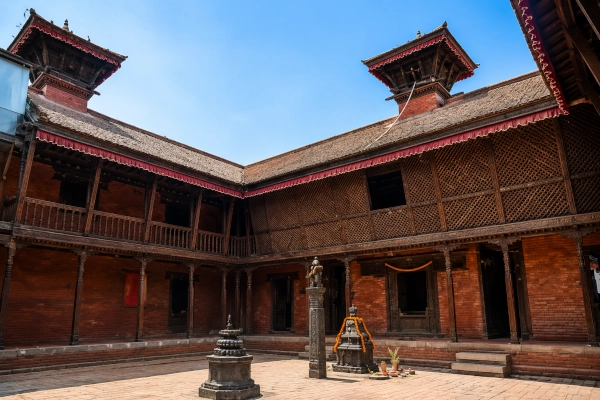
India and Nepal have jointly inaugurated the restored Shree Gusthal Mahavihar and Agam of Prathamshree Mahavihar at Guita Tole in Patan, reviving an important Buddhist living-heritage complex damaged by the devastating 2015 Gorkha earthquake.
The reconstructed site was inaugurated on July 28, 2026, by Indian Ambassador to Nepal Naveen Srivastava, Lalitpur Metropolitan City Mayor Chiribabu Maharjan and Nepalese Member of Parliament Jagdish Kharel. The ceremony included traditional rituals and the unveiling of an inaugural plaque, reflecting the monastery’s continuing religious and community role rather than treating it solely as an architectural monument.
The restoration was financed through a Government of India post-earthquake reconstruction grant of approximately NPR 12 crore. Nepal’s Central Level Project Implementation Unit for Building and Housing, operating under the Department of Urban Development and Building Construction, implemented the project. The Indian National Trust for Art and Cultural Heritage provided design and project-management consultancy.
Prathamshree Mahavihar forms part of Patan’s historic network of Buddhist monasteries, locally associated with the traditional bahi and bahal architectural traditions of the Kathmandu Valley. These complexes serve as places of worship, ritual practice, community gathering and preservation of Newar Buddhist traditions. The project covered the Gusthal Bahi and its Agam, a sacred component of the monastic complex used for religious and ceremonial functions.
The reconstruction therefore involved more than rebuilding walls and roofs. Heritage conservation at such sites must preserve the relationship between architecture, sacred spaces, traditional craftsmanship and the community that continues to use the buildings. The Indian-supported cultural programme in Nepal was designed to restore both tangible structures and the living traditions connected with them.
INTACH’s role included preparing conservation plans according to post-earthquake structural assessments, identifying significant architectural features, introducing seismic-strengthening measures and supervising implementation. Its broader Nepal programme seeks to retain traditional materials, construction techniques and historic forms while improving the ability of restored buildings to withstand future earthquakes.
The involvement of Nepalese government agencies ensured that the work remained integrated with the country’s post-earthquake reconstruction framework and heritage-protection requirements. Participation by the local community was equally important because religious monuments in Patan remain part of everyday social and spiritual life. A technically restored building can function successfully only when the custodians and users of the site remain involved in its conservation.
Speaking at the inauguration, Jagdish Kharel praised the resilience of the community and emphasised the importance of protecting ancient living-heritage sites. Mayor Chiribabu Maharjan acknowledged India’s contribution to the reconstruction of monuments in Lalitpur and other parts of Nepal while commending local residents for supporting the project.
Ambassador Naveen Srivastava described the restored structures as enduring symbols of the cultural relationship and friendship shared by India and Nepal. The project reflects a form of bilateral cooperation rooted in the two countries’ interconnected religious traditions, pilgrimage networks, artistic practices and civilisational history.
The Mahavihar is part of a much larger Indian-supported reconstruction programme launched after the 2015 earthquake caused extensive damage to homes, schools, health facilities and historic monuments across Nepal. India committed US$250 million in grant assistance for reconstruction, divided among housing, education, health and cultural heritage. Cultural conservation received an allocation of US$50 million.
Under this assistance, India has supported the conservation of 30 cultural heritage sites across eight districts of Nepal. The programme includes Buddhist monasteries, Hindu temples, traditional buildings, public structures, dharamshalas and other culturally important sites.
The wider reconstruction partnership has also supported the rebuilding of 50,000 private houses in Gorkha and Nuwakot districts, 85 educational institutions across eight districts and 133 health facilities in 11 districts. These projects connect cultural restoration with the reconstruction of essential public and residential infrastructure affected by the earthquake.
India and Nepal have periodically reviewed the progress of the reconstruction portfolio through a Joint Project Monitoring Committee. During a review in January 2025, officials noted the completion of the agreed housing projects in 2021 and education-sector projects in 2024, while both sides agreed to accelerate the remaining health and cultural-heritage works. The Indian delegation also visited the Gusthal Mahavihar project at Guita Tole to assess its progress and interact with members of the user community.
Prathamshree Mahavihar also belongs to a group of heritage projects in the Kathmandu Valley receiving technical support from INTACH. The programme includes the Seto Machhindranath Temple, Hiranya Varna Mahavihar, Gopichandra Mahavihar, Napichandra Mahavihar, Jestha Varna Mahavihar, Kumari Chhen, Jangam Math and other culturally significant structures.
Some completed projects have already demonstrated the international value of this conservation approach. The Indian-supported restoration of Jestha Varna Mahavihar in Lalitpur received an Award of Merit under the 2025 UNESCO Asia-Pacific Awards for Cultural Heritage Conservation. The project was recognised for balancing seismic strengthening with the preservation of historic Newari architecture, woodcarving and continuing community rituals.
The restoration of Prathamshree Mahavihar represents a similar effort to ensure that greater structural safety does not erase a monument’s traditional character. Rebuilding heritage after an earthquake requires careful documentation, skilled craftsmanship and an understanding of how religious communities use particular spaces. Modern interventions must strengthen the structure while remaining visually and materially compatible with its historic form.
For Patan, where Buddhist monasteries remain integral to the city’s cultural identity, the return of the Gusthal Mahavihar and Agam to community use is an act of cultural recovery. It restores a place where architecture, worship, collective memory and local identity converge.
The project also demonstrates how India–Nepal cooperation extends beyond conventional infrastructure. By combining Indian financial and technical assistance with Nepalese implementation and community participation, the two countries have preserved a shared civilisational asset while strengthening its resilience against future disasters.
Reference
Embassy of India, Kathmandu, Government of India. “Inauguration of Shree Gusthal Mahavihar & Agam of Prathamshree Mahavihar in Lalitpur, Nepal.” 28 July 2026. https://www.indembkathmandu.gov.in/media-detail/948
You may also like
-
Rare Stone Features Emerge as Kerala Archaeology Department Restores Megalithic Kudakkals at Karivellur
-
Vidarbha in the Mahabharata: The Ancient Kingdom of Damayanti in Eastern Maharashtra
-
Ramaphosa Calls for New Era in India–South Africa Economic Ties, Targets Green Energy, Minerals and Infrastructure
-
India and Brazil Push for Deeper Strategic Partnership as Trade Target Rises to $30 Billion
-
Modi–Xi Talks at BRICS Put Border Peace, Trade Imbalance and Market Access at Centre of India–China Ties
