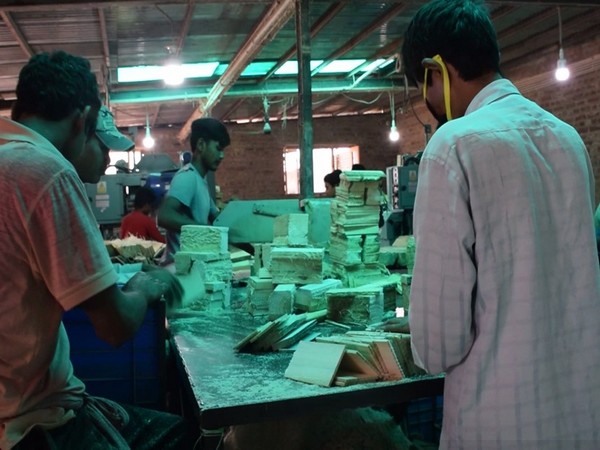
The Government’s One District One Product initiative has identified 1,244 distinctive products across 773 districts, strengthening efforts to promote local industries, traditional crafts, agricultural goods and food-processing enterprises.
Implemented by the Department for Promotion of Industry and Internal Trade, the initiative seeks to select, brand and promote at least one product from every district. Products are chosen by the respective State and Union Territory governments based on local resources, skills, heritage and production strengths.
The Government is improving the visibility of ODOP products through domestic and international exhibitions, capacity-building programmes, e-commerce onboarding and the dedicated ODOP Bazaar on the Government e-Marketplace.
More than 500 ODOP product categories covering over 1,300 products are currently available on GeM for public procurement. More than 10 states have also developed dedicated e-commerce platforms for the marketing and sale of local products.
PM Ekta Malls to Expand Retail Access
Under the Scheme for Special Assistance to States for Capital Investment, eligible states and Union Territories with legislatures can receive financial assistance of up to ₹200 crore through a 50-year interest-free loan for establishing PM Ekta Malls, also known as Unity Malls.
These malls are intended to provide dedicated retail space for ODOP products, Geographical Indication-tagged goods, handicrafts and other locally manufactured items. The initiative is expected to connect artisans and producers with larger consumer markets while improving the visibility of regional products.
PMFME Support for Food-Processing Enterprises
The Pradhan Mantri Formalisation of Micro Food Processing Enterprises Scheme follows the ODOP approach in the food-processing sector.
Eligible enterprises can receive a 35 per cent credit-linked capital subsidy of up to ₹10 lakh for individual projects. The scheme also provides seed capital assistance to members of self-help groups, entrepreneurship training, product-specific skill development and support for common infrastructure and incubation centres.
Under its branding and marketing component, the PMFME Scheme provides a grant covering 50 per cent of eligible expenditure for common branding, packaging, quality standardisation and food-safety compliance.
The scheme also promotes convergence with other government programmes to strengthen agricultural supply chains. The Ministry of Food Processing Industries works with the Ministry of Agriculture and Farmers’ Welfare to connect farmer clusters with food-processing centres.
Convergence committees have also been formed with the Agricultural and Processed Food Products Export Development Authority and the Department of Fisheries to develop export-oriented value chains.
Twenty-four common ODOP product clusters have been identified in collaboration with APEDA, while seven fish and marine-product clusters have been identified with the Marine Products Export Development Authority. These clusters are being supported through branding, market access and export-promotion measures.
Districts Being Developed as Export Hubs
The Districts as Export Hubs initiative complements ODOP by identifying products and services with export potential at the district level.
Export-potential goods and services have been identified across 734 districts. State Export Promotion Committees and District Export Promotion Committees have been established across all 36 states and Union Territories to coordinate implementation and address supply-chain bottlenecks.
A total of 249 District Export Action Plans have been adopted by the respective district committees. These plans are intended to improve the value chain from production and processing to logistics, marketing and exports.
No separate district-specific financial allocation is made under ODOP. States and Union Territories are encouraged to use existing Central and state schemes covering MSMEs, agriculture, food processing, handicrafts, handloom, skill development and exports.
These programmes provide assistance for infrastructure, credit access, skill improvement, product quality, branding, marketing and export readiness.
ODOP Products Enter International Markets
The Government has collaborated with the Ministry of External Affairs and Indian missions abroad to promote ODOP products through international exhibitions, buyer-seller meetings and promotional events.
Dedicated ODOP display walls have been established at Indian missions to showcase products representing different states and districts. Three overseas retail stores—two in Singapore and one in Kuwait—are selling ODOP products.
Selected ODOP items have also been presented as official gifts during bilateral and multilateral meetings, increasing their exposure among foreign dignitaries, institutions and potential buyers.
The initiative has helped improve market access for local products, encourage entrepreneurship and support employment generation among artisans, farmers, self-help groups and micro-enterprises. However, separate figures for exports specifically attributed to ODOP products are not maintained centrally.
The information was provided by Minister of State for Commerce and Industry Jitin Prasada in a written reply in the Rajya Sabha on July 24, 2026.
Source: PIB
You may also like
-
India and Uruguay Agree Trade and Connectivity Roadmap as Montevideo Ratifies International Solar Alliance
-
The Return of Multipolarity: Why the World Is Moving Beyond a Single Centre of Power
-
The Financial Chokepoint: Why BRICS Can No Longer Depend on SWIFT and the Dollar Alone
-
India Expands Market Access for South African Citrus With New In-Transit Cold Treatment Rules
-
South Africa Invites Indian Firms Into $100-Billion Infrastructure Pipeline as BRICS Ties Deepen
