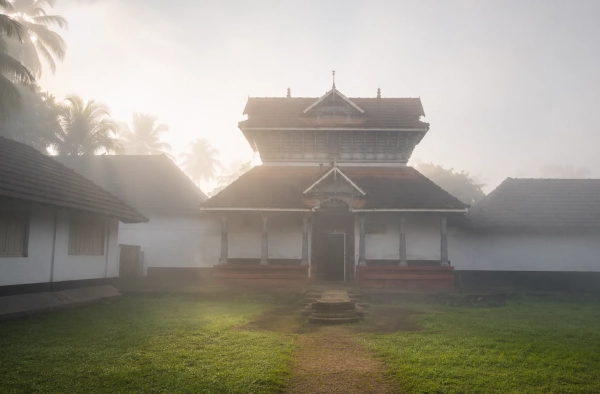
Sree Balussery Vettakkorumakan Temple is one of northern Kerala’s distinctive sacred sites, combining royal history, regional mythology, mural art and an exceptional ritual tradition. The ancient shrine stands within the surviving ruins of Balussery Kotta, or Balussery Fort, in Kozhikode district. Its setting preserves the memory of a period when temples, forts and royal households formed interconnected centres of political, military and spiritual authority in Malabar.
The temple is dedicated to Vettakkorumakan, a hunter-warrior deity widely worshipped across northern Kerala. He is traditionally regarded as the son of Lord Shiva and Goddess Parvati, born while the divine couple appeared in the forms of a hunter and huntress. The deity’s association with forests, hunting, martial courage and protection made him especially important to several royal and aristocratic families of Malabar.
A Temple Inside the Ruins of Balussery Kotta
The location of the temple gives it a character different from that of an ordinary village shrine. It occupies sacred ground within the remains of Balussery Fort, once connected with the political centre of the Kurumbranad rulers, also known as the Kurumbiathiri royal house.
Balussery developed as an important inland centre in the historical region of Kurumbranad. Widely cited historical accounts associate the royal capital with Balussery Kotta and describe the Vettakkorumakan shrine as closely connected with the ruling family. The deity’s martial and protective attributes suited a royal household responsible for defending territory, administering the countryside and maintaining armed retainers.
The physical fort has largely disappeared, leaving the temple as one of the most visible links with Balussery’s royal past. Its survival within the old fortified precinct illustrates how sacred institutions often endured after the political structures surrounding them declined.
The precise date of the temple’s foundation remains uncertain in publicly available records. Kerala Tourism officially identifies it as an ancient shrine while refraining from assigning a specific century or founder. Its association with the fort and the Kurumbranad royal tradition nevertheless places it within the historical sacred geography of medieval and early modern Malabar.
Vettakkorumakan: The Divine Hunter
The mythology of Vettakkorumakan is connected with the celebrated Kiratarjuniya episode of the Mahabharata. According to the tradition, Arjuna performed severe penance to obtain the powerful Pashupatastra weapon from Shiva. The deity appeared before him disguised as a forest hunter, or Kirata, while Parvati accompanied him in the form of a huntress.
Vettakkorumakan is believed to have been born from Shiva and Parvati during this divine hunting manifestation. His name is commonly understood through the idea of a son associated with the hunt. He is portrayed as youthful, energetic and skilled in the use of weapons, embodying the untamed strength of the forest combined with divine guardianship.
A legend recorded in Kerala Tourism’s festival documentation describes the young deity as extraordinarily powerful and mischievous. His use of the bow and arrow disturbed sages and celestial beings. Lord Vishnu eventually approached him in the guise of a hunter and displayed a beautiful golden dagger. Vettakkorumakan desired the weapon, and Vishnu presented it after securing his promise to use his power responsibly for protection.
The dagger, often understood as a churika, consequently became one of the deity’s principal emblems. The weapon represents controlled martial power—strength placed in the service of order, guardianship and justice.
The Legend of the Deity’s Arrival at Balussery
Temple tradition gives Balussery a special position in the sacred journey of Vettakkorumakan. After receiving permission from Shiva and Parvati, the deity is believed to have travelled from Kailasa to Kerala, the land traditionally associated with Parasurama.
The legend describes him crossing mountains, forests and rivers before reaching northern Kerala. Balussery Fort is identified as the first important place he entered, giving the shrine a position of considerable prestige among temples dedicated to Vettakkorumakan. Kerala Tourism’s festival documentation describes the Balussery shrine as a principal centre of the deity’s worship.
This narrative connects the temple with three powerful landscapes: the Himalayan world of Shiva, the forest world of the divine hunter and the fortified royal landscape of Malabar. The temple therefore represents both a mythological arrival and the historical adoption of a guardian deity by regional ruling communities.
A Guardian of Royal Houses and Warriors
Vettakkorumakan worship became especially prominent among royal families, warrior lineages and landholding households across northern and central Kerala. Kerala Tourism records his importance to royal houses associated with Chirakkal, Nileswaram and Kottakkal, while regional traditions connect the Balussery shrine with the rulers of Kurumbranad.
For such houses, the deity represented courage, success in difficult undertakings and protection against hostile forces. His bow, arrow and dagger expressed readiness for action, while his divine parentage connected martial strength with the authority of Shiva and Parvati.
Shrines dedicated to Vettakkorumakan were also established in Namboothiri households and local temples. In parts of northern Malabar, the deity appears within ritual traditions influenced by Theyyam and other forms of regional worship. The Balussery temple occupies an important position within this wider network of sacred sites.
Mural Paintings and Sacred Art
The temple is also noted for the mural paintings decorating its walls and ceiling. Kerala Tourism particularly identifies a representation of Ananthashayanam, Lord Vishnu reclining upon the serpent Ananta, as one of the shrine’s best-known murals.
The presence of a Vishnu mural inside a temple dedicated to the son of Shiva and Parvati reflects the integrative nature of Kerala’s temple traditions. It also resonates with the Vettakkorumakan legend in which Vishnu plays a decisive role by presenting the golden dagger and guiding the youthful deity toward responsible guardianship.
Kerala mural painting traditionally uses strong outlines, carefully arranged figures and symbolic colours to translate sacred narratives into visual form. At Balussery, these paintings contribute to the spiritual atmosphere of the shrine while preserving an important element of Kerala’s artistic heritage.
Vettakkorumakan Pattu
One of the central ritual traditions associated with the deity is Vettakkorumakan Pattu, a ceremonial performance combining sacred song, ritual drawing, worship and dramatic action.
The word pattu means song, and the performance consists of hymns and invocations praising the deity. Kerala Tourism describes it as a ritual conducted mainly by Namboothiris authorised to perform the ceremony. The observance recalls the divine hunter’s origin, powers and protective role.
A colourful ritual image of the deity may be created on the floor using natural powders. Songs narrating his divine story accompany offerings and worship. Through the performance, the deity is ceremonially invoked and honoured as the guardian of the temple, its devotees and the surrounding land.
Pantheerayiram Thengayeru: Breaking 12,000 Coconuts
The most celebrated feature of the Balussery temple festival is Pantheerayiram Thengayeru, the continuous breaking of 12,000 coconuts in a powerful rhythmic sequence.
The ritual forms part of the Vettakkorumakan Pattu and has become the temple’s defining public observance. The coconuts are broken one after another with remarkable speed and coordination, producing an intense combination of movement, rhythm and devotional energy. Both Kerala Tourism’s temple portal and festival documentation identify the ceremony as a unique feature of the shrine.
In Kerala’s ritual culture, the breaking of a coconut represents surrender, purity and the removal of obstacles. The scale of the Balussery ceremony transforms the individual offering into a collective act of devotion. The repeated sound and motion create a dramatic climax to the worship of the warrior deity.
The ritual also reflects the strength traditionally associated with Vettakkorumakan. The disciplined breaking of thousands of coconuts evokes energy brought under ritual control, echoing the legend in which the youthful hunter is guided to channel his formidable powers toward protection.
The Annual Festival
The principal festival is generally observed annually and extends over three days. Kerala Tourism places it in January, although the precise dates may vary according to the Malayalam calendar and temple authorities. The programme includes Kalam Pattu, Vettakkorumakan Pattu, Pantheerayiram Thengayeru, Utsava Ezhunnallathu and Thayambaka.
The ceremonial procession traditionally features decorated elephants and colourful parasols, while percussion performances add grandeur to the observances. Devotees gather to seek protection, courage, prosperity and relief from obstacles.
The festival brings together several layers of Kerala’s sacred culture: royal memory, oral mythology, temple music, mural art, percussion, ritual performance and community participation.
Cultural Importance of the Temple
Sree Balussery Vettakkorumakan Temple represents a rare meeting point between a ruined fort and a living place of worship. The fort recalls the political history of Kurumbranad, while the temple sustains a ritual tradition that continues to attract devotees.
The shrine also demonstrates the importance of regional deities within the larger Hindu tradition. Vettakkorumakan draws his identity from Shiva and Parvati while possessing a distinct mythology, iconography and ritual system shaped by the landscapes and communities of Malabar.
His identity as a hunter reflects Kerala’s old relationship with forests and martial culture. His adoption by ruling houses shows how regional kingship relied upon sacred guardians. The murals and annual ceremonies reveal how mythology was preserved through visual art, music and embodied ritual.
A Living Memorial to Balussery’s Past
Today, the temple remains one of the most significant heritage landmarks of Balussery. The surrounding fort survives mainly through ruins and historical memory, while worship continues within the sacred precinct.
The temple’s lasting importance rests on this continuity. Political dynasties changed, fortified centres declined and administrative boundaries shifted, yet the guardian deity continued to be worshipped. Annual ceremonies renew the connection between the present-day community and the royal, martial and artistic traditions of northern Kerala.
Sree Balussery Vettakkorumakan Temple therefore stands as a living memorial to the old kingdom of Kurumbranad and as a principal centre of devotion to Kerala’s divine hunter. Its fort setting, murals, legends and extraordinary coconut-breaking ritual make it one of Kozhikode district’s most distinctive sacred heritage sites.
How to Reach
Sree Balussery Vettakkorumakan Temple is located near the Government Girls Higher Secondary School in Balussery town, Kozhikode district. The Balussery bus stand is approximately 1.6 kilometres from the temple, with regular bus connections from Kozhikode, Koyilandy and nearby towns. Koyilandy Railway Station, situated about 17.8 kilometres away, is the nearest major railhead. Calicut International Airport at Karipur is approximately 49.4 kilometres from the shrine. Taxis, autorickshaws and local buses are available for the final journey to the temple.
REFERENCES
Kerala Tourism, Department of Tourism, Government of Kerala.
“Sree Balussery Vettakkorumakan Temple, Kozhikode.”
https://www.keralatourism.org/temples/kozhikode/balussery-vettakkorumakan
Kerala Tourism.
“Balusserykotta Sree Vettakkorumakan Temple — Festival Profile.”
https://www.keralatourism.org/1000festivals/assets/uploads/pdf/1530871540-0.pdf
William Logan.
Malabar Manual.
Superintendent, Government Press, Madras, 1887.
Kerala District Gazetteers.
Kozhikode District Gazetteer.
Government of Kerala.
A. Sreedhara Menon.
A Survey of Kerala History.
You may also like
-
Rare Stone Features Emerge as Kerala Archaeology Department Restores Megalithic Kudakkals at Karivellur
-
Vidarbha in the Mahabharata: The Ancient Kingdom of Damayanti in Eastern Maharashtra
-
Abhira in the Mahabharata: The Pastoral People of Western India and the Northern Deccan
-
Nasikya in the Mahabharata World: The Ancient Nashik Region on the Upper Godavari
-
Bharukachchha in the Mahabharata: The Ancient Port of Bharuch at the Mouth of the Narmada
