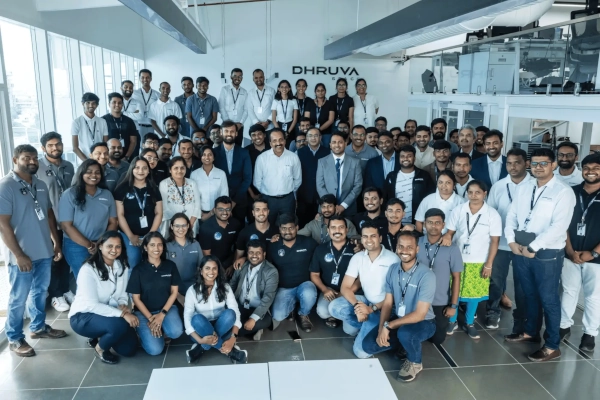
Dhruva Space is developing an indigenous, full-stack space infrastructure ecosystem covering satellite platforms, orbital deployment systems, spacecraft power hardware, launch integration and ground-station operations. Founded in 2012 and headquartered in Hyderabad, the company supplies these elements either as individual products or as an integrated mission service.
Its modular approach allows customers to select a standard satellite bus, integrate a mission-specific payload, obtain launch and separation hardware, and operate the spacecraft through Dhruva Space’s ground network. This reduces the engineering effort required to build every mission around a new spacecraft architecture.
Modular Satellite Platforms
Dhruva Space’s satellite portfolio covers spacecraft weighing from below one kilogram to approximately 500 kilograms. The platforms are designed for communications, Earth observation, scientific research, Internet of Things connectivity, technology validation and national-security missions.
The P-DoT platform serves CubeSat-class missions from 0.5U to 12U, with platform masses ranging from approximately one to 24 kilograms. It supports three-axis stabilisation, body-mounted or deployable solar arrays and multiple payload configurations. The platform has reached Technology Readiness Level 9 and is intended for low-Earth-orbit applications requiring a compact, flight-qualified bus.
The larger P-30 nanosatellite platform supports spacecraft in the 20-to-50-kilogram range. It incorporates three-axis attitude control, deployable power systems and options for electric propulsion, allowing orbital manoeuvring and station-keeping. Its modular payload interfaces make it suitable for hosted instruments and constellation deployment.
Dhruva Space validated major P-30 subsystems through its LEAP-TD mission aboard ISRO’s PSLV-C58 POEM-3 platform in January 2024. The in-orbit demonstration tested the onboard computer, UHF telemetry and command system, beacon, reaction-wheel-based attitude control and power-distribution electronics.
The P-Nu platform extends the architecture into the microsatellite category, supporting spacecraft weighing up to 500 kilograms. It is designed for multi-payload missions, deployable solar arrays, three-axis stabilisation and orbit-maintenance propulsion.
Hosted Payload Missions
Dhruva Space operates the Launching Expeditions for Aspiring Payloads programme, known as LEAP, to provide in-orbit validation and demonstration services.
Under this model, a customer’s sensor, processor, communication module or scientific instrument is integrated onto a P-30 satellite. The payload shares the spacecraft’s power, attitude control, communications and ground infrastructure, allowing organisations to test equipment in orbit without financing a complete independent satellite.
The standard hosted-payload configuration supports instruments occupying up to 12U, with payload mass reaching approximately 15 kilograms and power availability of up to 50 watts at a 50 per cent duty cycle. The platform offers pointing accuracy of up to 0.1 degrees.
LEAP-1 became the first commercial mission built around this service. Launched aboard a SpaceX Falcon 9 in August 2025, it carried an artificial-intelligence processing module and a hyperspectral-imaging payload on the P-30 platform.
Satellite Separation Systems
A satellite must remain securely attached to its launch vehicle during ascent and separate cleanly after reaching the required orbit. Dhruva Space develops this critical hardware through its Dhruva Space Satellite Orbital Deployer family.
The DSOD portfolio covers 1U, 3U, 6U, 12U and 16U spacecraft configurations, with payload capacities ranging from approximately one kilogram to 32 kilograms. The systems use non-pyrotechnic hold-down and release mechanisms, reducing the shock transmitted to sensitive spacecraft instruments during deployment.
Integrated telemetry sensors confirm deployment and measure ejection velocity. The larger deployers can accommodate different CubeSat combinations and additional side volume for solar panels or external components.
Dhruva Space space-qualified the DSOD-1U aboard ISRO’s PSLV-C53 mission in June 2022. Its DSOD-3U and DSOD-6U systems subsequently flew aboard PSLV-C55, establishing flight heritage for the company’s separation architecture.
The company also provides launch-vehicle interface engineering, structural analysis, payload integration, environmental testing and mission coordination. Combining these services with its deployers gives customers a single technical chain between spacecraft preparation and orbital release.
Spacecraft Communications
Dhruva Space has developed the Dhruva Space Orbital Link, a configurable S-band and X-band transceiver for telemetry, telecommand and payload-data transmission.
The DSOL system was space-qualified aboard PSLV-C55, with signals received through ISRO’s tracking infrastructure at Port Blair. It is intended for integration with Dhruva Space’s P-30 and P-Nu platforms and supports higher-data-rate missions requiring dependable spacecraft-to-ground communication.
This communication hardware complements the company’s ground segment, allowing Dhruva Space to engineer both ends of the satellite link.
Ground Stations and Mission Control
Dhruva Space operates and supplies remotely controlled ground stations for spacecraft tracking, telemetry reception, command transmission and payload downlink.
Its S-band and X-band stations use antennas ranging from three to 7.5 metres, with larger configurations available for specialised missions. The network supports spacecraft operating in low, medium and geostationary Earth orbit.
The company’s Integrated Space Operations Command Suite combines real-time satellite tracking, orbit prediction, antenna control, radio management, spacecraft-health monitoring and payload-data handling in one software environment.
Dhruva Space reports a network of 13 stations across ten countries with 99 per cent stated uptime. Customers can purchase dedicated infrastructure or access it through the company’s Ground Station as a Service model, which received authorisation from IN-SPACe in 2024.
Indigenous Spacecraft Solar Arrays
Power generation forms another part of Dhruva Space’s vertically integrated system. Its Solis solar arrays are designed for CubeSats from 0.5U to 16U, while the larger Solis+ range provides kilowatt-class power for small and medium spacecraft.
Solis+ uses high-efficiency triple-junction gallium-arsenide cells mounted on carbon-fibre-reinforced honeycomb substrates. The arrays incorporate flight-proven hinges, redundant low-shock release mechanisms and optional solar-array drive assemblies for maintaining favourable orientation towards the Sun.
Mission-specific arrays can be configured according to spacecraft mass, available volume, orbital conditions, power demand and operational lifetime. This capability allows Dhruva Space to supply a major satellite subsystem alongside its buses and launch hardware.
Project Garud
Project Garud represents Dhruva Space’s move towards larger, production-oriented communications satellites. In May 2026, the company received ₹105 crore under the Government of India’s Research, Development and Innovation Fund to develop the programme.
Garud is conceived as an indigenous, modular platform for satellites in the 300-to-500-kilogram class. Its initial focus is communications missions supporting telecommunications, defence and sovereign connectivity.
The proposed flat-pack architecture is designed to improve launch stacking, simplify system integration and support faster deployment of multiple spacecraft. Standardised structures, interfaces and subsystems would allow the same production line to manufacture a series of satellites while accommodating different communication payloads.
This model is particularly relevant to constellations. A network containing dozens of satellites requires repeatable manufacturing, predictable interfaces and efficient launch packaging. Project Garud aims to shift satellite production from individually engineered spacecraft towards a scalable industrial process.
The platform is being developed with applicability across low and medium Earth orbit, with potential extension to future geostationary mission architectures. Its modular design could support broadband connectivity, secure communications, direct-to-device services and strategic data networks.
Manufacturing Infrastructure
Dhruva Space currently operates from a 28,000-square-foot facility in Hyderabad and is developing a substantially larger spacecraft manufacturing complex at Shamshabad.
The planned 280,000-square-foot facility is intended to support design, assembly, integration and testing of satellites weighing up to 500 kilograms. Around 30,000 square feet is allocated to spacecraft solar-array development, while approximately 40,000 square feet is planned for parallel spacecraft integration bays.
Such infrastructure is essential for Project Garud because constellation manufacturing requires repeatable assembly processes, controlled environments, subsystem testing and simultaneous integration of several spacecraft.
A Full-Stack Indian Space Company
Dhruva Space’s technical strength lies in connecting systems that are frequently supplied by separate contractors. Its portfolio covers the satellite bus, electrical power generation, communications hardware, payload integration, launch interface, orbital deployer, ground station and mission-control software.
This architecture gives customers a shorter route from payload development to orbital operation while building domestic capability across spacecraft engineering and manufacturing.
Project Garud extends that model into the 500-kilogram communications class. Together with the P-DoT, P-30 and P-Nu platforms, it positions Dhruva Space to support missions ranging from compact technology demonstrators to sovereign satellite constellations.
REFERENCES
Dhruva Space. “Full-Stack Space Engineering Solutions.” Official Website.
https://www.dhruvaspace.com/
Dhruva Space. “Satellite Platforms: P-DoT, P-30 and P-Nu.”
https://www.dhruvaspace.com/satellite-platforms
Dhruva Space. “Launch Solutions and Satellite Orbital Deployers.”
https://www.dhruvaspace.com/launch-solutions
Dhruva Space. “Ground Stations and Integrated Space Operations Command Suite.”
https://www.dhruvaspace.com/ground-stations
Dhruva Space. “Solis and Solis+ Spacecraft Solar Arrays.”
https://www.dhruvaspace.com/spacecraft-solar-arrays
Dhruva Space. “LEAP-TD Mission and P-30 Platform Validation.”
https://www.dhruvaspace.com/dhruva-space-leap-td-mission
Dhruva Space. “DSOD and DSOL Space-Qualification Missions.”
https://www.dhruvaspace.com/dhruva-space-dsol-dsod-3u-dsod-6u-missions
Dhruva Space. “Project Garud: Indigenous 500 kg-Class Communications Satellite Platform.” May 14, 2026.
https://www.dhruvaspace.com/press-releases/dhruva-space-secures-inr-105-crores-rdif-backing-to-develop-project-garud-advancing-india-private-sector-500-kg-class-satellite-capability-for-constellation-missions
Dhruva Space. “Ground Station as a Service Authorisation from IN-SPACe.” July 15, 2024.
https://www.dhruvaspace.com/press-releases/dhruva-space-authorisation-from-inspace-gsaas-ground-station-as-a-service
Image Courtesy: Dhruvaspace.com
You may also like
-
EON Space Labs and Dhruva Space Advance Indian Space Hardware on Transporter-18 Mission
-
SatLeo Labs’ TAPAS-1 Reaches Orbit, Advancing India’s Private Thermal-Imaging Capability
-
TakeMe2Space’s MOI-1A Reaches Space on Falcon 9 Transporter-18 Mission
-
Bank of Baroda Enters Pension Fund Management After PFRDA Appointment
-
SCI and India’s Push for a Larger Indigenous Maritime Fleet
