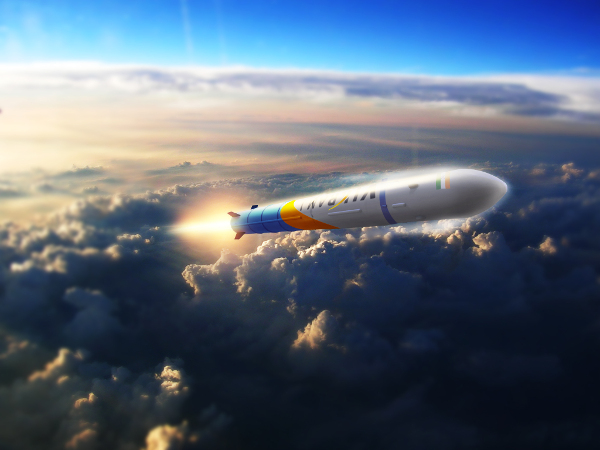
Skyroot Aerospace is developing an indigenous family of launch vehicles designed to place small satellites into orbit through dedicated and rideshare missions. Founded in Hyderabad in 2018 by former space scientists Pawan Kumar Chandana and Naga Bharath Daka, the company combines carbon-composite structures, solid propulsion, additively manufactured liquid engines and modular avionics to provide responsive commercial launch services.
The company’s Vikram launchers are named after Dr Vikram Sarabhai, the architect of India’s space programme. Their primary market consists of small satellites used for Earth observation, communications, navigation, scientific research and technology demonstration. Dedicated launches allow a customer to select mission parameters more precisely, while rideshare services distribute launch capacity and cost among several payload operators.
Vikram-S and Mission Prarambh
Skyroot demonstrated its core launch technologies through Vikram-S, a single-stage suborbital rocket launched from the Satish Dhawan Space Centre at Sriharikota on November 18, 2022. Named Mission Prarambh, the flight became the first launch of a privately developed rocket from India.
Vikram-S reached a peak altitude of 88.8 kilometres, attained Mach 5.07 and completed a flight lasting 301.4 seconds. It carried payloads from Space Kidz India, N-Space Tech India and BAZOOMQ Armenia before descending into the Bay of Bengal approximately 125 kilometres downrange.
The mission validated Skyroot’s solid propulsion system, carbon-composite airframe, spin-stabilisation hardware, flight computer, telemetry link and aerodynamic models. The composite structure remained intact under loads reaching 14.8G, while the telemetry system transmitted sensor information and live imagery to the ground at data rates of up to 3 Mbps. These results supplied flight data for the company’s orbital launcher programme.
Vikram-I Reaches Orbit
Skyroot advanced from suborbital testing to orbital operations with the maiden flight of Vikram-I on July 18, 2026. The rocket lifted off from the Satish Dhawan Space Centre at 12:05:30 pm and successfully reached orbit on its first attempt, making Skyroot the first private Indian company to launch an orbital-class rocket from Indian soil.
Vikram-I is a four-stage small-satellite launcher comprising three solid-propellant stages and a liquid-powered upper stage. It uses an all-carbon-composite structure to reduce inert mass, while the upper stage employs an additively manufactured Raman liquid engine for precise orbital insertion.
The rocket is designed to place up to 350 kilograms into Low Earth Orbit or approximately 260 kilograms into Sun-synchronous orbit. Its mission architecture supports dedicated launches, rideshare deployment and customised orbital insertion for small satellites and constellations.
The maiden orbital mission carried several customer payloads. The SCOPE and Grahaa satellites were inserted into Low Earth Orbit, while additional payloads remained attached to the upper stage for in-orbit experiments. The flight established an operational foundation for privately supplied launch services from India.
Propulsion and Composite Engineering
Skyroot’s solid motors belong to the Kalam series. Their composite motor casings reduce structural weight while retaining the strength required to contain high combustion pressure. Solid stages also offer operational advantages through simpler storage, rapid preparation and fewer moving components.
The liquid upper stage provides the accuracy needed to inject satellites into their prescribed orbit. ISRO facilities supported development testing of Skyroot’s Raman engine family, including tests covering ignition transients, steady-state combustion, cooling performance and shutdown behaviour.
Additive manufacturing allows complex combustion chambers, cooling passages and injector components to be consolidated into fewer parts. This can shorten manufacturing cycles and reduce the number of joints requiring inspection, while enabling geometries that are difficult to produce through conventional machining.
The company’s carbon-composite expertise extends across airframes, stage structures and motor casings. Lightweight construction improves the ratio between payload mass and total vehicle mass, an important consideration for small launch vehicles operating with limited propulsion margins.
Support from ISRO and IN-SPACe
Skyroot’s development programme has been supported by ISRO and the Indian National Space Promotion and Authorisation Centre. The arrangement gave the company access to technical expertise, launch infrastructure, motor-casting facilities, static-test stands and propulsion-testing systems.
ISRO supported casting and testing of Vikram-I’s solid stages at Sriharikota and facilitated testing of its liquid upper-stage engine. During the orbital mission, ISRO also assisted with vehicle integration, stage preparation, trajectory analysis, material handling and launch-pad operations. IN-SPACe provided regulatory coordination, technical consultation, mission-readiness reviews and launch authorisation.
This framework allows private companies to develop proprietary launch systems while using India’s established testing and range infrastructure. It also creates a pathway from component qualification to authorised commercial missions.
Vikram-II and Higher Payload Capacity
Skyroot is developing Vikram-II as the next member of the family. The proposed launcher will use a carbon-composite structure and an advanced cryogenic propulsion system, increasing payload capacity to approximately 900 kilograms for Low Earth Orbit and 600 kilograms for Sun-synchronous orbit.
The higher-capacity vehicle is intended to support larger spacecraft, satellite clusters and missions requiring deployment into multiple orbital positions. Common technologies across the Vikram family can help standardise manufacturing, testing, avionics and ground operations.
An Indigenous Commercial Launch Enterprise
Skyroot has built its engineering and manufacturing base in Hyderabad, where its team works across propulsion, aerodynamics, composites, avionics, guidance, vehicle integration and mission operations. Its development history includes India’s first privately conducted rocket-engine static test, a privately developed cryogenic-engine test, the Vikram-S suborbital mission and the successful orbital flight of Vikram-I.
The Vikram programme gives satellite operators an Indian option for responsive small-payload deployment. Its modular architecture, composite construction and mix of solid and liquid propulsion have been selected to support rapid mission preparation and customised orbital access.
With Vikram-S establishing flight heritage and Vikram-I successfully reaching orbit, Skyroot Aerospace has progressed from a launch-vehicle startup into an operational private space-launch company. The programme strengthens India’s commercial space ecosystem while building domestic capability in orbital propulsion, advanced materials, launch operations and small-satellite deployment.
REFERENCES
Skyroot Aerospace. “About Skyroot.” Official Website.
https://www.skyroot.in/about-skyroot
Skyroot Aerospace. “Vikram Launch Vehicles.” Official Website.
https://www.skyroot.in/
Skyroot Aerospace. “Mission Prarambh: Vikram-S.”
https://www.skyroot.in/mission-prarambh
Indian Space Research Organisation. “Mission Prarambh.” November 18, 2022.
https://www.isro.gov.in/mission_prarambh.html
Indian Space Research Organisation. “First Private Orbital Launch Lifts Off from Sriharikota.” July 18, 2026.
https://www.isro.gov.in/First_private_orbital_launch_lifts_from_Sriharikota.html
Indian Space Research Organisation. “ISRO Supports a Space Startup’s Rocket Engine Test.” July 22, 2023.
https://www.isro.gov.in/ISRO_EN/Support_SpaceStartup_RocketEngine.html
Indian Space Research Organisation. “Non-Disclosure Agreement Signed with Skyroot Aerospace.” February 2, 2021.
https://www.isro.gov.in/nondisclosure.html
Press Information Bureau, Government of India. “Vikram-1: Charting India’s Cosmic Future.” July 18, 2026.
https://www.pib.gov.in/PressReleasePage.aspx?PRID=2286011&lang=1®=48
Press Information Bureau, Department of Space. “India Established as a Serious Global Space Power with Vikram-1 Success.” July 18, 2026.
https://www.pib.gov.in/PressReleasePage.aspx?PRID=2286087&lang=1®=3
You may also like
-
Structural Optimisation Reportedly Cuts HAL LUH Vibration by Up to 50%
-
India and Russia Move Into Titanium Sponge Production as Rosatom’s Giredmet Partners Hyderabad-Based ALT Metals
-
NRL’s World-First Bamboo 2G Ethanol Plant Produces Fuel, Moves Toward Commercial Operations
-
IAF Opens Race to Develop Indigenous High-Altitude Pseudo Satellite for Persistent Surveillance
-
BDL Confirms ASRAAM Missile Facility Fully Operational as Major IAF Requirement Looms
