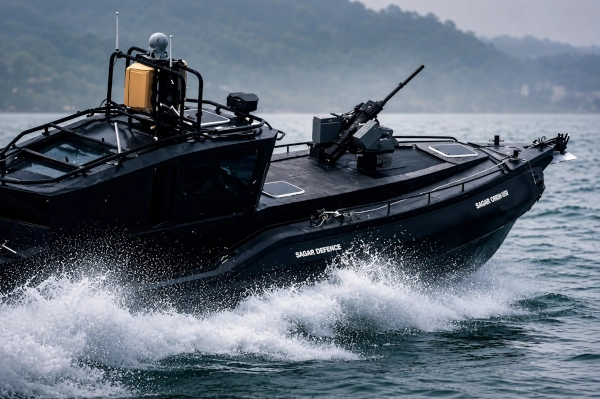
India’s maritime domain stretches across a vast coastline, busy commercial ports, offshore energy installations, island territories and an exclusive economic zone covering millions of square kilometres. Monitoring this enormous area through conventional crewed vessels demands ships, trained personnel, fuel, maintenance and continuous logistical support. Sagar Defence Engineering is addressing this challenge by developing unmanned and autonomous marine vehicles capable of navigating, collecting data and conducting missions without placing personnel aboard the craft.
Founded in 2015 by Captain Nikunj Parashar and his team, Sagar Defence Engineering has emerged as one of India’s early specialists in unmanned maritime technology. The company develops autonomous surface vessels for defence, scientific, industrial, survey and emergency-response applications. A government announcement associated with the Maritime India Summit 2016 recognised the startup for developing an unmanned marine surface vehicle and identified possible uses in the Navy, oil and gas, inland waterways, oceanography, disaster management and scientific research.
Many maritime missions require a sensor or payload to remain at sea rather than a human crew. An autonomous boat can perform repetitive, hazardous or prolonged operations while its controllers remain on shore or aboard a larger command vessel. This approach can reduce operational costs, expand the area covered by each mission and limit the exposure of sailors, researchers and technicians to dangerous environments.
An Ocean-Going Robot
An unmanned surface vehicle travels on the surface of the water without an onboard crew. It may be controlled remotely, follow a predetermined route or perform parts of a mission autonomously using navigation software and onboard sensors.
Sagar Defence describes its unmanned marine surface vehicle as an autonomous ocean robot capable of collecting and communicating information under changing maritime conditions. The company’s long-term concept involves connecting surface vehicles with subsea sensors, satellites, shore stations and other crewed or unmanned platforms to create a digitally connected ocean-monitoring network.
A conventional survey boat usually carries a captain, technical crew, survey personnel, fuel and safety equipment. An unmanned vessel can devote a larger proportion of its size and energy to sensors, communication equipment and the mission payload. Smaller vehicles can also be launched from shore, transported by road or deployed from larger ships.
Autonomous boats can therefore become useful wherever maintaining a permanent human presence is expensive, hazardous or operationally inefficient.
Autonomous Navigation
The defining capability of Sagar Defence’s marine vehicles is their ability to navigate with reduced human intervention. The company lists several operational modes, including autonomous navigation, semi-autonomous navigation, autonomous collision avoidance and dual-manual operation. This allows a vessel to be configured according to the complexity of the mission and the level of control required by the operator.
During an autonomous mission, the operator can define a route through geographical waypoints. The vessel’s control system then follows the planned path while monitoring its location and surrounding traffic. When an obstacle or changing condition is detected, the navigation system can adjust the vessel’s movement while preserving the wider mission objective.
Semi-autonomous operation gives the human controller a more active role. The software may handle basic steering, course-keeping and speed control while the operator supervises important decisions. Remote manual control can be used during launch, recovery, docking or operations in congested areas.
Maintaining several control modes also provides operational resilience. A mission can begin under direct control, shift to autonomous navigation in open water and return to manual operation when the vessel approaches a harbour or support ship.
Collision Avoidance at Sea
Autonomous movement on water presents a different challenge from operating a driverless vehicle on land. Roads have lanes, traffic lights and relatively predictable boundaries. The sea is open, dynamic and affected by waves, currents, visibility, floating debris and vessels moving in different directions.
An autonomous surface craft must continuously assess its own position, the location of nearby vessels and the possibility of collision. It must distinguish between fixed structures, moving ships and temporary obstacles while maintaining a safe route.
Sagar Defence lists autonomous collision avoidance as part of its command-and-control architecture. The company also supports the integration of Automatic Identification System receivers, which provide the identity and navigational position of participating vessels. Optical cameras can supply real-time imagery for situational awareness and observation of the water surface.
The combination of navigation data, traffic information and visual observation allows the vehicle’s control system to build a more complete picture of its environment. Shore-based operators can review the transmitted information and intervene when mission conditions require human judgement.
Flexible Hull and Propulsion Options
Different maritime missions require different types of vessels. A small hydrographic survey craft operating inside a harbour has different requirements from a long-endurance surveillance platform working far offshore.
Sagar Defence offers configurations using single or twin propulsion systems and inboard, outboard or electric power. Its platforms can also be constructed from fibre-reinforced plastic, glass-reinforced plastic, carbon fibre, aluminium or steel.
Lightweight composite materials can suit portable craft and specialised scientific missions. Aluminium offers strength, corrosion resistance and relatively simple repair, while steel may be selected for larger platforms or applications requiring greater structural durability.
Propulsion can similarly be adapted to the mission. Electric propulsion offers quieter operation and can support short-duration monitoring, harbour patrol and research missions. Conventional marine engines may provide greater range or higher power for larger craft.
This modular approach allows the company to treat the autonomous system as an adaptable technology layer rather than limit it to one fixed boat design.
Converting Existing Boats into Autonomous Vessels
One of Sagar Defence Engineering’s significant capabilities is the conversion of existing boats into unmanned or autonomous platforms.
A maritime organisation may already possess a suitable hull, engine and deck arrangement. Replacing the entire craft can be expensive, especially when the objective is to test autonomous operations or undertake a specialised mission. Sagar Defence installs control, communication and navigation systems on existing vessels, enabling organisations to experiment with unmanned operation while retaining much of their original marine infrastructure.
The company previously demonstrated this approach while working with the Dutch maritime contractor Van Oord. It retrofitted an existing remotely operated boat with autonomous systems for applications that included maritime surveys and surveillance.
Conversion also creates a practical pathway for gradual adoption. An operator can begin with remote control, introduce waypoint navigation and later deploy increasingly autonomous mission functions after testing the system under real operating conditions.
Sensor-Carrying Platform
The usefulness of an autonomous vessel depends heavily on the instruments it carries. The boat transports those instruments to the required location, maintains the prescribed route and transmits their findings to the operator.
Sagar Defence’s platforms are designed to host or tow different sensor packages. The company lists optical cameras, Automatic Identification System receivers and acoustic sensors among the equipment that can be integrated into its vehicles.
Optical cameras can support harbour security, coastline observation, infrastructure inspection and general situational awareness. A downward-facing camera can examine shallow water, submerged structures or the condition of an underwater asset when water clarity permits.
Automatic Identification System data helps operators observe participating commercial and naval traffic. The system can supply information such as vessel identity, location, course and speed, making it valuable for traffic monitoring and collision avoidance.
Acoustic sensors extend the vehicle’s reach beneath the surface. Hydrophones may be mounted on the craft or towed behind it individually, in arrays or as part of a streamer. Such equipment can support scientific observation, environmental measurement and selected underwater surveillance missions.
The vessel may therefore operate as the surface component of a larger maritime information network, collecting data from above and below the water while communicating with a shore station or command ship.
Hydrographic Survey
Hydrographic surveying is among the most practical civilian uses of autonomous boats. Ports, waterways, coastal authorities and marine contractors need accurate information about water depth and the shape of the seabed.
Sedimentation can gradually reduce the depth of a harbour or navigation channel. Construction activity can alter underwater terrain, while storms and currents can shift sand and debris. Survey vessels repeatedly travel along closely spaced routes while sonar and positioning systems collect measurements.
These missions are well suited to autonomy because they involve precise and repetitive movement. A robotic vessel can follow pre-programmed survey lines and maintain consistent coverage without requiring a full crew aboard a small craft.
Sagar Defence presents hydrographic surveying as one of the principal applications for its unmanned surface platforms. Automation can improve the repeatability of the survey while allowing specialists to monitor the incoming information from a safer location.
Autonomous surveys can assist port maintenance, dredging operations, dam inspections, river mapping, offshore construction and the examination of areas that may be hazardous for small crewed boats.
Oceanographic and Environmental Data Collection
Scientists require regular information about ocean temperature, currents, weather, salinity, waves, underwater sound and biological activity. Conventional research ships can collect highly detailed data, though their size and operating cost limit how frequently they can be deployed.
Autonomous surface vehicles can complement research ships by conducting repeated measurements across selected areas. They can carry instruments along a prescribed route, remain at a monitoring station or tow sensors through the water.
Sagar Defence identifies remote sensing, acoustic-system deployment and meteorological and oceanographic data collection among the applications of its unmanned platforms.
Such systems could support fisheries research, marine pollution assessment, coastal erosion studies, weather forecasting and the monitoring of sensitive marine habitats. They could also be sent into rough, contaminated or otherwise risky waters before researchers commit a crewed vessel.
The data gathered by multiple unmanned platforms could eventually be combined with satellite observations, coastal radar and information from underwater systems to create a wider picture of ocean conditions.
Maritime Surveillance
India must monitor ports, naval bases, offshore energy installations, shipping routes and coastal approaches. Maintaining continuous coverage through large crewed patrol vessels alone requires considerable resources.
An unmanned surface vehicle can act as a mobile observation post. It can patrol a designated area, carry cameras and other sensors and transmit data to a remote control centre. Several craft can be distributed across a wider zone to improve coverage.
Sagar Defence has positioned surveillance and maritime-domain awareness as major applications for its technology. Its platforms are intended to deliver real-time maritime information and can be configured to operate individually or in coordinated groups.
Possible missions include harbour patrol, observation around anchored ships, monitoring of restricted waters, inspection of offshore platforms and detection of suspicious movement near sensitive infrastructure.
Unmanned craft can also be deployed ahead of crewed patrol vessels. They can investigate an object or area while keeping sailors farther from an uncertain threat.
Swarm Operations
A swarm consists of several unmanned vehicles operating cooperatively. Each craft can receive its own task while sharing information with the wider group and its command station.
Sagar Defence states that its unmanned marine surface vehicles can operate independently or as part of a swarm using its Genesis Control System.
Swarming can expand maritime coverage. One vessel may patrol a narrow sector, while multiple craft can spread across a harbour entrance, coastal corridor or offshore area. When one vehicle detects an object, another can approach from a different direction or reposition itself to maintain contact.
The concept can also improve resilience. A mission may continue even when one member of the group returns for maintenance or experiences a technical problem.
Swarm control requires reliable communication, accurate positioning and software capable of preventing collisions among the unmanned vessels themselves. The command system must also allow human supervisors to understand the status and intentions of every craft.
Autonomous Weaponised Boat Programme
Sagar Defence’s work has extended into the development of autonomous boat swarms for naval applications. During Aero India 2023, the Ministry of Defence listed an agreement between Sagar Defence Engineering and Israel Aerospace Industries connected with an Innovations for Defence Excellence challenge for an autonomous weaponised boat swarm for the Indian Navy.
The programme reflects a wider change in naval warfare. Unmanned boats can potentially support reconnaissance, perimeter defence, interception and other high-risk missions while reducing direct exposure of personnel.
A coordinated group of small craft can approach from several directions, distribute sensors across a wide area or create a layered defence around a valuable naval asset. Such systems also present complex requirements involving identification, secure communications, human authorisation and reliable command-and-control arrangements.
The partnership with Israel Aerospace Industries indicated an effort to combine Sagar Defence’s Indian autonomous-boat expertise with the experience of an established international defence company.
Search, Rescue and Disaster Response
Autonomous marine vehicles can also support life-saving operations. Floods, cyclones, industrial accidents and maritime disasters can create conditions in which sending a crewed boat presents additional risk.
Sagar Defence has developed portable unmanned platforms that can be divided into smaller units for road transportation and deployed rapidly during rescue operations.
A robotic craft can carry cameras into flooded streets, inspect the condition of a damaged structure or deliver emergency equipment across water. It can also survey an area before rescue personnel enter it.
During a maritime accident, an autonomous boat could assist in locating survivors, transmitting images and carrying flotation or communication equipment. Its value would come from allowing responders to gain information quickly while keeping personnel away from the most dangerous location.
Offshore Energy and Industrial Uses
Oil and gas operators maintain platforms, pipelines, terminals and other infrastructure in demanding marine environments. Inspection and survey work can require frequent boat deployment and specialised crews.
Autonomous surface vehicles can carry sensors around an offshore installation, support seabed surveys, monitor exclusion zones or collect environmental information. They may also serve as communication links between underwater instruments and shore stations.
Sagar Defence’s early development programme explicitly identified the oil and gas sector as a market for its unmanned surface technology. The startup said the financial support received through the Maritime India Summit award would assist the construction of a surface vehicle intended for this industry.
Other potential industrial uses include port inspection, dredging support, inland-waterway surveys, aquaculture monitoring and examination of marine construction sites.
Collaboration with Liquid Robotics and Boeing
In March 2025, Sagar Defence Engineering entered a collaboration with Liquid Robotics, a Boeing company, to co-develop and co-produce autonomous surface vessels in India.
The agreement covers manufacturing, system interoperability, ocean testing and the creation of maintenance, repair and overhaul capabilities for the Wave Glider platform. The partnership is also intended to strengthen undersea-domain awareness and establish India as a regional location for supporting and sustaining such systems.
Wave Glider is an uncrewed surface vehicle powered by wave and solar energy. Liquid Robotics says the platform can remain on mission continuously for several months while providing communications and real-time information for scientific, commercial and defence users.
For Sagar Defence, the partnership offers access to experience gained through long-endurance ocean operations. For India, domestic co-production and maintenance could build expertise in persistent maritime surveillance, sensor integration and the support of autonomous vessels operating far from shore.
The collaboration also reflects the growing role of Indian startups in international defence-industrial partnerships. Instead of serving solely as component suppliers, young Indian companies are increasingly participating in co-development, system integration, testing and lifecycle support.
Reducing Risk to Human Life
The strongest argument for unmanned maritime systems lies in the hazardous nature of many ocean operations.
Mine-threat assessment, contaminated-water inspection, surveillance near suspicious craft and data collection during severe weather can expose crews to considerable danger. Autonomous boats allow the sensor and vehicle to enter the risk area while the human operator remains at a safer distance.
Sagar Defence describes saving time, cost and human life as the principal purpose behind its autonomous technology.
Removing the onboard crew can also allow a vessel to be smaller. It requires less space for accommodation, seating and life-support equipment. The resulting craft may be easier to transport and deploy while consuming less fuel or electrical energy.
The Importance of Indigenous Maritime Autonomy
Modern maritime autonomy combines several critical technologies: navigation, sensors, propulsion, communication, artificial intelligence, control software, hull design and secure data handling.
Developing these systems in India provides greater control over design, integration and future upgrades. It also allows platforms to be adapted to Indian coastal conditions, naval requirements and operating doctrines.
Domestic capability becomes especially important when a vehicle is used for surveillance or defence. The navigation data, control links and mission information handled by such a platform can be highly sensitive. Indigenous development can reduce dependence on external suppliers for software updates, integration and long-term maintenance.
Sagar Defence’s work also contributes to a wider supplier ecosystem. Autonomous vessels require marine engines, batteries, electric motors, composite structures, cameras, communication systems, actuators, navigation equipment and specialised software. Growth in this sector can therefore create opportunities across several areas of Indian manufacturing and engineering.
Technical and Regulatory Challenges
Autonomous boats must prove that they can operate reliably through saltwater exposure, waves, rain, vibration, heat and long missions. Electronics and communication equipment require protection against corrosion and water ingress.
Navigation software must remain effective when satellite signals become weak or maritime traffic behaves unpredictably. Communication links may also degrade as the vessel moves farther offshore.
Cybersecurity is another critical requirement. An autonomous craft depends on digital commands and transmitted data. Its control system must resist unauthorised access, interference and manipulation.
Operators must also determine how autonomous vessels will comply with navigational rules intended primarily for human-controlled ships. Responsibility during an accident, interaction with other traffic and the level of required human supervision will need clear operational procedures.
Defence applications introduce additional questions concerning secure control, identification of targets and human oversight. Autonomy may assist navigation and coordination, while decisions involving force require strict command authority and safeguards.
Building India’s Digital Ocean
Sagar Defence Engineering’s autonomous boats represent a broader transition in the maritime sector. Ships, buoys, underwater sensors, aircraft and satellites are increasingly becoming part of a connected information network.
An unmanned surface vessel can occupy an important position within this network. It can travel to a location, deploy or tow sensors, receive data from underwater instruments and relay that information through radio or satellite communication.
A fleet of such vehicles could provide persistent coverage across ports, coastal waters and offshore areas. Scientific agencies could obtain more frequent environmental measurements, while security organisations could gain a clearer understanding of maritime activity.
The company’s progress from an early Indian maritime startup to collaborations involving the Indian defence ecosystem, Israel Aerospace Industries, Liquid Robotics and Boeing shows the growing maturity of India’s autonomous-systems sector.
Sagar Defence Engineering is developing more than remotely controlled boats. Its objective is to build adaptable maritime robots capable of navigating, avoiding collisions, carrying sensors, gathering oceanographic information and operating as coordinated fleets.
As India expands its blue economy, strengthens coastal security and increases its presence in the Indian Ocean, autonomous surface vessels can become important partners to conventional ships. They can undertake repetitive and dangerous assignments, extend the reach of maritime sensors and help place Indian technology at the centre of the emerging digital ocean.
REFERENCES
Sagar Defence Engineering. “Unmanned Marine Surface Vehicles and Autonomous Maritime Systems.” Official Website.
https://www.sagardefence.com/
Sagar Defence Engineering. “UMSV Features: Autonomous Navigation, Mission Planning and Collision Avoidance.”
https://www.sagardefence.com/umsv-features/
Sagar Defence Engineering. “About Us: Building a Connected Digital Ocean through Unmanned Systems.”
https://www.sagardefence.com/about-us/
Sagar Defence Engineering. “Existing Craft Conversion and Autonomous Maritime Survey Operations.”
https://www.sagardefence.com/sagar-defence-signs-international-contract-with-vanoord-in-portxl/
Sagar Defence Engineering. “Successful Autonomous-Vessel Pilot with Van Oord.”
https://www.sagardefence.com/successful-pilot-with-van-oord/
Press Information Bureau, Ministry of Defence. “Sagar Defence Engineering and Israel Aerospace Industries Collaboration for the iDEX Autonomous Weaponised Boat Swarm Challenge for the Indian Navy.” February 15, 2023.
https://www.pib.gov.in/PressReleaseIframePage.aspx?PRID=1899388
Boeing India. “Liquid Robotics and Sagar Defence Engineering Sign MoU to Strengthen Maritime Security.” March 19, 2025.
https://www.boeing.co.in/news/2025/liquid-robotics-and-sagar-defence-engineering-strengthen-maritim
Liquid Robotics. “Liquid Robotics and Sagar Defence Engineering Sign MoU to Strengthen Maritime Security.” March 19, 2025.
https://www.liquid-robotics.com/press-releases/liquid-robotics-and-sagar-defence-engineering-sign-mou-to-strengthen-maritime-security/
Sagar Defence Engineering. “Press Information Bureau: MIS 2016–DP World Prize and Development of an Unmanned Marine Surface Vehicle.”
https://www.sagardefence.com/press-information-bureau-government-of-india/
You may also like
-
When Trade Routes Become Weapons: Why BRICS Needs a Resilient Supply-Chain Architecture
-
India’s Trade With BRICS More Than Doubles to $417 Billion as Export Opportunity Expands
-
Structural Optimisation Reportedly Cuts HAL LUH Vibration by Up to 50%
-
India and Uruguay Agree Trade and Connectivity Roadmap as Montevideo Ratifies International Solar Alliance
-
The Return of Multipolarity: Why the World Is Moving Beyond a Single Centre of Power
