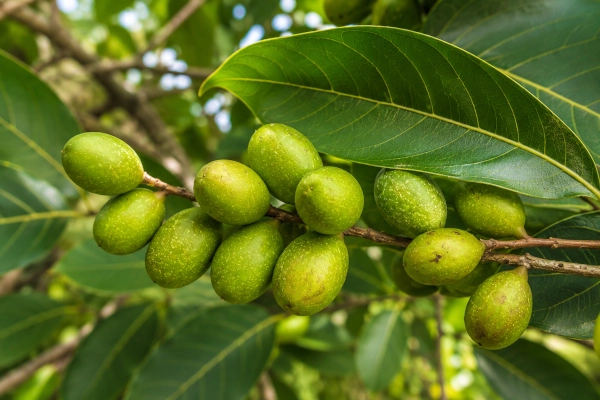
Botanical name: Terminalia chebula Retz.
Family: Combretaceae
Sanskrit names: Haritaki, Abhaya, Pathya, Shiva, Vijaya, Kayastha
English names: Chebulic myrobalan, myrobalan
Hindi: Harad, Haritaki
Malayalam: Katukka
Tamil: Kadukkai
Kannada: Alalekai
Telugu: Karakkaya
Part used: Dried pericarp of the mature fruit
Haritaki is one of the most respected medicinal fruits in Ayurveda. Classical literature praises it as a Rasayana, a substance used to preserve strength, support healthy ageing and maintain the proper functioning of the body. The Sanskrit name Abhaya, meaning “free from fear,” reflects the high regard in which the fruit was held, while Pathya indicates something wholesome and beneficial for the body’s channels.
The accepted botanical source of Haritaki is Terminalia chebula Retz., a tree belonging to the Combretaceae family. The Ayurvedic Pharmacopoeia of India defines the medicinal drug as the pericarp of the mature fruit. The species is native across the Indian subcontinent and extends eastward into parts of China and Indo-China.
The Haritaki Tree
Haritaki grows as a medium-sized or large deciduous tree and may reach a considerable height under favourable forest conditions. It occurs in deciduous forests, areas of moderate rainfall and occasionally in slightly moist forests, rising to around 1,500 metres in parts of India. Its natural distribution includes India, Nepal, Bangladesh, Sri Lanka, Myanmar, Thailand, Laos, Cambodia, Vietnam and western Yunnan in China.
The trunk bears greyish or dark-brown bark, while the branches form a broad, spreading crown. The leaves are simple, oval or elliptic-oblong and arranged alternately or almost opposite one another. A useful identifying feature is the presence of small glands near the upper end of the leaf stalk. Young leaves may possess fine hairs that gradually disappear as the leaf matures.
The flowers are small, pale yellowish-white or greenish and appear in elongated spikes. The fruits develop as firm, oval drupes containing a single hard seed. Fresh fruits are green and gradually become yellowish or brown as they mature.
How to Identify Genuine Haritaki Fruit
The dried Haritaki fruit is generally yellowish-brown, oval and strongly wrinkled, with longitudinal ribs running from one end to the other. The Ayurvedic Pharmacopoeia describes intact fruits as approximately 20–35 millimetres long and 13–25 millimetres wide. The fibrous pericarp is about 3–4 millimetres thick and separates relatively easily from the hard inner seed. Its dominant taste is strongly astringent.
Good-quality fruits are mature, firm, heavy for their size and possess a substantial pericarp. Fruits that are excessively hollow, insect-damaged, mouldy or coated with artificial colour should be avoided. The medicinal powder is brownish and has a distinctly astringent taste.
Haritaki in Classical Ayurveda
Haritaki occupies a special place in the Charaka Samhita, Sushruta Samhita, Ashtanga Hridaya, Bhavaprakasha Nighantu and other Ayurvedic works. It is repeatedly described as a restorative drug with particular affinity for the digestive system, respiratory passages, skin, eyes and the body’s channels.
Classical descriptions recognise seven varieties of Haritaki:
Vijaya, Rohini, Putana, Amrita, Abhaya, Jivanti and Chetaki.
These names distinguish fruits according to their shape, geographical origin and traditional therapeutic preference. Vijaya is generally regarded as the variety suitable for a broad range of medicinal preparations. The surviving commercial drug commonly consists of cultivated or wild forms of Terminalia chebula, and the ancient sevenfold classification should be understood primarily within the framework of classical Ayurvedic pharmacognosy.
Ayurvedic Properties
Haritaki possesses five of the six tastes recognised in Ayurveda. It contains sweet, sour, pungent, bitter and astringent tastes, with the astringent taste usually being the most prominent. Salty taste is absent.
Rasa: Madhura, Amla, Katu, Tikta and Kashaya
Guna: Laghu and Ruksha
Virya: Ushna
Vipaka: Madhura
Dosha action: Traditionally described as Tridosha-shamaka
Principal actions: Rasayana, Anulomana, Dipana, Medhya, Chakshushya and Hridya
Its Laghu quality supports lightness and digestion, while Ruksha indicates a drying effect. Its warming potency encourages digestive activity, and its sweet post-digestive effect contributes to its restorative character. The Ayurvedic Pharmacopoeia lists Haritaki as Sarvadosha-prashamana, indicating its traditional use in balancing all three doshas when selected and combined appropriately.
Haritaki and the Digestive System
Haritaki is especially associated with Anulomana, the proper downward movement of Vata through the gastrointestinal tract. Ayurveda employs it where disturbed Apana Vata produces abdominal fullness, irregular elimination, retained gas or difficult bowel movements.
Its action varies with the condition of the fruit, method of preparation, quantity and accompanying substance. In carefully selected preparations, it may support regular evacuation while preserving digestive strength. Its astringent constituents also explain why stronger or differently prepared formulations have historically been used in conditions involving loose stools.
Haritaki is further described as Dipana, supporting the digestive fire, and as beneficial in Aruchi, or impaired desire for food. These traditional actions form the basis of its inclusion in many digestive powders, fermented preparations and herbal confections.
Rasayana and Healthy Ageing
As a Rasayana drug, Haritaki is traditionally used to maintain vitality, tissue nourishment, sensory clarity and resistance to the effects of ageing. Rasayana practice extends beyond taking a single herb: it includes suitable food, sleep, conduct, digestion and seasonal discipline.
Haritaki’s Rasayana reputation is closely connected with its effect on digestion and elimination. Ayurvedic thought holds that clear channels and efficiently functioning digestion allow nourishment to reach the tissues properly. Haritaki therefore represents a restorative substance whose benefits begin with the regulation of digestion and the movement of Vata.
Support for the Respiratory System
Classical formulations containing Haritaki are employed in Kasa and Shwasa, Ayurvedic categories associated with coughing and disturbed breathing. It appears in preparations such as Agastya Haritaki Rasayana and Chitraka Haritaki, where it is combined with other herbs selected according to the individual’s digestive strength, respiratory symptoms and doshic condition.
Haritaki’s traditional respiratory use should be viewed as part of a complete formulation rather than as a universal home treatment. Persistent cough, breathing difficulty, chest pain, fever or blood in the sputum requires prompt medical assessment.
Haritaki and the Mind, Eyes and Heart
The pharmacopoeial description includes the actions Medhya, Chakshushya and Hridya. Medhya refers to support for faculties such as memory, understanding and concentration. Chakshushya indicates traditional benefit for the eyes, while Hridya signifies something considered agreeable or supportive to the heart and mind within Ayurvedic terminology.
These classical terms carry broader meanings than modern disease-specific claims. They describe the traditional sphere of action assigned to the drug and should not be interpreted as evidence that Haritaki independently treats neurological, ophthalmic or cardiovascular disorders.
Haritaki in Triphala
Haritaki is one of the three fruits forming Triphala, together with Amalaki and Bibhitaki. The combination brings together fruits traditionally associated with the regulation of Vata, Pitta and Kapha.
Triphala Churna is one of Ayurveda’s best-known formulations and is used to support digestion, elimination, eye health and Rasayana therapy. Its character differs from Haritaki used alone because the three fruits modify and complement one another.
Other recognised classical formulations include Abhayarishta, Agastya Haritaki Rasayana, Chitraka Haritaki, Danti Haritaki, Dashamula Haritaki, Brahma Rasayana, Abhaya Lavana and Triphaladi Taila.
Ritu Haritaki
Ayurvedic tradition describes a seasonal practice known as Ritu Haritaki, in which Haritaki is combined with different accompanying substances according to the season. The principle reflects Ayurveda’s understanding that climate changes the condition of the doshas, digestion, tissues and bodily channels.
Traditional descriptions associate Haritaki with specific substances such as ginger, rock salt, sugar, honey, long pepper or jaggery during different seasons. The exact sequence varies among textual and regional traditions. Ritu Haritaki is a structured Rasayana practice and is best followed under the guidance of a qualified Ayurvedic physician, especially when the person has an existing illness or takes regular medication.
Important Natural Constituents
Haritaki fruit contains abundant hydrolysable tannins and polyphenolic compounds. Identified constituents include chebulagic acid, chebulinic acid, gallic acid, ellagic acid and related phenolic substances. The Ayurvedic Pharmacopoeia also records tannins, anthraquinones and polyphenolic compounds among its principal constituents.
Laboratory and animal studies have investigated antioxidant, antimicrobial, anti-inflammatory, digestive, metabolic and neuroprotective activities of Haritaki extracts and isolated compounds. These findings help explain the scientific interest surrounding the plant, though many proposed benefits remain based on preclinical research. Larger, well-designed human clinical trials are required before such findings can be translated into confirmed treatments for specific diseases.
Traditional Forms of Use
The mature fruit pericarp may be processed into powder, decoction, paste, fermented medicine, herbal jam or compound tablets. Haritaki is often combined with different substances according to the therapeutic intention. Ayurveda may pair it with ghee in Vata-predominant conditions, with suitable cooling substances where Pitta requires attention, or with honey and warming herbs in selected Kapha conditions.
The Ayurvedic Pharmacopoeia records 3–6 grams of powdered drug as its general monograph dose. This represents a pharmacopoeial range rather than a recommendation for unrestricted self-treatment. The proper amount varies with age, digestive strength, constitution, disease, formulation and accompanying medicine.
Precautions
Haritaki possesses a drying and bowel-regulating character and may be unsuitable in certain situations without professional guidance. Excessive use may produce loose stools, abdominal discomfort, dehydration or increased dryness.
Extra care is appropriate during pregnancy and breastfeeding, in young children, in frail or underweight individuals, during acute dehydration and in people experiencing persistent diarrhoea. Those using medicines for diabetes, blood pressure, bowel disorders or other chronic conditions should consult a qualified medical professional before taking concentrated Haritaki extracts or long-term formulations.
Herbal products should come from reliable manufacturers that follow appropriate standards for identification, purity and contamination testing. The medicinal fruit must be correctly distinguished from other species sold under regional myrobalan names.
Haritaki’s Enduring Place in Ayurveda
Haritaki represents Ayurveda’s close connection between digestion, elimination, nourishment and longevity. Its value lies in its adaptability: it appears as a simple fruit powder, a component of Triphala, a base for respiratory Rasayanas and an ingredient in complex preparations for digestive and systemic disorders.
Its five tastes, warming potency, sweet post-digestive effect and Anulomana action give it an unusually broad classical profile. Modern research has revealed a fruit rich in tannins and biologically active polyphenols, while clinical evidence still requires further development.
Haritaki remains a significant medicinal substance whose full use depends on correct identification, thoughtful processing and personalised Ayurvedic assessment. Its ancient names—Abhaya, Pathya and Vijaya—preserve the esteem granted to this modest ribbed fruit across centuries of Indian medical tradition.
Health Disclaimer
This article is intended for educational and cultural information. It does not provide medical diagnosis, prescription or individual treatment advice. Haritaki and Haritaki-containing formulations should be used under the guidance of a qualified Ayurvedic physician or other licensed healthcare professional, particularly during pregnancy, childhood, chronic illness or concurrent medication use.
References
Central Council for Research in Ayurvedic Sciences. Ayurveda: The Science of Life. Ministry of AYUSH, Government of India.
https://ccras.nic.in/wp-content/uploads/2024/07/AYURVEDA_The_Science_of_LifeDossier.pdf
Central Council for Research in Ayurvedic Sciences. Geriatric Health Care Through Ayurveda. Ministry of AYUSH, Government of India.
https://ccras.nic.in/wp-content/uploads/2024/06/Geriatic-Health-Care-Through-Ayurveda.pdf
Central Council for Research in Ayurvedic Sciences. Digestive Disorders: Poor Appetite, Indigestion and Constipation. Ministry of AYUSH, Government of India.
https://ccras.nic.in/wp-content/uploads/2024/06/Digestive-Disorders.pdf
Royal Botanic Gardens, Kew. “Terminalia chebula Retz.” Plants of the World Online.
https://powo.science.kew.org/taxon/urn:lsid:ipni.org:names:171037-1
International Plant Names Index. “Terminalia chebula Retz.”
https://www.ipni.org/n/171037-1
Ratha, K. K., and Joshi, G. C. “Haritaki (Chebulic Myrobalan) and Its Varieties.” Ayu, Volume 34, Issue 3, 2013, pp. 331–334.
https://pmc.ncbi.nlm.nih.gov/articles/PMC3902605/
Bag, A., Bhattacharyya, S. K., and Chattopadhyay, R. R. “The Development of Terminalia chebula Retz. (Combretaceae) in Clinical Research.” Asian Pacific Journal of Tropical Biomedicine, Volume 3, Issue 3, 2013, pp. 244–252.
https://pmc.ncbi.nlm.nih.gov/articles/PMC3631759/
Nigam, M., Mishra, A. P., Adhikari-Devkota, A., et al. “Fruits of Terminalia chebula Retz.: A Review on Traditional Uses, Bioactive Chemical Constituents and Pharmacological Activities.” Phytotherapy Research, Volume 34, Issue 10, 2020, pp. 2518–2533.
https://pubmed.ncbi.nlm.nih.gov/32307775/
Bulbul, M. R. H., Chowdhury, M. N. U., Naima, T. A., et al. “A Comprehensive Review on the Diverse Pharmacological Perspectives of Terminalia chebula Retz.” Heliyon, Volume 8, Issue 8, 2022.
https://pmc.ncbi.nlm.nih.gov/articles/PMC9424961/
Wang, C., Cheng, X., et al. “Comprehensive Review on Fruit of Terminalia chebula.” 2024.
https://pmc.ncbi.nlm.nih.gov/articles/PMC11643145/
Directorate of AYUSH, Government of NCT of Delhi. “Ayurveda: Frequently Asked Questions and Medicine-Safety Guidance.”
https://ayush.delhi.gov.in/faqs/ayurveda
Classical Ayurvedic Sources
Charaka Samhita — Sutrasthana and Chikitsasthana.
Sushruta Samhita — Sutrasthana and Uttara Tantra.
Vagbhata. Ashtanga Hridaya.
Bhavamishra. Bhavaprakasha Nighantu — Haritakyadi Varga.
Dhanvantari. Dhanvantari Nighantu.
Shodhala. Shodhala Nighantu.
You may also like
-
Indian MedTech Startup Periwinkle Takes Rapid AI Cervical Cancer Screening to BRICS
-
WHO Chief Praises India’s Gains in Maternal, Child Health and NCD Care
-
Ayurvedic Foods for Liver Health and Digestion
-
Ayurvedic Diet for Joint Health and Stiffness
-
Ayurvedic Breakfasts: What Traditional Ayurveda Suggests for the First Meal of the Day
