Chavya is a warming, pungent medicinal climber valued in Ayurveda for awakening Agni, supporting the digestion of Ama and relieving disorders associated with accumulated Vata and Kapha in the digestive tract. Its sharp action places it among Ayurveda’s stronger Deepana-Pachana substances—herbs employed to stimulate appetite, improve digestion and restore the proper downward movement of Vata.
The correct botanical spelling is Piper retrofractum Vahl. The older botanical name Piper chaba W.Hunter appears frequently in Ayurvedic literature and regional medical traditions, while current botanical classification treats it as a synonym of Piper retrofractum. The plant belongs to the Piperaceae family, which also includes black pepper and long pepper.
Sanskrit and Regional Names
The principal Sanskrit name is Chavya, also written as Cavya or Chavika. The Ayurvedic Pharmacopoeia records Cavika as a Sanskrit synonym.
Regional names include Chavya in Hindi and Kannada, Chavaka in Marathi and Gujarati, Chavyam in Tamil, Chevyamu in Telugu, Chei in Bengali and Kattumulaku or Kattumulakunveru in Malayalam. The plant is also known in English as Java long pepper or Javanese long pepper, although the pharmacopoeial English entry uses the older common name cubeb.
Botanical Identity
Botanical name: Piper retrofractum Vahl.
Family: Piperaceae
Ayurvedic part used: Dried stem
Older botanical synonym: Piper chaba W.Hunter
General English names: Java long pepper, Javanese long pepper, Balinese pepper
The Ayurvedic Pharmacopoeia of India officially defines Chavya as the dried stem of Piper retrofractum. It describes the plant as a smooth, fleshy climber cultivated mainly in southern India. The dried medicinal stem occurs as cylindrical or slightly twisted greyish-brown pieces with visible nodes and internodes. It possesses a pepper-like odour and a distinctly acrid taste.
How to Identify the Plant
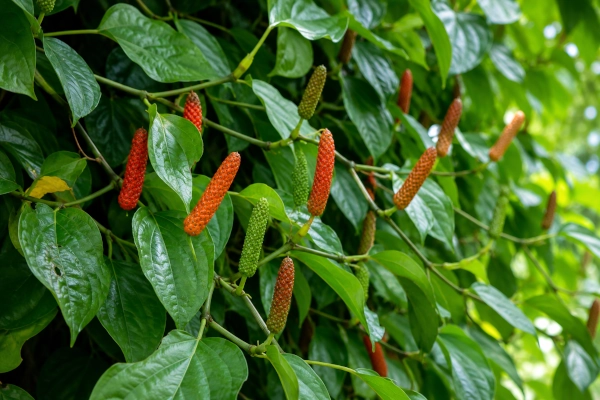
Chavya is a perennial pepper vine that grows along the ground or climbs over trees and other supports. It bears simple, oval or broadly elliptic leaves and elongated fruiting spikes resembling a larger, thicker form of long pepper. The fruits become red as they mature and turn darker after drying.
The plant may resemble other members of the Piper genus, particularly Pippali. Identification should therefore consider the whole vine, leaves, fruit spikes and medicinal stem. For pharmacopoeial use, the recognised Chavya drug consists primarily of the dried stem rather than the commonly traded fruit of Indian long pepper.
Ayurvedic Properties of Chavya
| Ayurvedic principle | Traditional description |
|---|---|
| Rasa — Taste | Katu — pungent |
| Guna — Qualities | Laghu — light; Ruksha — dry; Tikshna — sharp and penetrating |
| Virya — Potency | Ushna — heating |
| Vipaka — Post-digestive effect | Katu — pungent |
| Dosha action | Pacifies aggravated Vata and Kapha; may increase Pitta when used excessively |
| Principal karma | Deepana, Pachana, Rechana and Bhedana |
These properties explain the plant’s strong affinity for conditions involving heaviness, coldness, sluggish digestion, mucus accumulation and obstructed movement within the gastrointestinal system. The official pharmacopoeia identifies its classical actions as Vatahara, Kaphahara, Deepana, Pachana, Rechana and Bhedana.
Deepana: Awakening the Digestive Fire
Chavya is chiefly regarded as a Deepana Dravya, a substance that stimulates Agni and promotes the desire for food. Ayurveda considers Agni the transforming power responsible for digesting food, processing sensory experience and sustaining healthy tissue metabolism.
When Agni becomes weak, a person may experience poor appetite, abdominal heaviness, sluggish digestion, belching, bloating and a feeling that food remains undigested for a long period. Chavya’s pungent taste, heating potency and sharp quality are traditionally employed to counter this cold and stagnant digestive condition.
Its use is especially associated with Kapha-dominant Agnimandya, where heaviness, excessive mucus, lethargy and diminished appetite occur together.
Pachana: Supporting the Digestion of Ama
Chavya also possesses Pachana activity. Deepana kindles digestive power, while Pachana assists the processing of Ama—the heavy, incompletely transformed material associated in Ayurveda with impaired digestion and metabolic stagnation.
In classical practice, Chavya is commonly combined with other pungent herbs rather than used alone. Such combinations aim to rekindle Agni gradually, clear obstruction, improve appetite and encourage normal movement through the digestive tract.
This role becomes especially prominent in Panchakola, one of Ayurveda’s recognised groups of five digestive herbs.
Chavya in Panchakola
Chavya is an essential ingredient of Panchakola, a classical combination consisting of:
Pippali — fruit of Piper longum
Pippalimula — root of Piper longum
Chavya — stem of Piper retrofractum
Chitraka — root of Plumbago zeylanica
Shunthi or Nagara — dried rhizome of Zingiber officinale
All five ingredients possess a strong association with Agni, Ama and the regulation of Vata-Kapha conditions. Chavya contributes sharpness, warmth and a penetrating digestive action to the group. Official Ayurvedic food and formulation documents identify the stem of Piper retrofractum as the Chavya component in Panchakola preparations.
Panchakola may be processed as a powder, decoction, medicated gruel, milk preparation or part of a larger compound formula. Its strength requires careful selection according to the patient’s constitution, digestive state, age and Pitta tolerance.
Traditional Uses in Ayurveda
Agnimandya and loss of appetite
Chavya is traditionally administered when appetite has weakened and digestion has become slow. Its Deepana property is intended to awaken hunger, while its Pachana action supports the processing of accumulated Ama.
Anaha and abdominal distension
Anaha refers to obstruction, distension or difficulty in the normal passage of flatus and stool. Chavya’s heating and Vata-regulating nature is traditionally used in formulas for bloating, abdominal fullness and obstructed movement in the digestive tract.
Shula or abdominal colic
The pharmacopoeia lists Shula, or pain and colic, among the traditional indications of Chavya. Its use is particularly associated with pain accompanied by coldness, gas, heaviness and Kapha-Vata obstruction.
Gulma
Gulma is a classical Ayurvedic term describing palpable or shifting abdominal masses, distension and complex accumulations involving Vata and other Doshas. Chavya appears in compound formulations designed to stimulate digestion, reduce stagnation and restore the movement of Vata.
Udara Roga
Udara Roga includes a broad classical category of abdominal disorders. Chavya is selected when digestive weakness, Ama, abdominal enlargement, gas or obstruction form part of the presentation.
Arsha
The Ayurvedic Pharmacopoeia records Arsha, commonly translated as piles or haemorrhoidal disease, among Chavya’s classical therapeutic uses. Its inclusion relates to improving digestive function, reducing Ama and supporting appropriate bowel movement rather than serving as a universal treatment for every form of the condition.
Krimi
Chavya is also classified among herbs traditionally employed in Krimi, a broad Ayurvedic category involving intestinal organisms and certain microbial or parasitic conditions. Its pungent, heating and sharp qualities contribute to this classical application.
Pliha Roga
Pliha Roga refers to disorders associated with the spleen and the left upper abdominal region in classical medicine. Chavya may appear in compound formulations when such conditions are accompanied by poor appetite, abdominal heaviness and impaired digestion.
Rechana and Bhedana Action
The pharmacopoeia attributes both Rechana and Bhedana actions to Chavya. Rechana describes an evacuating or downward-cleansing effect, while Bhedana refers to breaking through hard or obstructed accumulations and assisting their elimination.
These actions arise from its Ushna and Tikshna qualities. They also make careful dosing important, since excessive use may provoke loose stools, burning or irritation in sensitive individuals.
Classical Preparations Containing Chavya
Panchakola Ksheera
Panchakola Ksheera is prepared by processing the five Panchakola ingredients in milk. An official Ayurveda Aahara compendium describes a preparation using Pippali, Pippalimula, Chavya stem, Chitraka root and Shunthi. It associates the preparation with support for strength, complexion and digestive fire, together with classical use in respiratory and febrile conditions.
This formulation illustrates an important Ayurvedic principle: a group of strongly heating herbs may be processed in a nourishing medium such as milk to shape their action and improve suitability for a particular clinical context.
Panchakola Yavagu
Yavagu is a thin medicated rice gruel. Panchakola Yavagu combines rice and water with the five Panchakola herbs, creating a light dietary preparation centred on digestive stimulation. Classical medicated gruels occupy an intermediate position between food and medicine, allowing the physician to support digestion while providing gentle nourishment.
Because Chitraka, Chavya and the other Panchakola drugs possess strong heating qualities, this preparation belongs under professional Ayurvedic guidance.
Chandramrita Rasa and Pranada Gutika
The Ayurvedic Pharmacopoeia lists Chandramrita Rasa and Pranada Gutika among important formulations containing Chavya. These are compound medicines whose preparation and administration require trained professional supervision.
Chavya, Pippali and Gajapippali
Chavya is closely related to Pippali and is sometimes confused with Gajapippali in regional trade. All belong to the wider pepper group and share a pungent, warming character, yet their medicinal parts and botanical identities differ.
The official pharmacopoeial Chavya drug is the dried stem of Piper retrofractum. Pippali generally refers to the fruit of Piper longum, while Pippalimula refers to its root. Accurate identification becomes especially important when preparing Panchakola, since the formula intentionally combines separate plant parts with related yet distinct actions.
Principal Constituents
The Ayurvedic Pharmacopoeia broadly records alkaloids, glycosides and steroids among the constituents of Chavya stem. Modern phytochemical studies have identified compounds such as piperine, piplartine, beta-sitosterol, chabamides and several retrofractamides in different parts of the plant.
Piperine contributes to the characteristic pungency associated with many medicinal and culinary plants of the Piper genus.
Modern Scientific Perspective
Laboratory and animal research has examined Piper retrofractum extracts and isolated compounds for antimicrobial, anti-inflammatory, gastroprotective, antidiarrhoeal, antioxidant and other biological activities. Researchers have also investigated its alkaloids and amides as possible leads for future drug development.
Most of this evidence comes from experimental studies involving cells, isolated compounds or animals. Human clinical evidence remains limited. Modern findings therefore support continued research while the plant’s established use remains rooted primarily in classical Ayurvedic practice.
Part Used and Classical Dose
The Ayurvedic Pharmacopoeia recognises the dried stem as the official medicinal material and records 1–2 grams of the powdered drug as general adult dose guidance.
Dose selection in clinical Ayurveda depends upon the patient’s Prakriti, age, digestive strength, condition, season, accompanying herbs and chosen Anupana. Chavya’s sharp and heating nature makes individual assessment particularly important.
Precautions
Chavya possesses Ushna Virya and Tikshna Guna. Strong or prolonged use may increase heat and dryness, particularly in people with pronounced Pitta or sensitive gastrointestinal tissue.
Professional assessment is advisable in the presence of acid reflux, gastritis, peptic irritation, frequent burning sensations, active inflammatory bowel conditions or a tendency toward loose stools. Pregnancy, breastfeeding, childhood use and use alongside regular medication also call for guidance from a qualified practitioner.
Self-preparation of potent Panchakola formulations may produce excessive heat or digestive irritation when the proportions, processing medium and indication are poorly matched.
Conclusion
Chavya is a significant yet less widely known member of Ayurveda’s pepper group. Its pungent taste, light and sharp qualities, heating potency and affinity for Vata-Kapha conditions make it an important Deepana-Pachana herb. Classical medicine values it in Agnimandya, Ama-related digestive stagnation, abdominal distension, colic, Gulma, Arsha, Krimi and related disorders.
Its place within Panchakola reveals its deeper therapeutic identity. Chavya acts most effectively as part of a carefully designed formulation in which several digestive herbs work together to rekindle Agni, clear obstruction and restore the orderly movement of Vata. Its potency also demands respect, correct botanical identification and professionally guided use.
Health Disclaimer
This article is intended for educational and cultural information about Ayurveda. Diagnosis, medicinal dosing and treatment should be undertaken with a qualified Ayurvedic physician or licensed healthcare professional. People with chronic illness, pregnancy, breastfeeding, digestive inflammation or ongoing medication should seek individual medical guidance before using Chavya or Panchakola preparations.
References
- Government of India, Ministry of AYUSH. The Ayurvedic Pharmacopoeia of India. Entry on Cavika/Chavya—Piper retrofractum Vahl., Piperaceae.
https://ia800501.us.archive.org/34/items/AyurvedicPharmacopoeiaOfIndiaAllVolume/Ayurvedic%20Pharmacopoeia%20of%20India%20All%20Volume.pdf - Royal Botanic Gardens, Kew. “Piper retrofractum Vahl.” Plants of the World Online.
https://powo.science.kew.org/taxon/urn:lsid:ipni.org:names:683079-1 - Central Council for Research in Ayurvedic Sciences. Ayurveda Aahara Compendium. Ministry of AYUSH, Government of India. Information on Panchakola and preparations containing Chavya.
https://ccras.nic.in/wp-content/uploads/2024/10/03102024-FSSAIs-Ayurveda-Aahara-Compendium.pdf - Khare, C. P. Indian Medicinal Plants: An Illustrated Dictionary. Springer, New York. Entry on Piper retrofractum and its traditional medicinal applications.
- Kirtikar, K. R., and Basu, B. D. Indian Medicinal Plants. International Book Distributors, Dehradun. Botanical descriptions and traditional uses of plants belonging to the genus Piper.
- Sharma, P. V. Dravyaguna Vijnana. Chaukhambha Bharati Academy, Varanasi. Classical Ayurvedic properties, actions and therapeutic applications of Chavya.
- Bhavamishra. Bhavaprakasha Nighantu, commentary and translation by K. C. Chunekar. Chaukhambha Bharati Academy, Varanasi. Classical description of Chavya and its Deepana-Pachana qualities.
- Sharma, P. V. Dhanvantari Nighantu. Chaukhambha Orientalia, Varanasi. Traditional nomenclature, properties and therapeutic indications of Chavya.
- Charaka. Charaka Samhita, with Ayurvedadipika commentary of Chakrapanidatta. Chaukhambha Sanskrit Sansthan, Varanasi. Classical references to Panchakola, Agni, Ama and digestive formulations.
- Sushruta. Sushruta Samhita, with Nibandhasangraha commentary of Dalhana. Chaukhambha Sanskrit Sansthan, Varanasi. Classical principles concerning Deepana, Pachana and the management of digestive disorders.
You may also like
-
How Much Exercise Is Enough According to Ayurveda?
-
AIIA and 132 ECO Task Force Launch 10,000-Plant Ashwagandha Research Initiative in Delhi’s Aravalli Landscape
-
Dr Reddy’s to Bring India’s First CDSCO-Approved Dengue Vaccine QDENGA to Private Market in 2027
-
The Ayurvedic Approach to Exercise and Physical Activity
-
FSSAI Moves to Reserve ‘Paneer’ Name for Milk-Derived Products
:%20Ayurveda’s%20Pungent%20Herb%20for%20Agni,%20Ama%20and%20Digestive%20Balance)