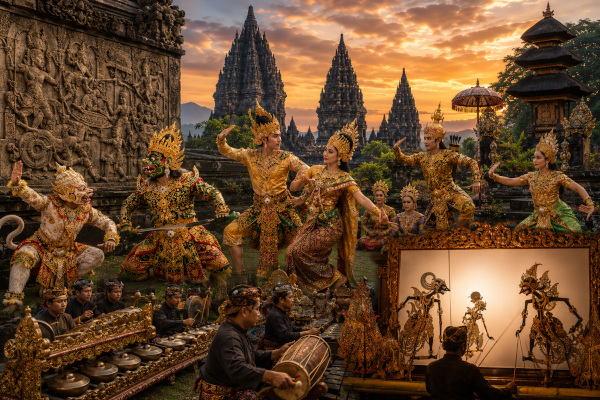
Indonesia holds one of the richest Ramayana traditions outside Bharat. The epic lives in Old Javanese literature, temple sculpture, Balinese ritual culture, Javanese court dance, Wayang Kulit shadow puppetry, gamelan music, and living theatre. In Indonesia, the story of Rama became Serat Rama, Kakawin Ramayana, Wayang Ramayana, Sendratari Ramayana, and a sacred artistic language shared by Java, Bali, Lombok, and other cultural regions.
In a positive Akhand Bharat sense, Indonesia is one of the finest examples of Brihattar Bharat — the larger civilisational world shaped by Indian epics, Sanskritic vocabulary, Hindu-Buddhist philosophy, temple architecture, maritime exchange, and sacred performance. India’s Ministry of Culture notes that the Ramayana had extensive influence on Southeast Asian culture, where it appears in dance, ballet, theatre, paintings, sculpture, and local literary forms.
Kakawin Ramayana: The Old Javanese Ramayana
The most important literary form of the Indonesian Ramayana is the Kakawin Ramayana, an Old Javanese rendering of the epic composed in the refined kakawin poetic style. Academic work on the Old Javanese Ramayana treats it as a major classical text of Java’s Hindu-Buddhist literary world, and OAPEN lists C. Hooykaas’s scholarly edition The Old-Javanese Rāmāyaṇa Kakawin, showing the importance of the text in global Ramayana studies.
The word kakawin itself reflects the deep Sanskritic influence on Java. Kakawin poetry used metres and literary ideals connected with Sanskrit kāvya, while giving the epic a Javanese courtly personality. Rama became a refined royal hero of Java. Sita became the model of sacred dignity. Lakshmana became the devoted companion. Hanuman became the brilliant warrior-servant. Ravana, known in Indonesian forms such as Rahwana, became the dramatic figure of power, desire, and downfall.
This is the genius of Indonesia’s Ramayana tradition. The epic arrived from Bharat, entered Java’s literary world, and became Indonesian in sound, rhythm, scenery, and emotion.
Prambanan: Ramayana Carved in Stone
The clearest stone witness of Ramayana influence in Indonesia is Prambanan, the great Hindu temple complex in Central Java. UNESCO describes Prambanan as the largest temple compound dedicated to Shiva in Indonesia, with three main temples dedicated to Shiva, Vishnu, and Brahma, and with reliefs illustrating the epic of the Ramayana.
UNESCO also states that the Hindu temples of Prambanan are decorated with reliefs illustrating the Indonesian version of the Ramayana epic, calling them masterpieces of stone carving. This makes Prambanan one of the grandest examples of Ramayana art in the world. Here, the epic is read through stone panels, temple pathways, sacred circumambulation, and the architectural dignity of the Trimurti.
The presence of Ramayana scenes at Prambanan shows that the epic was central to ancient Java’s sacred imagination. The story was worthy of temple walls because it taught kingship, loyalty, duty, courage, restraint, devotion, and the victory of dharmic order.
Wayang Kulit: Ramayana in Light and Shadow
Indonesia’s most famous performing tradition connected with the Ramayana is Wayang Kulit, the shadow-puppet theatre of Java and Bali. UNESCO recognises Wayang puppet theatre as an Indonesian intangible cultural heritage form, noting that it originated on Java and flourished for centuries in the royal courts of Java and Bali as well as in rural communities.
In Wayang Kulit, the Ramayana becomes shadow, voice, leather carving, music, philosophy, humour, and moral teaching. The dalang, or master puppeteer, controls the puppets, narrates the story, gives different voices to characters, guides the gamelan orchestra, and interprets the epic for the audience. Rama, Sita, Lakshmana, Hanuman, Sugriva, Rahwana, Kumbhakarna, and other figures move across the glowing screen as living symbols.
Wayang is one of Indonesia’s greatest gifts to world culture because it makes the Ramayana deeply local. Indian characters enter Javanese cosmology. Sanskritic ideals blend with village humour. Royal dharma meets local wisdom. The result is a sacred theatre where entertainment, philosophy, devotion, and community memory become one experience.
Ramayana Ballet at Prambanan
Indonesia also presents the Ramayana through Sendratari Ramayana, popularly known as the Ramayana Ballet. At Prambanan, the performance combines Javanese dance, music, costume, gesture, and dramatic staging. The official Prambanan ticketing platform describes the Ramayana Ballet as one of Indonesia’s captivating cultural performances, blending dance and drama without spoken dialogue, with more than 200 dancers and musicians performing at the open-air stage with Prambanan Temple in the background since 1961.
This performance gives the ancient epic a modern public life. Visitors see Rama’s search for Sita, Hanuman’s courage, Rahwana’s palace, the burning of Lanka, and the final triumph of righteousness under the night sky, with the towers of Prambanan behind the stage. It is one of Asia’s most powerful examples of heritage becoming living art.
Balinese Ramayana Culture
Bali preserves the Ramayana with special devotion. In Balinese culture, the epic appears in dance, temple festivals, masks, painting, carving, literature, and ritual theatre. The Balinese Ramayana is closely linked with Agama Hindu Dharma, the living Hindu tradition of Bali. Bali’s religious world honours the Hindu deities while also preserving local ancestral spirits, nature forces, village guardians, and indigenous sacred forms.
This gives Bali a unique role in the Indonesian Ramayana world. In Java, the Ramayana is often seen through court literature, wayang, and temple sculpture. In Bali, it becomes part of daily Hindu ritual life, dance, offering, temple aesthetics, and community identity.
Hindu Gods and Indonesian Traditional Culture
The comparison between Hindu gods and Indonesian traditional culture must be read as cultural resonance and historical blending. Indonesia received Indian spiritual ideas through centuries of maritime contact, yet Java and Bali gave those ideas their own local personality.
Brahman and Sang Hyang Widhi Wasa form the deepest theological comparison. In Balinese Hinduism, Sang Hyang Widhi Wasa is understood as the supreme divine principle. A scholarly source on Agama Hindu Dharma describes the name as meaning “Almighty, Divine and Supreme Ruler.” This connects beautifully with the Hindu concept of Brahman, the supreme reality beyond form, name, and limitation.
Shiva and Batara Guru form one of the strongest Indonesian parallels. In Java and Bali, Shiva appears as Siwa and also through the form Batara Guru, the divine teacher and lordly figure of Indonesian Hindu mythology. Sources on Batara Guru describe him as connected with Rudra-Shiva and as a spiritual teacher figure shaped by Indonesian Hindu imagination. Prambanan itself, dedicated primarily to Shiva, shows how deeply Shaiva worship shaped ancient Java.
Vishnu and Rama are central to the Ramayana tradition. In Hinduism, Rama is the avatar of Vishnu, the preserver of cosmic order. In Indonesia, Rama becomes a Javanese and Balinese royal ideal: graceful, disciplined, courageous, and committed to justice. The Ramayana panels of Prambanan and the living performances of Wayang and Sendratari show Vishnu’s dharmic principle becoming Indonesian royal ethics and theatre.
Brahma and the Javanese-Balinese Trimurti are clearly visible at Prambanan, where the main sacred arrangement honours Shiva, Vishnu, and Brahma. UNESCO records these three great Hindu divinities as central to the Prambanan temple compound. This shows how the Indian Trimurti concept entered Indonesian temple architecture and became part of Java’s sacred landscape.
Lakshmi, Sri, and Dewi Sri form a beautiful agricultural connection. In Hinduism, Lakshmi or Sri represents prosperity, fertility, auspiciousness, and abundance. In Indonesian culture, Dewi Sri is revered as the goddess of rice and fertility in Java, Bali, and Lombok; the Royal Collection Trust describes Dewi Sri as the goddess of rice and fertility. This is one of the strongest examples of how Indic Sri-Lakshmi symbolism blended with Indonesia’s rice civilisation.
Hanuman and Hanoman show how a Hindu devotional hero became an Indonesian performance icon. In Wayang and Ramayana ballet, Hanuman or Hanoman is brave, intelligent, agile, humorous, and loyal. His leap, strength, and service to Rama made him one of the most loved characters in Indonesian theatre. Through Hanoman, bhakti becomes movement, music, and stage energy.
Durga, Uma, Rangda, and fierce goddess traditions reveal the layered nature of Balinese sacred culture. Indian goddess traditions entered Bali through Shivaite and Shakta streams, while local spirit worlds gave them dramatic new forms. Balinese Barong-Rangda performance expresses the rhythm of protection, danger, purification, and cosmic balance; research on Barong and Rangda links these figures to Shivaistic teachings and ritual performance.
Semar and the Punakawan show Indonesia’s most creative localisation of epic culture. Semar is a Javanese wayang figure who serves Rama in Ramayana-based tales, and the World Encyclopedia of Puppetry Arts describes him as the main clown figure of Java’s wayang world. Semar has no direct equivalent in Valmiki’s Ramayana, yet he became essential to Javanese epic performance. Through Semar, Indonesia added local wisdom, humour, humility, and village philosophy to the Ramayana universe.
The Indonesian Genius of Adaptation
Indonesia did something remarkable with the Ramayana. It preserved the epic’s core dharmic message while reshaping its artistic form. The story became Old Javanese poetry in Kakawin Ramayana. It became temple sculpture at Prambanan. It became shadow-puppet theatre in Wayang Kulit. It became royal and public dance in Sendratari Ramayana. It became ritual culture in Bali.
This proves that the Ramayana travelled as a living civilisational seed. It adapted to local languages, local gods, local landscapes, local costumes, local music, and local philosophy. Indonesia did not merely receive the Ramayana. Indonesia made it bloom.
Akhand Bharat and Indonesia
In the Indonesian context, Akhand Bharat is best understood as civilisational unity through culture. It is the memory of Bharat’s stories, gods, scripts, sacred words, temple ideals, and spiritual concepts travelling across the seas and entering the heart of island Southeast Asia. This was a cultural ocean of exchange, carried by merchants, Brahmins, monks, scholars, sailors, sculptors, poets, dancers, and kings.
Indonesia stands as one of the brightest jewels of this larger civilisational world. Prambanan, Borobudur, Bali’s Hindu culture, Wayang Kulit, Kakawin literature, Sanskrit-derived names, and Ramayana performance traditions all show how deeply India and Indonesia were connected. UNESCO describes Borobudur as one of the greatest Buddhist monuments in the world, built in the 8th and 9th centuries under the Syailendra dynasty, giving Indonesia a Buddhist counterpart to its Hindu sacred heritage at Prambanan.
This is the positive meaning of Akhand Bharat: a shared civilisational family bound by story, spirituality, art, dharma, memory, and respect. India gave the Ramayana to the seas, and Indonesia gave it new light, shadow, rhythm, stone, and colour.
Cultural Importance Today
Today, the Ramayana remains a living part of Indonesia’s cultural identity. It is studied by scholars, performed for audiences, carved into heritage memory, and preserved through UNESCO-recognised Wayang traditions. It also continues through Balinese Hindu worship, Javanese court arts, tourism, education, and cultural diplomacy.
For India, Indonesia’s Ramayana tradition is a reminder that Bharat’s civilisational influence spread through culture and wisdom. For Indonesia, the Ramayana is a reminder of its own deep classical past — a past where Java and Bali stood among Asia’s great centres of literature, sculpture, performance, and sacred imagination.
Conclusion
Ramayana influence in Indonesia is one of the greatest examples of Bharat’s cultural journey across Asia. Through Kakawin Ramayana, the epic became Old Javanese literature. Through Prambanan, it became sacred stone. Through Wayang Kulit, it became shadow and voice. Through Sendratari Ramayana, it became dance and spectacle. Through Bali, it became part of a living Hindu ritual world.
The Indonesian Ramayana carries Rama’s dharma, Sita’s dignity, Lakshmana’s loyalty, Hanuman’s devotion, and Ravana’s warning against arrogance. At the same time, it carries Indonesia’s own genius: gamelan music, wayang humour, Balinese devotion, Javanese refinement, temple carving, and local cosmic imagination.
In the positive light of Akhand Bharat, Indonesia is not a distant receiver of Indian culture. It is a creative partner in the larger civilisational ocean of Asia. The Ramayana crossed the sea from Bharat, entered the islands of Indonesia, and became one of the most beautiful flowers of Southeast Asian civilisation.
You may also like
-
PM Vishwakarma Reaches 30-Lakh Artisan Registration Target as Scheme Completes Three Years
-
Mahishaka in the Mahabharata: The Ancient Southern Country of the Upper Kaveri
-
Vanavasi in the Mahabharata: The Ancient Forest Kingdom of Karnataka
-
Kuntala in the Mahabharata: The Ancient Country of Northern Karnataka and Southern Maharashtra
-
Ashmaka or Assaka in the Mahabharata: The Ancient Kingdom of the Godavari Valley
