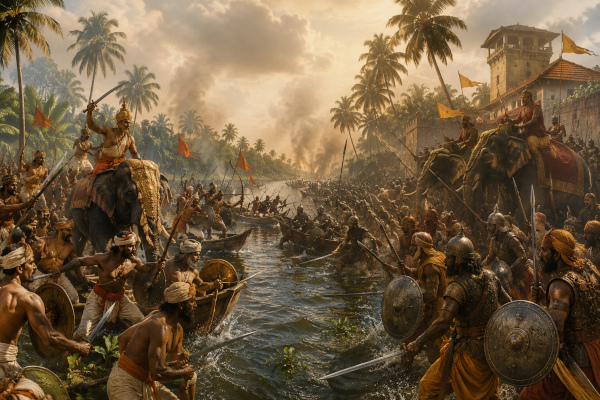
The Purakkad Rajas were the rulers of the Ambalappuzha–Purakkad region before the expansion of Travancore under Anizham Thirunal Marthanda Varma. Their kingdom is also remembered as the Chempakassery kingdom, with Ambalappuzha becoming its most famous royal and sacred centre. In Kerala’s medieval history, the Purakkad Rajas stand out as rulers of a coastal-backwater region where temples, pepper trade, naval strength, river routes, literature and political rivalry came together.
Purakkad lies in present-day Alappuzha district, close to Ambalappuzha and the Kuttanad backwater world. This region was not merely a quiet coastal settlement. It stood between the Arabian Sea, the inland waterways and the fertile paddy lands of Kuttanad. Such geography gave the rulers access to maritime trade, river transport, agrarian wealth and military movement through boats and canals.
The older identity of the kingdom is connected with Purakkad, while its later and more famous identity came through Ambalappuzha. Historical accounts of the Dutch presence in Kerala describe Purakkad as a feudatory principality whose headquarters was at Ambalappuzha under the Chempakassery clan in the 17th century. The same account records that the King of Purakkad entered into trade discussions with the Dutch in 1664, showing the kingdom’s importance in the pepper trade and coastal politics of the time.
The Purakkad Rajas are closely associated with the title Devanarayanan. Kerala Tourism records that the Ambalappuzha Sree Krishna Temple was constructed by the erstwhile ruler of Chembakasserry, Sree Pooradam Thirunal Devanarayanan Thampuran, during the 15th–17th century period. It also notes that the king offered his state to the deity and ruled as the Lord’s regent, assuming the title Deva Narayana.
This act gives the Purakkad royal house a distinctive sacred character. Like several Kerala rulers who saw kingship as service to a deity, the Chempakassery Raja placed royal authority under divine sovereignty. The king became not merely a political ruler, but a guardian of temple, land, people and dharma. This made Ambalappuzha Sree Krishna Temple the spiritual centre of the kingdom.
The Ambalappuzha Sree Krishna Temple remains the greatest living monument connected with the Purakkad Rajas. The temple is dedicated to Lord Krishna in the form of Parthasarathy, the charioteer of Arjuna in the Mahabharata. Kerala Tourism identifies it as one of Kerala’s seven great Vaishnava temples and notes its Kerala-style architecture, Chuttambalam and wall paintings of the Dasavatharam.
The temple’s famous Ambalappuzha Palpayasam also became part of the royal and devotional identity of the region. The offering of sweet milk-rice pudding is one of Kerala’s most beloved temple traditions. Through this sacred food, the memory of the Chempakassery ruler, Lord Krishna and the people of Ambalappuzha remains connected across generations.
The Purakkad Rajas also patronised art and performance. Ambalappuzha is strongly associated with Ottanthullal, the satirical Malayalam performance tradition created by Kunchan Nambiar. Kerala Tourism records the belief that Ottanthullal was first performed at the Ambalappuzha Sree Krishna Temple premises. This makes the temple not only a religious centre but also a cradle of Kerala’s literary and performing arts heritage.
The kingdom’s political importance came from its control over the coast and backwaters. In 1664, Dutch records mention that Purakkad had abundant pepper and a large fleet of war boats. The account of Nieuhoff also records that the ruler of Purakkad was known for strict administration and that the region produced pepper in plenty. Such details show that the Purakkad Rajas controlled an economically valuable and militarily active zone.
The reference to hundreds of warships also reveals the maritime nature of the kingdom. In the watery landscape of Ambalappuzha and Kuttanad, military strength depended not only on land forces but also on boats, canals and backwater movement. The Purakkad Rajas ruled a naval kingdom in the Kerala sense, where waterways acted as roads, trade arteries and defence lines.
Purakkad’s maritime memory also reaches into older layers of Kerala’s coastal history. Classical Greco-Roman geographical texts mention ports such as Bacare and Nelcynda on the Malabar Coast, with Bacare functioning as a loading point connected with inland trade. The exact identification of these ancient places remains debated, but the references show that this stretch of Kerala belonged to a very old seafaring and pepper-trading world.
The Chempakassery kingdom existed in a competitive political landscape. Its neighbours included Kayamkulam, Thekkumkur, Vadakkumkur, Cochin and Travancore. In medieval Kerala, small kingdoms survived through alliances, trade control, temple legitimacy and military preparedness. The Purakkad Rajas had to balance coastal trade, European companies and the ambitions of neighbouring rulers.
The 17th century brought Portuguese, Dutch and other European interests into Kerala’s coastal politics. Purakkad’s rulers interacted with these forces because pepper and maritime trade had become central to the economy. The Dutch account of 1664 shows that native rulers such as those of Purakkad entered trade agreements with European companies as part of the changing balance of power on the Malabar Coast.
The rise of Travancore under Marthanda Varma changed this political world permanently. Travancore expanded northwards by annexing neighbouring principalities and bringing the fragmented Kerala political order under a more centralised state. Ambalappuzha, Purakkad and the Chempakassery kingdom came under this wave of consolidation.
The fall of the Purakkad–Ambalappuzha kingdom is generally placed in the period of Travancore’s 18th-century campaigns. Historical summaries record that the Chempakassery kingdom was annexed by Travancore under Marthanda Varma in 1746, while other accounts place the wider incorporation of Ambalappuzha into Travancore’s consolidation by the early 1750s.
The Battle of Purakkad and related Travancore campaigns formed part of this larger transformation. The region’s strategic value came from its coastal position, pepper links and connection to Kayamkulam and central Kerala. Once Travancore absorbed this belt, the political map of south-central Kerala changed sharply.
The annexation of Purakkad and Ambalappuzha did not erase their cultural identity. Instead, the region became part of the Travancore state while preserving its temple traditions, festivals, art forms and local memory. Ambalappuzha Sree Krishna Temple continued to flourish, and the fame of Palpayasam, Ottanthullal and the temple festival carried the Chempakassery legacy into later centuries.
The Purakkad Rajas deserve special remembrance because they represent a rare model of Kerala kingship. They were coastal rulers, temple patrons, maritime administrators and guardians of a culturally rich region. Their kingdom linked the sea with the backwaters, the palace with the temple, and political power with devotional service.
Their story also reminds us that Kerala’s history was not shaped only by large kingdoms. Smaller principalities such as Purakkad, Kayamkulam, Thekkumkur, Vadakkumkur and Chempakassery played a major role in shaping local culture. These royal houses preserved temples, supported artists, managed trade routes and created the regional identities that later became part of modern Kerala.
The greatest legacy of the Purakkad Rajas is Ambalappuzha itself. The Sree Krishna Temple, the tradition of Devanarayanan, the offering of Palpayasam, the memory of Kunchan Nambiar and the waterways of Kuttanad together form a living heritage landscape. Every time devotees gather at Ambalappuzha, the old Chempakassery kingdom is remembered through faith, food, music and ritual.
In the larger history of Kerala, the Purakkad Rajas stand as the royal house that gave Ambalappuzha its sacred and cultural identity. They ruled a land of water, paddy, pepper and Krishna devotion. Their political sovereignty ended with Travancore expansion, but their cultural sovereignty continues through temple tradition, oral memory and the enduring fame of Ambalappuzha.
The Purakkad Rajas were therefore not merely rulers of a small coastal principality. They were builders of a sacred landscape, patrons of Kerala’s artistic heritage and guardians of one of the most beloved Vaishnava centres in the state. Their name remains woven into the history of Purakkad, Ambalappuzha and the backwater civilisation of Alappuzha.
You may also like
-
PM Vishwakarma Reaches 30-Lakh Artisan Registration Target as Scheme Completes Three Years
-
Mahishaka in the Mahabharata: The Ancient Southern Country of the Upper Kaveri
-
Vanavasi in the Mahabharata: The Ancient Forest Kingdom of Karnataka
-
Kuntala in the Mahabharata: The Ancient Country of Northern Karnataka and Southern Maharashtra
-
Ashmaka or Assaka in the Mahabharata: The Ancient Kingdom of the Godavari Valley
