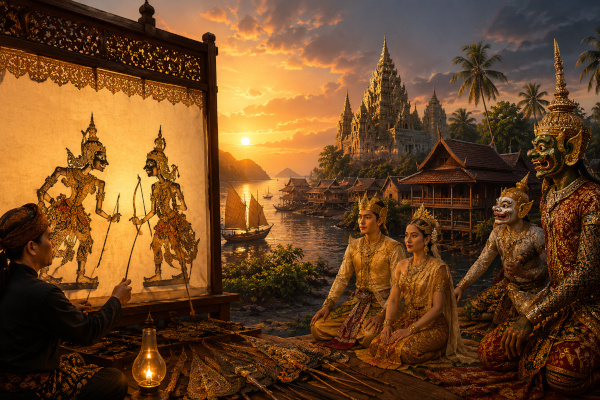
Malaysia holds one of the most graceful Southeast Asian memories of the Ramayana through Hikayat Seri Rama, the Malay literary version of the great Indian epic, and through Wayang Kulit Kelantan, the shadow-puppet theatre of northern Malaysia. In Malaysia, the Ramayana did not remain only a Sanskrit story from India. It became Malay literature, village theatre, courtly imagination, puppet design, oral performance, moral teaching, and shared Asian heritage.
In a positive Akhand Bharat sense, Malaysia shows the beauty of Brihattar Bharat — the larger civilisational world shaped by Indian stories, maritime trade, Sanskritic vocabulary, Hindu-Buddhist ideas, temple culture, and shared epics. This was a cultural Akhand Bharat: a sacred network of ideas crossing seas, ports, kingdoms, and languages. The Malay world received these influences with creativity and gave the Ramayana a local soul.
Malaysia’s own tourism identity celebrates the country as a multiethnic and multicultural meeting place of Malay, Chinese, Indian, Aboriginal, and other indigenous traditions, with cultural influences from surrounding Asian worlds as well as Arabic, Persian, English, and European histories. This diversity forms the perfect setting for understanding how the Ramayana lived in Malaysia as both Indian inheritance and Malay expression.
Hikayat Seri Rama: The Malay Ramayana
The most important Malay literary form of the Ramayana is Hikayat Seri Rama. The word hikayat refers to a traditional Malay narrative or romance, often written in elegant prose and used for storytelling, courtly entertainment, moral instruction, and public recitation. In this tradition, Rama becomes Seri Rama, Sita becomes Siti Dewi, Lakshmana becomes Laksamana, and Ravana becomes Maharaja Wana or Rawana.
Scholars of Malaysian shadow play identify two Malay-language Ramayana traditions as central to the dramatic repertoire of Wayang Kulit Kelantan: the written Hikayat Seri Rama, whose manuscript form was collected around 1600, and the oral Hikayat Maharaja Wana. These traditions became the core source material for Malaysian shadow-puppet theatre.
The greatness of Hikayat Seri Rama lies in its local transformation. The basic epic structure remains familiar: a noble prince, a virtuous princess, exile, abduction, heroic search, monkey-warrior assistance, battle against a powerful king, and restoration of dharmic order. Yet the Malay version gives the story a new rhythm. It carries Malay names, Malay courtly atmosphere, Malay emotional style, and the spiritual vocabulary of a society that had passed through Hindu-Buddhist, animist, and Islamic cultural phases.
This makes Hikayat Seri Rama a powerful example of how Indian civilisation travelled. It did not erase local culture. It entered local culture and helped create something new.
Wayang Kulit Kelantan: Ramayana in Light and Shadow
Malaysia’s most visually striking Ramayana tradition is Wayang Kulit Kelantan, also known historically as Wayang Kulit Siam. It is one of the major shadow-puppet traditions of Malaysia and has been especially associated with Kelantan and the northern Malay Peninsula. A University of Malaya study describes Wayang Kulit Kelantan as the principal form of Malaysian shadow play, with its main dramatic source in Hikayat Maharaja Wana, a local oral folk version of the Ramayana.
In this theatre, the Ramayana is not simply narrated. It is performed through leather puppets, shadows, music, voice, improvisation, ritual memory, and the genius of the dalang, the master puppeteer. The dalang gives life to kings, queens, warriors, demons, clowns, sages, birds, monkeys, and divine beings. Through shadow and flame, the ancient story of Rama becomes a living village experience.
Wayang Kulit Kelantan also shows how deeply Malaysia localised the Ramayana. The same study notes that the Kelantan tradition uses a folk version rather than only a classical literary version, and that generations of puppeteers simplified plots, reshaped characters, and added local colour through improvisation.
The Malaysian Transformation of Ramayana Characters
In the Indian Ramayana, Lord Rama is the avatar of Vishnu, Sita is linked with Lakshmi, Lakshmana is the ideal brother, Hanuman is the son of Vayu and the supreme servant of Rama, and Ravana is the proud king of Lanka. In Malaysia, these figures are reimagined within Malay storytelling.
Seri Rama carries the royal dignity of Rama, but in some Malaysian performance traditions, Laksamana receives a stronger heroic role. This reflects the Malay admiration for decisive courage, loyalty, and warrior responsibility.
Siti Dewi represents the dignity, grace, and moral purity of Sita. Her abduction remains the emotional centre of the story, and her rescue becomes the purpose of the great war.
Maharaja Wana is the Malay form of Ravana. In shadow play, he becomes more than a villain. He is majestic, powerful, dramatic, proud, and visually impressive. This gives Malaysian puppetry a strong theatrical contrast between refined royal virtue and fierce royal arrogance.
Hanuman becomes Hanuman Kera Putih, the White Ape. In the Kelantan tradition, his character develops in fascinating local ways. One study notes that Hanuman Kera Putih becomes the son of Seri Rama and Siti Dewi in the Kelantan shadow-play tradition, giving his loyalty to Rama and Sita a deeper family meaning.
This is the Malaysian genius of adaptation. The characters remain connected to India, but they speak in a Malay dramatic language.
Ancient Indian Links in Malaysia
The Ramayana entered Malaysia through a larger world of maritime exchange. Indian merchants, monks, Brahmins, Buddhist teachers, craftsmen, and storytellers moved across the Bay of Bengal and the Strait of Malacca. Ports such as Kedah connected India with the Malay Peninsula, Srivijaya, Java, Sumatra, China, and the wider island world.
The ancient Bujang Valley in Kedah is one of Malaysia’s most important archaeological witnesses to this Hindu-Buddhist past. Archaeology Magazine records that more than 30 temple ruin sites are found across the Bujang Valley, along with evidence of a possible jetty dating as early as the second century CE and iron-smelting activity. At Candi Bukit Batu Pahat, archaeologists found evidence connected with Hindu worship, including gold foil impressed with the image of Nandi, the bull associated with Lord Shiva. Buddhist remains have also been found in the valley.
This background helps explain how the Ramayana found a natural home in Malaysia. The story arrived in a land already connected to Indic religion, Sanskritic kingship, temple culture, maritime trade, and sacred storytelling.
Hindu Gods and Malay Traditional Culture
The comparison between Hindu gods and Malay traditional culture must be understood with care and respect. Malaysia’s traditional culture is layered: indigenous animist beliefs, Hindu-Buddhist influence, Malay court culture, Islamic civilisation, and regional links with Java, Sumatra, Thailand, and the wider Nusantara world all shaped it. The result is not a direct copy of India, but a rich cultural blending.
Shiva and Batara Guru form one of the strongest parallels. In old Malay magical and literary traditions, Batara Guru appears as a powerful supreme figure. Walter William Skeat’s classic study of Malay folklore records that Malay traditions invoked Vishnu, Brahma, Batara Guru, Kala, and Sri, and identifies Batara Guru with Shiva-related divine authority in Malay belief.
This connection is important because Batara Guru appears across the wider Malay-Indonesian world as a great divine teacher and cosmic ruler. In Hindu thought, Shiva is Mahadeva, the lord of yogic power, dissolution, knowledge, and transformation. In Malay traditional imagination, Batara Guru became a high divine being associated with power, sacred knowledge, and supernatural authority.
Vishnu and Seri Rama are also deeply connected. In the Sanskrit Ramayana, Rama is the avatar of Vishnu, the preserver of cosmic order. In Malay Ramayana traditions, Seri Rama carries this preserving function through kingship, moral order, and the restoration of justice. Yet the Kelantan version also localises the divine background; researchers note that Rama and Sita are reinterpreted in that tradition through local heavenly figures rather than simply as Vishnu and Lakshmi.
Lakshmi, Sri, and Malay ideas of prosperity form another beautiful link. In Hinduism, Lakshmi is the goddess of prosperity, beauty, fertility, abundance, and auspiciousness. Malay folklore records the invocation of S’ri along with other Hindu deities, showing how the idea of prosperity and sacred abundance entered Malay ritual memory.
This idea also resonates with the Malay agricultural reverence for rice. Southeast Asian rice cultures often treated rice as sacred life, and Malaysian traditions include the idea of semangat padi, the rice spirit. Studies of rice myths in Asia list Malaysia’s Semangat Padi alongside other Asian rice-spirit traditions.
Brahma and Malay creator imagery also appear through older Malay invocations. In Hinduism, Brahma represents creation. Malay magical and literary traditions knew Brahma as a creator figure, often alongside Vishnu and Batara Guru. This shows how the Hindu cosmic triad entered Malay intellectual and ritual vocabulary.
Indra and Malay royal-heavenly imagination connect through the old Sanskritic word Indera, seen in classical Malay names, hikayat settings, and heavenly imagery. Indra in Hindu tradition is king of the devas, lord of storms, royalty, and celestial splendour. In Malay literature, names and places carrying Indera/Indra associations often evoke courtly grandeur and heavenly authority.
Kala and Malay threshold spirits also show an Indic layer. In Hindu tradition, Kala is linked with time, power, death, and fierce divine energy. Malay folklore records Batara Kala and related forms in supernatural geography, including forest and sea-linked authority.
Naga is another shared symbol. In Hindu and Buddhist tradition, nāgas are serpent beings connected with water, fertility, protection, hidden treasure, and sacred power. In Malay and wider Nusantara culture, naga forms appear in royal art, maritime symbolism, weapons, architecture, and folklore. The naga shows how ancient Asian cultures shared a serpent-water symbolism across India and Southeast Asia.
Sanskritic Words in Malay Cultural Memory
The cultural connection is also visible in language. Present-day Malay preserves many Sanskrit-origin words, including dewa for god, bahasa for language, indera from Indra, guna for quality or virtue, and setia for loyalty. A recent linguistic study on Malay–Sanskrit loanwords notes these Sanskrit-origin words in modern Malay vocabulary.
This matters because the Ramayana did not travel only as a story. It travelled with words. Words such as raja, putera, puteri, dewa, dewi, mantra, pustaka, bahasa, sukma, and samudra created a shared cultural vocabulary across the Indian Ocean. In the Malay world, this vocabulary entered kingship, literature, ritual, poetry, theatre, and daily speech.
Akhand Bharat and Malaysia: A Positive Civilisational Reading
The Malaysian Ramayana tradition is a fine example of Akhand Bharat in its cultural meaning. It shows Bharat as a civilisational source whose stories travelled through friendship, trade, scholarship, devotion, and art. The Ramayana reached Malaysia by the sea, through ports, courts, storytellers, temple traditions, manuscripts, and performance communities.
This civilisational Akhand Bharat was never about uniformity. Its beauty lay in diversity. India gave the epic, but Malaysia gave it Malay voice, Malay rhythm, Malay theatre, Malay puppets, Malay music, and Malay emotional depth. The result was Hikayat Seri Rama, a Ramayana that belongs to Malaysia while still carrying the fragrance of Ayodhya.
Malaysia therefore stands as a golden link in the Ramayana world. It connects Bharat with the Malay Archipelago, the Strait of Malacca, Kedah, Kelantan, Java, Sumatra, Thailand, and the wider Southeast Asian sacred theatre tradition.
Cultural Importance Today
Today, the Ramayana in Malaysia survives through manuscripts, scholarship, Wayang Kulit Kelantan, Hindu temple communities, Tamil cultural traditions, and heritage discussions. It belongs to Malaysia’s multicultural identity and to Asia’s shared civilisational memory.
For Indian readers, Malaysia’s Ramayana tradition is a reminder that the epic was one of India’s greatest cultural ambassadors. For Malaysian readers, Hikayat Seri Rama is a reminder that Malay literature has always been open, creative, maritime, and connected to the larger Asian world.
The story of Seri Rama, Siti Dewi, Laksamana, Hanuman Kera Putih, and Maharaja Wana is therefore more than a retelling. It is a civilisational bridge.
Conclusion
Ramayana influence in Malaysia is one of the most beautiful chapters of India’s cultural journey across Southeast Asia. Through Hikayat Seri Rama, the Indian epic became Malay literature. Through Wayang Kulit Kelantan, it became shadow, music, puppet, voice, and living theatre. Through figures such as Batara Guru, Vishnu, Brahma, Sri, Indera, Kala, and the naga, Malay traditional culture preserved deep memories of the Hindu-Buddhist and Sanskritic world.
Malaysia shows how the Ramayana travels without losing its soul. It changes names, costumes, music, and setting, yet its inner message remains: dharma must stand, loyalty must endure, arrogance must fall, and righteousness must return.
In the positive light of Akhand Bharat, Malaysia is not a distant land outside India’s story. It is part of the larger civilisational ocean where Bharat’s epics sailed, settled, and bloomed in new colours. Hikayat Seri Rama is the Malay flower of the Ramayana tree — rooted in India, nourished by the seas, and blossoming beautifully in Malaysian soil.
You may also like
-
Rare Stone Features Emerge as Kerala Archaeology Department Restores Megalithic Kudakkals at Karivellur
-
Vidarbha in the Mahabharata: The Ancient Kingdom of Damayanti in Eastern Maharashtra
-
Abhira in the Mahabharata: The Pastoral People of Western India and the Northern Deccan
-
Nasikya in the Mahabharata World: The Ancient Nashik Region on the Upper Godavari
-
Bharukachchha in the Mahabharata: The Ancient Port of Bharuch at the Mouth of the Narmada
