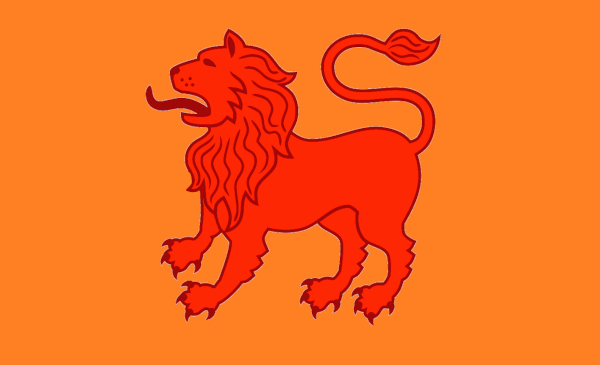
The Thekkumkur Rajas were among the important regional rulers of medieval central Kerala. Their kingdom covered parts of present-day Kottayam and nearby regions before the rise of Travancore under Marthanda Varma. In Kerala’s political history, Thekkumkur stands as one of the old principalities that connected fort culture, river trade, temple life, agrarian wealth and regional military power.
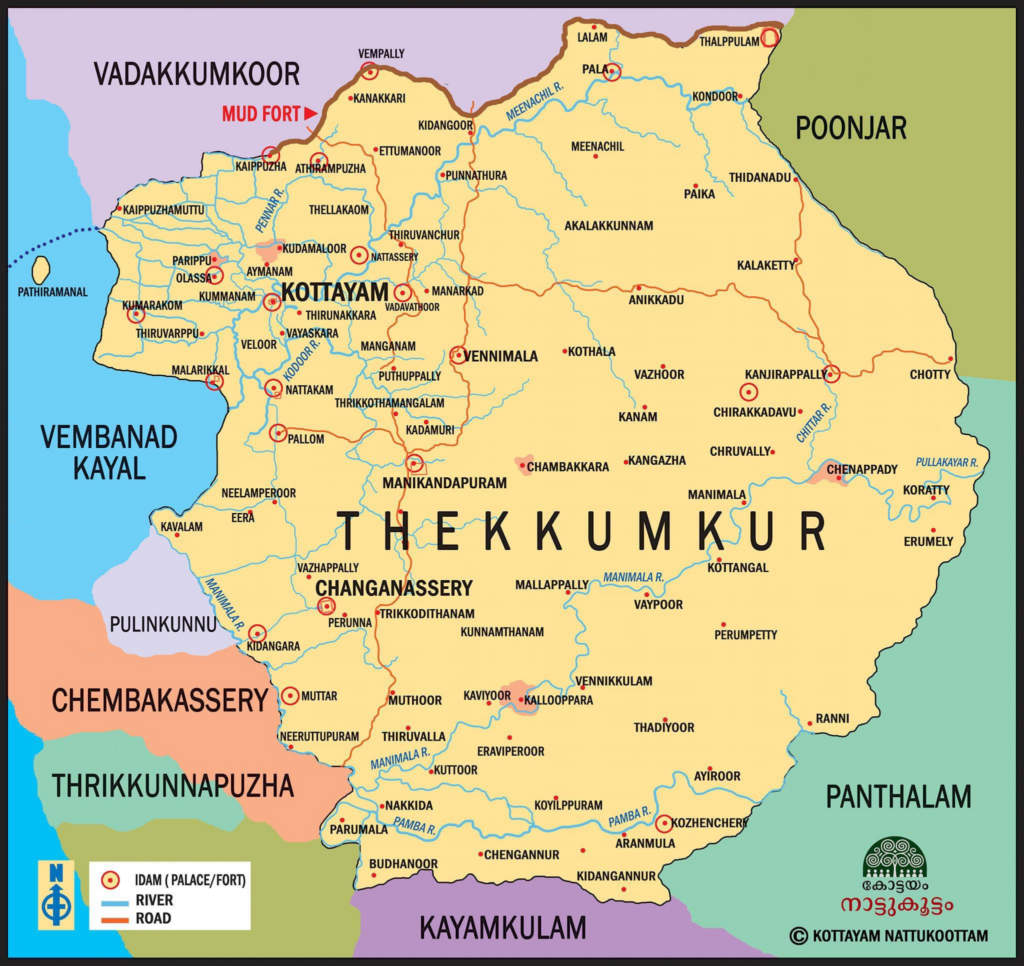
The name Thekkumkur is commonly understood as the “southern regent” or southern division, often remembered in relation to Vadakkumkur, the northern counterpart. These two political houses emerged after the older regional order of Vempolinad weakened and split into smaller principalities. Local historical accounts connect the Kottayam region with the older Kulasekhara and Vempolinad background before the rise of Thekkumkur and Vadakkumkur as separate powers.
Thekkumkur ruled a strategically valuable region. Its territory lay around the fertile lands, rivers and trade routes of central Kerala. The Meenachil river system, the Vembanad backwaters and the inland routes towards the high ranges made this region important for agriculture, movement of goods and political control. Pepper, forest produce, timber, sandalwood, ivory and other commodities moved through the old trade networks of Kottayam and nearby areas, giving the region commercial value.
Kottayam’s own name carries the memory of this fortified past. The official Kottayam district history explains the name as Kotta + Akam, meaning the interior of a fort. It also records that the rulers of Munjanad and Thekkumkur had their headquarters at Thazhathangadi in present-day Kottayam town. This shows how deeply the Thekkumkur story is tied to the origin and identity of Kottayam itself.
The early centres of the Thekkumkur royal house are associated with places such as Vennimala, Manikandapuram, Changanassery and later Kottayam / Thazhathangadi. Local tradition remembers Thekkumkur as a kingdom that shifted its centres according to political security, trade convenience and military needs. The Kottayam Municipality account states that after the Thekkumkur kings conquered Venmalinad and Manjunadu, they shifted their capital from Changanassery to Kottayam for security reasons, and the royal centre was known as Kottakkam, from which the name Kottayam is believed to have developed.
Thekkumkur was not merely a small local chieftaincy. It was a serious regional power of central Kerala. Its rulers controlled riverine access, inland trade, agricultural settlements and temple-linked social structures. Kottayam, Thazhathangadi and Changanassery became important centres in this political landscape. The region’s later importance as a centre of learning, religion, literature and public life was built upon this older foundation of settlement, trade and administration.
Thekkumkur’s capital zones also reveal the nature of Kerala’s medieval statecraft. Forts, temples, palaces, Brahmin settlements, market towns and water routes worked together as the backbone of power. The royal centre was not only a military camp; it was a network of temples, trading communities, warrior households, landholders and administrative families.
The religious and cultural atmosphere of Thekkumkur was deeply rooted in Kerala’s temple tradition. Thaliyil temple, Thirunakkara Mahadeva Temple, older Devi shrines and other sacred centres formed part of the cultural geography of the region. Kottayam’s historical accounts describe Thirunakkara Mahadeva Temple and Talikotta Temple as centuries-old places of worship, showing the continuity of sacred institutions in the former Thekkumkur zone.
Thekkumkur also existed in a landscape of cultural diversity. Ancient churches, temples and trading communities flourished in the Kottayam region. The Valiya Palli and Cheriya Palli traditions, along with old temples and river settlements, show that the region was a meeting point of Hindu, Christian and mercantile cultures. This plural cultural foundation later helped Kottayam become one of Kerala’s great centres of education, printing, literature and social reform.
Politically, the Thekkumkur Rajas had to deal with neighbouring powers such as Vadakkumkur, Chempakassery, Kayamkulam, Cochin and Travancore. Like many Kerala principalities, Thekkumkur’s strength depended on alliances, control of trade routes and the loyalty of local military houses. The rise of Travancore under Anizham Thirunal Marthanda Varma changed this balance permanently.
Marthanda Varma’s expansion in the 18th century transformed the political map of southern and central Kerala. After consolidating power in Venad and defeating several neighbouring principalities, Travancore advanced northward. The Kottayam district history records that Marthanda Varma attacked Thekkumkur and destroyed the palace and the Thaliyil fort, with remnants of those palaces and forts still remembered in the area.
The fall of Thekkumkur is closely linked with the Battle of Changanassery and Travancore’s campaign into central Kerala. Historical summaries describe the battle as a conflict between Thekkumkur and Travancore in 1749, resulting in a Travancore victory and the loss of Thekkumkur’s independent dominance.
By the mid-18th century, Thekkumkur and surrounding parts of Kottayam were annexed into Travancore. Kottayam.com’s historical account states that Thekkumkur ruled from Thazhathangadi until the mid-18th century, after which Marthanda Varma annexed Thekkumkur and nearby areas into the Kingdom of Travancore.
This annexation marked the end of Thekkumkur as an independent political power, but it did not erase its legacy. Instead, its old territories became an important part of Travancore’s northern structure. Kottayam later gained strategic importance under Travancore, especially during the Mysorean threat from Hyder Ali and Tipu Sultan. The region also became a refuge for several princes and families displaced from Malabar during the Mysore invasions.
The legacy of the Thekkumkur Rajas survives most clearly in Kottayam’s historical memory. The idea of Kottayam as a fortified interior settlement, the old royal and temple centres of Thazhathangadi, the remnants of forts and palaces, and the long tradition of trade and learning all carry traces of the Thekkumkur age.
Thekkumkur’s story is important because it represents the medieval Kerala pattern of regional sovereignty. Before the emergence of larger consolidated states, Kerala was shaped by many local royal houses. These rulers protected temples, controlled trade routes, patronised settlements, maintained military households and governed through local networks of chiefs, Brahmin institutions and merchant communities.
The Thekkumkur Rajas therefore deserve to be remembered as builders of central Kerala’s political identity. They ruled a region that later became one of Kerala’s most culturally powerful districts. Kottayam’s transformation into a centre of letters, education, reform and public life rests upon older foundations laid during the era of regional kingdoms such as Thekkumkur.
In the larger history of Kerala, Thekkumkur stands as a bridge between the post-Chera medieval order and the later Travancore state. Its rise shows the strength of local kingship, its fall shows the power of 18th-century state consolidation, and its legacy shows how old royal centres continue to shape the identity of modern Kerala.
The Thekkumkur Rajas may have lost political sovereignty to Travancore, but their memory remains woven into Kottayam’s name, landscape, temples, trade routes and historical consciousness. They were the rulers of a fort-country, the guardians of a riverine kingdom and one of the royal houses that gave central Kerala its medieval character.
You may also like
-
India Creates History with Record 114 Medals at Asian Para Games 2026, Prime Minister Modi Hails Para-Athletes
-
Shaka in the Mahabharata: Central Asia’s Steppe Peoples, Nakula’s Campaign and the Alliance with Duryodhana
-
Yavana in the Mahabharata: Greek Connections, Pandava Campaigns and the Warriors of Kurukshetra
-
India and Sri Lanka Launch SAMHiTA Manuscript Digitisation Project to Preserve Ancient Buddhist Heritage
-
ASI Uses Ground-Penetrating Radar to Investigate Ancient Buddhist Stupa at Ujjain After Nearly 90 Years
