Indian researchers have achieved an important breakthrough in advanced materials engineering by developing a crack-free bi-metallic structure using laser-based powder bed fusion additive manufacturing. The development can help reduce the use of expensive superalloys in critical industrial components and lower India’s dependence on imported superalloy materials.
The research was carried out by the International Advanced Research Centre for Powder Metallurgy and New Materials, Hyderabad, an autonomous institute under the Department of Science and Technology. The work focused on joining stainless steel SS316L with the nickel-based superalloy Inconel IN718 through additive manufacturing, creating a strong and reliable interface between two very different metals.
Stainless steels and nickel-based superalloys are widely used in aerospace, nuclear power, thermal power plants, oil and gas systems, and other high-performance engineering sectors. These materials are chosen because they can withstand harsh conditions involving high temperature, corrosion, mechanical stress and long service life.
In advanced gas turbines and energy systems, different parts of the same component may face very different operating conditions. Certain regions may experience temperatures as high as 2000°C, while nearby sections may operate at much lower temperatures. This makes it attractive to combine stainless steel and nickel-based superalloys within a single component. Stainless steel provides toughness and corrosion resistance, while Inconel offers excellent high-temperature strength and creep resistance.
The challenge lies in joining the two materials successfully. Conventional welding of SS316L and IN718 is difficult because the two metals differ in chemical composition, melting behaviour and thermal expansion. These differences can create cracks, porosity, segregation of niobium- and molybdenum-rich phases, and brittle intermetallic compounds. Such defects can weaken the joint and reduce the reliability of components used in critical sectors.
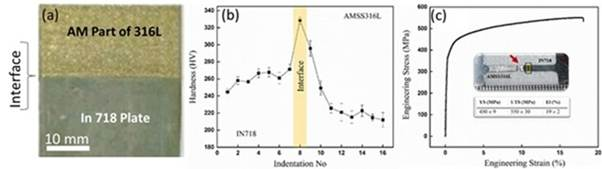
The ARCI team addressed this challenge using laser-based powder bed fusion, also known as PBF-LB/M. In this process, a laser selectively melts layers of metal powder to build a component with high precision. The researchers fabricated the SS316L structure directly on a surface-ground IN718 plate and achieved a crack-free, porosity-free interface.
The resulting bi-metallic structure showed strong mechanical performance. The material recorded a peak hardness of around 310 HV at the interface and an ultimate tensile strength of 550 ± 30 MPa. During tensile testing, failure occurred on the softer SS316L side rather than at the bi-metallic junction. This result demonstrates the strength and integrity of the interface created by the additive manufacturing process.
The research was conducted by S. Narayanaswamy, Gururaj Telasang, Nokeun Park and Ravi Bathe, and has been published in the journal Progress in Additive Manufacturing. The work represents a significant step in the fabrication of multi-material components for demanding industrial environments.
The importance of this development lies in material optimisation. Instead of making an entire component from costly imported superalloy, manufacturers can use superalloy only in the region exposed to extreme heat and stress, while using stainless steel in sections where toughness and corrosion resistance are sufficient. This can reduce cost, improve material efficiency and support domestic capability in advanced manufacturing.
The technology has strong potential in power generation. Boiler tubes, heat exchangers, nuclear systems and ultra-supercritical coal-fired power plants can benefit from components that combine corrosion resistance with high-temperature strength. In such systems, different parts of a component often experience different temperature and stress conditions, making bi-metallic design highly useful.
The breakthrough is also relevant for the aerospace sector. A bi-metallic component can be designed with a steel side serving as the load-bearing section, while the Inconel side handles high-temperature exposure. This approach can improve performance while reducing the amount of expensive superalloy required.
Additive manufacturing also allows greater design freedom. Internal structures, graded interfaces and material placement can be engineered more precisely than in conventional manufacturing. This opens the possibility of strategically placing high-performance alloys only where they are required, creating lighter, stronger and more cost-effective components.
For India, the achievement carries strategic value. Superalloys are critical for aerospace engines, turbines, nuclear systems and advanced energy technologies. Reducing import dependence in this area strengthens domestic manufacturing, supports high-value industrial innovation and aligns with India’s broader goals in self-reliant technology development.
The ARCI breakthrough shows how advanced additive manufacturing can transform the way critical components are designed and produced. By successfully creating a crack-free and mechanically robust stainless steel–Inconel bi-metallic structure, Indian researchers have opened a promising pathway for cost-effective, high-performance materials in aerospace, energy and strategic industries.
Publication link: https://doi.org/10.1007/s40964-025-01036-1.
Source: PIB
You may also like
-
Indian Scientists Discover How Rapidly Spinning Black Holes Produce High-Frequency X-Ray Oscillations
-
ISRO Completes Historic SPADEX Mission as Both Satellites Re-enter Earth’s Atmosphere After Successful Space Docking Experiments
-
Indian Scientists Discover Rare Accretion Disk Around Neutron Star 24,000 Light-Years Away
-
BARC Scientists Develop Indigenous Technology to Recover 90% of Lithium from Seawater
-
How Indigenous Indian Technologies Are Helping Aircraft and Trains Navigate Safely Through Dense Fog
