
Union Minister for Environment, Forest and Climate Change Bhupender Yadav on Sunday inaugurated the National Workshop on “Tiger Re-introduction: Opportunities & Challenges” in Alwar, Rajasthan, underscoring that conserving tigers is essential for protecting forests, watersheds and the country’s rich biodiversity.
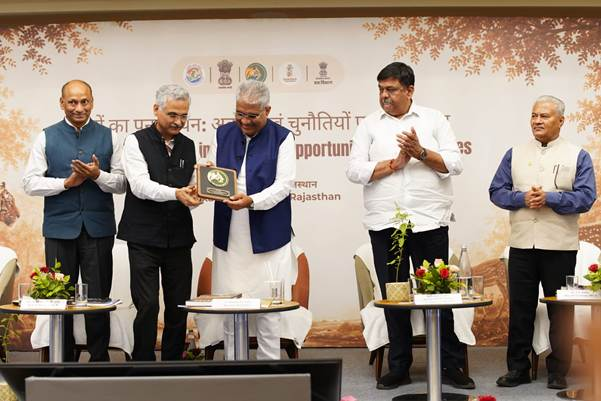
Organised by the National Tiger Conservation Authority (NTCA) in collaboration with the Rajasthan Government, the workshop marked 18 years of tiger reintroduction in Sariska Tiger Reserve and brought together Chief Wildlife Wardens, field directors and wildlife experts from across India to discuss science-based strategies for tiger conservation and active wildlife management.
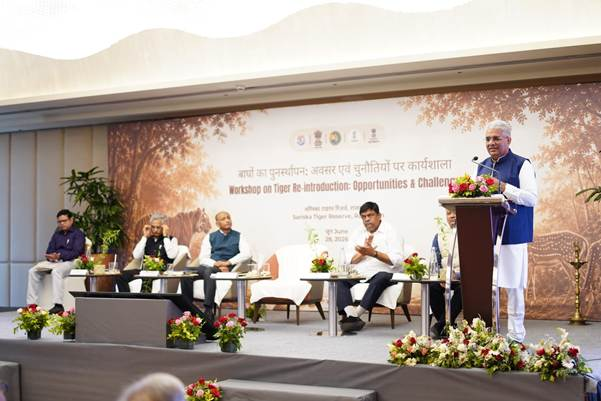
Addressing the gathering, Yadav described the Sariska tiger reintroduction programme as a historic milestone, noting that it was the world’s first successful scientific reintroduction of tigers into a landscape where the species had become locally extinct.
“Sariska has recovered remarkably from local extinction in 2005 to supporting 56 tigers today,” he said, adding that the reserve has emerged as a global model for species restoration through scientific management, dedicated conservation efforts and community participation.
Highlighting India’s conservation achievements, the Minister said the number of tiger reserves has increased from 46 to 58 over the past decade. He also noted that India successfully met the St. Petersburg Declaration target of doubling its wild tiger population by 2022.
Yadav emphasized that community participation has been central to the success of tiger reintroduction in Sariska and Panna, while noting that similar efforts in Odisha’s Satkosia Tiger Reserve faced setbacks due to inadequate local support. He said the success of Project Cheetah has likewise been driven by active involvement of local communities.
The Minister stressed that conservation initiatives must balance ecological goals with the welfare of people living around protected areas.
“Our priority is to ensure that our tigers are protected, our forests remain green and healthy and local communities continue to prosper,” he said.
He also called for maintaining landscape connectivity in areas where tiger and elephant habitats overlap and urged experts to identify potential source and sink populations to strengthen future tiger reintroduction programmes.
On the occasion, the Minister released three key publications: the Road Map on Active Management of Tigers in India, the Booklet on Reintroduction and Recovery of Tigers in India, and the Annual Report of Project Cheetah (September 2024–December 2025).
The roadmap provides a framework for managing tiger populations by identifying source and sink areas across India’s tiger landscapes, while the booklet documents lessons from tiger restoration efforts in Sariska and Panna. The Project Cheetah report outlines progress in cheetah translocations, habitat management, veterinary care, community engagement and future priorities.
The workshop featured technical sessions on habitat restoration, prey augmentation, wildlife translocation, landscape connectivity, monitoring protocols and active management strategies. Experts shared experiences from tiger reintroduction programmes in Sariska, Panna and other reserves, while tiger-deficient reserves presented preparedness plans for future recovery.
A dedicated session on Project Cheetah and discussions on prey augmentation through the translocation of species such as gaur and barasingha also formed part of the programme.
The recommendations emerging from the workshop are expected to guide future conservation planning for tiger-deficient landscapes through science-based tiger reintroduction, habitat restoration, prey base augmentation and stronger collaboration between the National Tiger Conservation Authority, State Forest Departments and scientific institutions.
Source: PIB
You may also like
-
How Indigenous Indian Technologies Are Helping Aircraft and Trains Navigate Safely Through Dense Fog
-
ISRO Successfully Completes Critical Gaganyaan Crew Module Separation Tests at VSSC
-
ISRO’s Aditya-L1 Expands Global Solar Research as Joint Observations with Europe’s Proba-3 Reveal New Insights
-
ISRO Advances Indigenous 1,100 kN Methane Rocket Engine for Next-Generation Launch Vehicle
-
Indian Scientists Identify A Few Martian Analogue Sites
