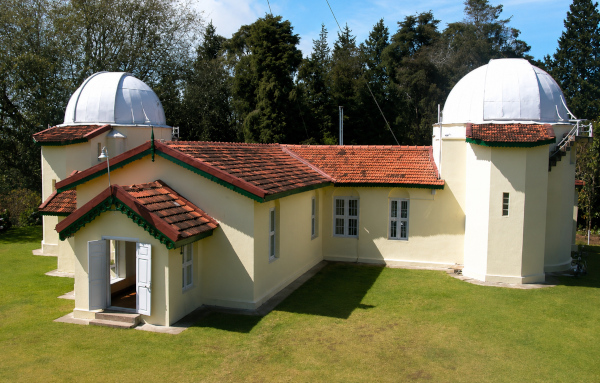
Artificial Intelligence has now helped scientists look deeper into the Sun’s past by analysing nearly 100 years of hand-drawn solar records from the Kodaikanal Solar Observatory. The study has converted old suncharts, created between 1916 and 2007, into useful scientific data to understand how bright, magnetically active regions on the Sun shifted over time.
The research was led by Dibya Kirti Mishra from the Aryabhatta Research Institute of Observational Sciences, an autonomous institute under the Department of Science and Technology. The work was carried out with collaborators from the Indian Institute of Space Science and Technology, Thiruvananthapuram, the Southwest Research Institute in Boulder, USA, and the Indian Institute of Astrophysics, Bengaluru.
For more than a century, scientists have studied the rise and fall of solar activity. The Sun follows repeated magnetic cycles that influence sunspots, flares, eruptions and other energetic events. These solar events are important because they can affect satellites, communication systems, navigation networks and even power infrastructure on Earth. To understand such long-term behaviour, scientists need records that go far beyond the modern space age.
The Kodaikanal Solar Observatory has one of the most valuable historical solar archives in the world. Its daily suncharts, maintained from 1904 to 2022, recorded solar features such as sunspots, plages, filaments and prominences on a standard grid. These drawings were made carefully by observers before the age of digital imaging, making them a rare scientific bridge between early observational astronomy and modern solar physics.
However, using these old records has always been difficult. Hand-drawn charts naturally vary in style and precision. Paper ageing, scanning quality, faded markings and differences in observation methods make it hard to extract clean, consistent data through conventional techniques. This is where machine learning has made a major difference.
In the new study, published in The Astrophysical Journal Supplement Series, the researchers used a supervised machine learning model known as U-Net. The process worked in two major stages. First, the AI system identified the solar disk in each scanned chart by locating its centre, radius and tilt. This helped place every recorded feature in its correct position on the Sun. In the next stage, the model detected and traced plages across the drawings.
Plages are bright regions associated with strong magnetic activity on the Sun. They are important indicators of the solar magnetic cycle and are often used to understand how active regions move across solar latitudes over time. By extracting plage data from old suncharts, the researchers were able to create a much longer view of the Sun’s magnetic behaviour.
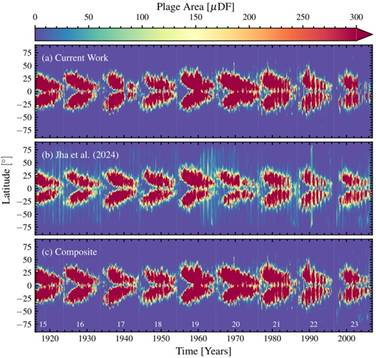
The AI-based analysis covered nine solar cycles from 1916 to 2007. The researchers used the extracted data to prepare a time-latitude “butterfly diagram,” a visual map showing how magnetic activity appears at different solar latitudes during each solar cycle. Such diagrams are called “butterfly diagrams” because the pattern of active regions resembles butterfly wings as they shift from higher latitudes towards the solar equator over time.
One of the most important outcomes of the study is that the plage areas derived from the hand-drawn suncharts matched well with plage measurements obtained from KoSO’s Ca II K full-disk observations. This confirms that the old drawings are not just historical documents, but reliable scientific records that can help fill gaps in long-term solar datasets.
The study shows how India’s historic solar archives can support modern space science. By combining traditional observations with advanced AI, researchers can reconstruct the Sun’s magnetic activity over many decades. This is valuable for comparing the strength and structure of different solar cycles, improving estimates of how the Sun’s radiation and magnetic influence have changed over time, and understanding long-term space weather risks.
The work also demonstrates a broader scientific lesson: old records, even when uneven or hand-drawn, can gain new life through machine learning. Archives that were once difficult to analyse at scale can now be converted into machine-readable datasets, opening new possibilities for climate studies, astronomy, geophysics and other fields that depend on long-term observations.
The Kodaikanal Solar Observatory’s suncharts are therefore more than a century-old visual archive. With the help of AI, they have become a powerful scientific resource for studying the changing face of the Sun and its influence on Earth.
Source: PIB
You may also like
-
Indian Scientists Discover How Rapidly Spinning Black Holes Produce High-Frequency X-Ray Oscillations
-
ISRO Completes Historic SPADEX Mission as Both Satellites Re-enter Earth’s Atmosphere After Successful Space Docking Experiments
-
Indian Scientists Discover Rare Accretion Disk Around Neutron Star 24,000 Light-Years Away
-
BARC Scientists Develop Indigenous Technology to Recover 90% of Lithium from Seawater
-
How Indigenous Indian Technologies Are Helping Aircraft and Trains Navigate Safely Through Dense Fog
