
Indian researchers have developed a new electrolyte additive that can help build safer, longer-lasting and more affordable rechargeable zinc batteries. The breakthrough is important for the future of large-scale energy storage, especially as renewable energy systems require durable and cost-effective battery technologies.
Aqueous zinc ion batteries, or AZIBs, are being studied as a promising alternative to conventional lithium-ion batteries. They use water-based electrolytes, making them safer and more environmentally friendly. Zinc is also more abundant and economical, which makes the technology attractive for grid-scale energy storage, backup power systems and renewable energy applications.
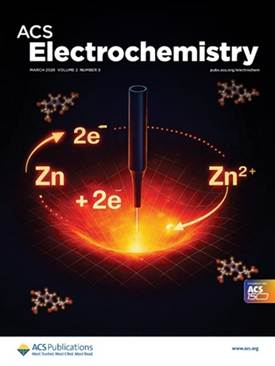
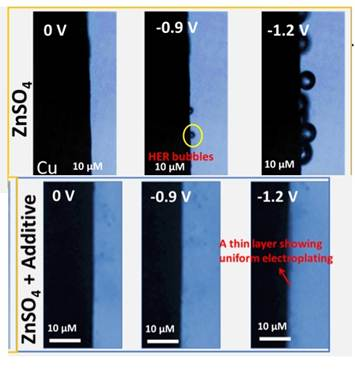
Fig: (Top) Cover image of the work accepted in ACS Electrochemistry showing how electrolyte additive controls the Zn surface. (Bottom) Comparison of the effect of the BDIM additive on the zinc anode surface in suppressing HER
However, zinc batteries face several technical challenges. During repeated charging and discharging, zinc metal can form needle-like structures known as dendrites. These dendrites reduce battery performance and can affect safety. Other issues such as hydrogen evolution reaction, corrosion and poor cycling stability have also slowed the commercial development of zinc-ion batteries.
Scientists from the Institute of Nano Science and Technology, Mohali, an autonomous institute under the Department of Science and Technology, have addressed these challenges through electrolyte engineering. Instead of redesigning the battery materials through expensive methods, the team focused on controlling the battery interface where key electrochemical reactions take place.
The researchers developed an electrolyte additive called 1,3-bis (1,3-dicarboxypropyl)-1H-imidazole-3-ium chloride, known as BDIM. This additive selectively attaches itself to the zinc metal surface during battery operation. It regulates the Inner Helmholtz Plane, a critical region at the electrode-electrolyte interface where charge transfer and electrochemical reactions occur.
BDIM contains oxygen and nitrogen donor sites that strongly interact with zinc. When the battery operates, BDIM preferentially adsorbs on the negatively charged zinc surface. This helps push water molecules away from the active zinc interface. By reducing direct water interaction, the additive helps suppress hydrogen evolution, corrosion and dendrite formation.
This interface protection improves zinc anode stability and supports smoother zinc deposition. In practical terms, it can extend battery life, reduce performance degradation and improve the reliability of rechargeable zinc batteries.
The research team also used advanced electrochemical tools to better understand zinc deposition mechanisms. A tiny lab-made ultramicroelectrode was combined with fast-scan cyclic voltammetry to study interfacial charge-transfer and mass-transfer processes. The ultramicroelectrode, with dimensions below around 50 micrometres, allows diffusion behaviour to shift from linear to radial or hemispherical, enabling high scan-rate studies. Fast-scan cyclic voltammetry helped the researchers observe how the addition of BDIM changed the charge-transfer regime.
The study was led by Dr. Ramendra Sundar Dey, Scientist E at INST Mohali, and has been published in ACS Electrochemistry. The findings offer a practical and scalable strategy for improving aqueous zinc ion batteries without making the technology costly or complex.
The development has wider significance for India’s clean energy ecosystem. As solar, wind and other renewable energy systems expand, the need for reliable battery storage is increasing. Improved zinc-ion batteries can support grid-scale energy storage, backup power infrastructure and safer rechargeable battery systems.
By enhancing battery lifetime and reducing maintenance requirements, this technology can contribute to stronger and more dependable sustainable energy infrastructure. The work also highlights India’s growing research strength in advanced materials, electrochemistry and next-generation energy storage technologies.
Publication link – https://doi.org/10.1021/acselectrochem.5c00322
Source: PIB
You may also like
-
How Indigenous Indian Technologies Are Helping Aircraft and Trains Navigate Safely Through Dense Fog
-
ISRO Successfully Completes Critical Gaganyaan Crew Module Separation Tests at VSSC
-
ISRO’s Aditya-L1 Expands Global Solar Research as Joint Observations with Europe’s Proba-3 Reveal New Insights
-
ISRO Advances Indigenous 1,100 kN Methane Rocket Engine for Next-Generation Launch Vehicle
-
Indian Scientists Identify A Few Martian Analogue Sites
