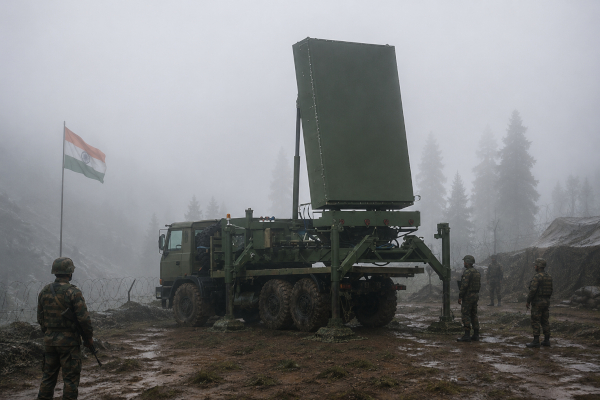
The EL/M-2084 Multi-Mission Radar, developed by ELTA Systems of Israel Aerospace Industries, is one of the most recognised battlefield radar systems in modern air defence. It has earned its reputation through its role in detecting rockets, artillery shells, mortars, aircraft, drones and missile threats, while also supporting interceptor systems with high-quality tracking and fire-control data. For a modern army operating in a complex threat environment, a radar of this class is not merely a sensor; it is the nerve centre of the kill chain.
The EL/M-2084 is best known globally as a key radar associated with Israel’s layered air defence architecture, including Iron Dome and other interceptor systems. Its strength lies in its multi-mission design. Unlike older radars that were built for a single specialised task, the EL/M-2084 can support several missions from the same radar architecture: air surveillance, counter-rocket artillery and mortar detection, weapon locating, early warning, trajectory calculation and fire-control support.
This makes it highly relevant to the Indian Army’s operational environment. India faces a wide spectrum of aerial and ground-launched threats, ranging from rockets and artillery shells to unmanned aerial systems, cruise missiles, aircraft and tactical ballistic trajectories. In such a battlefield, the ability to detect, classify, track and respond quickly becomes decisive. A radar such as the EL/M-2084 provides the kind of real-time situational awareness required for integrated air defence and counter-battery response.
The radar uses Active Electronically Scanned Array technology, commonly known as AESA. This is one of its most important features. In an AESA radar, the beam is electronically steered rather than mechanically moved in the traditional manner. This allows the radar to scan rapidly, track multiple targets, shift between missions and maintain high availability. AESA technology also improves reliability because the radar is built around many transmit-receive modules. Even if some modules degrade, the radar can continue operating with reduced performance rather than suffering a total failure.
The EL/M-2084 is often described as a 4D radar. In practical battlefield terms, this means it can generate target data that includes range, azimuth, elevation and velocity-related information. This is crucial for building an accurate air picture. A radar must know not only that a target exists, but also where it is, how high it is, how fast it is moving and where it is likely to go next. Such data allows command systems to decide whether a target is a drone, aircraft, rocket, shell or missile, and then assign the correct response.
One of the radar’s most important missions is air surveillance. In this role, it scans the sky and builds a continuous air situation picture. It can detect and track aircraft, helicopters, unmanned aerial vehicles and other airborne threats. For the Indian Army, this capability is important because land forces increasingly require their own organic air-defence awareness. Modern battlefields are saturated with drones, precision-guided weapons and low-flying platforms. A ground force that cannot see the airspace around it becomes vulnerable to surprise strikes.
The second major role is counter-rocket, artillery and mortar detection, commonly called C-RAM. In this mission, the radar detects an incoming projectile soon after launch, tracks its ballistic path and calculates both the likely impact point and the probable launch location. This gives friendly forces two major advantages. First, troops and command centres can receive early warning. Second, artillery units can conduct counter-battery fire against the hostile launcher or gun position.
This weapon-locating role is extremely important for armies operating along contested borders. Artillery duels, mortar fire and rocket attacks can cause heavy damage within minutes. A radar that can rapidly identify the launch point of enemy fire gives commanders the ability to respond before the enemy system relocates. It also supports precision fire correction by tracking friendly artillery rounds and helping adjust fire onto target.
The EL/M-2084 therefore acts as both shield and sword. As a shield, it detects threats and supports interception or warning. As a sword, it helps locate hostile firing positions and supports counter-strike missions. This dual role gives the radar great value in land warfare.
The radar’s fire-control role is another major strength. In air-defence systems, detection alone is not enough. The radar must provide accurate, continuous target tracks to the battle management and weapon-control system. The command system then evaluates the threat, assigns an interceptor, calculates engagement geometry and supports the missile until the target is neutralised. The EL/M-2084’s combat reputation comes partly from its ability to feed this chain with high-quality data.
In an Indian Army context, such a radar architecture fits naturally into the broader movement towards networked air defence. India’s battlefield air-defence environment includes systems for short, medium and long-range protection. The Army’s Medium Range Surface-to-Air Missile system, developed jointly by DRDO and Israel Aerospace Industries, uses a multi-function radar, command post, mobile launchers and support vehicles. A radar of the EL/M-2084 class represents the kind of sensor backbone required for such systems: mobile, multi-target capable and integrated with modern command architecture.
Mobility is another important advantage. The EL/M-2084 is designed as a mobile radar system that can be mounted on vehicle platforms and deployed with field forces. Mobility matters because fixed sensors can be mapped, targeted and suppressed. Mobile radars can shift location, survive longer and support manoeuvre formations. For the Indian Army, which operates across plains, deserts, mountains and semi-urban border sectors, mobility allows radar coverage to be adapted to the tactical situation.
The radar’s ability to deal with low radar cross-section targets is especially important in the drone era. Small UAVs, loitering munitions and quadcopter-type systems can be difficult to detect because they fly low, move slowly and present a small radar signature. Modern AESA radars with advanced processing are better suited to filtering clutter and identifying such targets. This makes the EL/M-2084 type of radar increasingly relevant for counter-drone defence.
The radar also supports layered defence. No single interceptor system can defeat every threat. A modern army needs multiple defensive layers: electronic warfare, guns, missiles, counter-drone systems, short-range air defence, medium-range missiles and long-range sensors. The radar sits at the centre of this structure. It detects the threat, tracks it, classifies it and passes data to the most suitable response system. This sensor-to-shooter connection is what makes modern air defence effective.
The EL/M-2084 also contributes to command decision-making. Its data can be integrated into battle management systems, allowing commanders to see the air and projectile threat picture in real time. This supports decisions such as when to activate air-defence batteries, when to warn forward troops, where to move assets, when to launch counter-fire and how to prioritise multiple incoming threats.
In combat, speed is everything. Rockets, artillery shells and drones may offer only seconds or minutes of reaction time. A radar that can quickly detect launch, classify trajectory and generate engagement-quality tracks gives commanders precious time. This is why multi-mission radars have become essential to modern armies.
The EL/M-2084’s experience in conflict zones has also strengthened its reputation. It has been associated with high-tempo air-defence operations where large numbers of rockets and missiles must be tracked and evaluated quickly. This operational history gives it credibility among military planners looking for systems that have been tested beyond controlled trials.
For India, the strategic relevance of such radars is clear. The future battlefield around India will involve drones, stand-off weapons, rockets, cruise missiles, precision artillery and saturation attacks. Air defence will no longer be limited to protecting airbases and major cities. It must protect field formations, logistics nodes, ammunition dumps, command posts, bridges, forward bases and critical military infrastructure. Multi-mission radars are central to this transformation.
The radar also fits India’s larger defence modernisation approach, where surveillance, command networks and missile systems are being integrated into a stronger national air-defence architecture. The emphasis is shifting from individual platforms to connected systems. In such an architecture, the sensor is as important as the weapon. A missile battery without a strong radar is half-blind; a radar connected to the right weapons becomes a combat multiplier.
Another key advantage is scalability. The EL/M-2084 family has different configurations and variants suited to different operational needs. This allows it to be used in air-defence, weapon-locating and C-RAM roles depending on mission requirement. A force can deploy it for forward-area protection, artillery detection, base defence or integration with interceptor batteries.
From a technical standpoint, the radar’s strength comes from its combination of AESA architecture, digital processing, mobility, multi-target tracking and mission flexibility. From an operational standpoint, its value comes from giving commanders fast, reliable and actionable information. From a strategic standpoint, it supports the transition from platform-based defence to network-centric warfare.
The Indian Army’s interest in radars of this class reflects a wider understanding of modern conflict. Precision firepower and aerial threats are expanding rapidly. The side that sees first, classifies first and responds first gains a decisive advantage. The EL/M-2084 MMR is built around exactly that requirement.
In the coming years, radars like the EL/M-2084 will remain important not only for traditional air defence but also for counter-drone warfare, artillery survivability, missile defence and battlefield transparency. The radar’s ability to perform multiple missions from a single system gives it high value in a contested environment where threats appear from different directions, altitudes and trajectories.
The EL/M-2084 is therefore more than an imported radar name. It represents a modern defence concept: one sensor performing many battlefield functions, integrated into a larger command-and-fire network, capable of protecting troops and enabling retaliation. For the Indian Army, such capability supports a stronger, faster and more resilient air-defence posture.
As India continues to strengthen its layered air-defence and battlefield surveillance ecosystem, the importance of multi-mission AESA radars will only grow. The EL/M-2084 MMR stands as a combat-proven example of how radar technology has evolved from simple detection to full-spectrum battlefield management.
You may also like
-
Bengaluru Startup Paar Autonomy Develops AI-Powered Drone Systems for GPS-Denied Environments
-
Sigma Advanced Systems Secures Fresh ₹973 Crore NATO Artillery Ammunition Order
-
India Advances Indigenous Defence and Space Technologies Through Naval Innovation, Drones and Advanced Electronics
-
Thales Seeks Indian Partnerships for Next-Generation Missiles, Radars and Electronic Warfare Systems
-
Indian and Australian Armies Conduct Jungle and Coastal Warfare Drills in AUSTRAHIND 2026
